Pusatlı, Özgür Tolga
Loading...
Profile URL
Name Variants
Pusatlı, O. Tolga
Pusatli, Tolga
Pusatli, T.
Pusatli, O.T.
Pusatli, Ozgur Tolga
Pusatlı, T.
Tolga Pusatli, O.
Pusatli, Tolga
Pusatli, T.
Pusatli, O.T.
Pusatli, Ozgur Tolga
Pusatlı, T.
Tolga Pusatli, O.
Job Title
Doç. Dr.
Email Address
pusatli@cankaya.edu.tr
Main Affiliation
03.07. Yönetim Bilişim Sistemleri
03. İktisadi ve İdari Birimler Fakültesi
01. Çankaya Üniversitesi
03.07. Yönetim Bilişim Sistemleri
Yönetim Bilişim Sistemleri
03. İktisadi ve İdari Birimler Fakültesi
01. Çankaya Üniversitesi
03. İktisadi ve İdari Birimler Fakültesi
01. Çankaya Üniversitesi
03.07. Yönetim Bilişim Sistemleri
Yönetim Bilişim Sistemleri
03. İktisadi ve İdari Birimler Fakültesi
01. Çankaya Üniversitesi
Status
Current Staff
Website
ORCID ID
Scopus Author ID
Turkish CoHE Profile ID
Google Scholar ID
WoS Researcher ID
Files
Sustainable Development Goals
8
DECENT WORK AND ECONOMIC GROWTH

1
Research Products
16
PEACE, JUSTICE AND STRONG INSTITUTIONS

1
Research Products
17
PARTNERSHIPS FOR THE GOALS

2
Research Products

Documents
23
Citations
278
h-index
9

Documents
14
Citations
222

Scholarly Output
24
Articles
12
Views / Downloads
1684/133
Supervised MSc Theses
1
Supervised PhD Theses
0
WoS Citation Count
183
Scopus Citation Count
226
WoS h-index
7
Scopus h-index
7
Patents
0
Projects
0
WoS Citations per Publication
7.63
Scopus Citations per Publication
9.42
Open Access Source
3
Supervised Theses
1
Google Analytics Visitor Traffic
| Journal | Count |
|---|
Current Page: 1 / NaN
Scopus Quartile Distribution
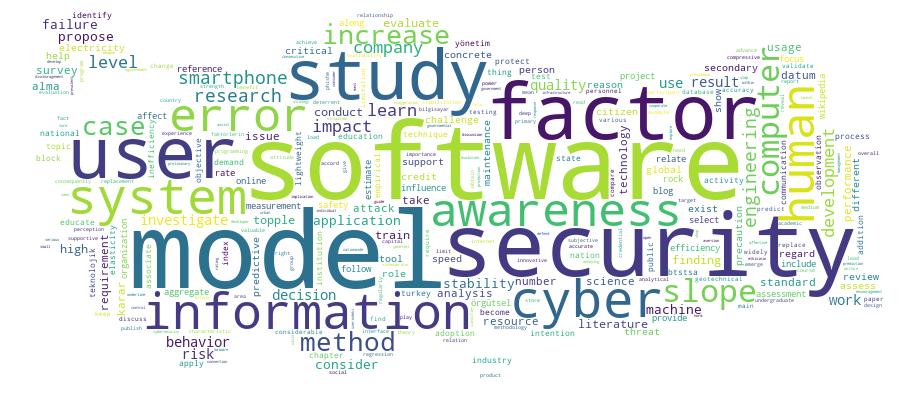
Competency Cloud

Scholarly Output Search Results
Now showing 1 - 10 of 24
Conference Object Citation - WoS: 13Citation - Scopus: 15A Survey of Applying Machine Learning Techniques for Credit Rating: Existing Models and Open Issues(Springer international Publishing Ag, 2015) Xu, Min; Pusatli, Ozgur Tolga; Wang, XiangIn recent years, machine learning techniques have been widely applied for credit rating. To make a rational comparison of performance of different learning-based credit rating models, we focused on those models that are constructed and validated on the two mostly used Australian and German credit approval data sets. Based on a systematic review of literatures, we further compare and discuss about the performance of existing models. In addition, we identified and illustrated the limitations of existing works and discuss about some open issues that could benefit future research in this area.Article Citation - WoS: 1Exploring Supportive and Deterrent Factors on Online Shopping in a Developing Country(Igi Global, 2020) Pusatli, Tolga; Akman, IbrahimThis study explores the influence of the reasons of individuals' supportive and deterrent behaviors against commercial usage of online media in the emerging market of Turkey. The supportive and deterrent factors are grouped in empirical categories as discouragement and encouragement, respectively. The impact of these factors on actual behavior were assessed via intermediary empirical category including the variables inefficiency, efficiency, intention, and subjective norm. A survey was conducted using a sample of 251 observations obtained from the visitors of three large/busy malls using purposive sampling. The multiple least-square regression was utilized to test the nature of the relationships between variables. Results indicated a significant discouraging impact of warranty, finance, habits, security on inefficiency perceptions, an encouraging impact of geography and convenience on efficiency perceptions. Significant behavioral impact of perceptions regarding inefficiency, efficiency, subjective norms, and intention on actual usage of online shopping was also observed.Article A Discussion On the Role of People in Global Software Development [Rasprava O Ulozi Ljudi U Globalnom Razvoju Softvera](2013) Misra, Sanjay; Colomo-Palacios, Ricardo; Pusatlı, Özgür Tolga; Soto-Acosta, PedroLiterature is producing a considerable amount of papers which focus on the risks, challenges and solutions of global software development (GSD). However, the influence of human factors on the success of GSD projects requires further study. The aim of our paper is twofold. First, to identify the challenges related to the human factors in GSD and, second, to propose the solution(s), which could help in solving or reducing the overall impact of these challenges. The main conclusions of this research can be valuable to organizations that are willing to achieve the quality objectives regarding GSD projects.Conference Object Security Requirements in Iot Environments(Springer Science and Business Media Deutschland GmbH, 2022) Koyuncu, M.; Pusatlı, T.; Binglaw, F.The Internet of Things (IoT) is a relatively new concept as it connects things (or objects) that do not have high computational power. The IoT helps these things see, listen, and take action by interoperating with minimal human intervention to make people’s lives easier. However, these systems are vulnerable to attacks and security threats that could potentially undermine consumer confidence in them. For this reason, it is critical to understand the characteristics of IoT security and their requirements before starting to discuss how to protect them. In this scope, the present work reviews the importance of security in IoT applications, factors that restrict the use of traditional security methods to protect IoTs, and the basic requirements necessary to judge them as secure environments. © 2022, ICST Institute for Computer Sciences, Social Informatics and Telecommunications Engineering.Book Part Maintaining Cybersecurity Awareness in Large-Scale Organizations: a Pilot Study in a Public Institution(IGI Global, 2023) Aslan, M.; Pusatli, T.Research was conducted to increase the awareness of employees with regard to cyber security to fill the gap in the literature where few studies on how effective the measures implemented in organizations were reported. This research uses the outcome of the phishing drills that a public institution applied to its personnel, participation of said personnel in awareness training, and the reading statistics of regularly published information security bulletins. This has been beneficial in determining the methods to increase the cyber security awareness of personnel in organizations with 1,000 or more personnel; users were considered as a whole, and not individually evaluated. Findings report that organizations can increase users' cybersecurity awareness by systematically conducting phishing exercises, providing awareness training, and regularly publishing information security bulletins. The awareness of reading bulletins rapidly increased after phishing exercises and training and decreased in the following months; however, an increase was observed in the long term. © 2023, IGI Global. All rights reserved.Conference Object Citation - Scopus: 2Software Quality in Academic Curriculum: a Case Study in Turkey(2012) Pusatli, O.T.; Misra, S.A variety of courses are taught in the undergraduate programs of computer science, computer engineering, software engineering and information system engineering. The preferred choices of the software industry are for hiring engineers for their companies from these disciplines, related to this fact, the emphasis on quality in software given to the associated departments' students, hence on quality objectives in software process, are studied. With this aim, a survey of the curricula of these branches in the top ten Turkish universities is undertaken. Our observations show software quality is not considered commonly as a core course except in software engineering, while the computer engineering departments provide the majority of the graduates to the industry. The results may be interpreted as suggesting that a reason for loose monitoring of standards in the software industry may be associated with this observation because graduates with transcripts on quality are few in number. © 2012 IEEE.Article A Prelımınary Work On Investıgatıng Unıted Natıons’s Egovernment Crıterıa In Mıddle East Countrıes(2017) Hussein, Mohammed; Pusatlı, O. TolgaThe benefits of e-government initiatives empowered by the information and communication technologies, are acknowledged widely with assessment criteria published by the United Nations regularly over the last 15 years. One of the reasons that United Nations has taken such assessment into agenda is the apparent advantages of such initiatives over the citizen, society and government. In parallel literature review and current status of Middle East countries, these issues are investigated with examples: Internet users, awareness and training, culture, intention to use e-government applications of the citizens, portal and interoperability. It is noted that assessment of human capital indices for these countries should be read carefully while considering these topics. The findings reveal the impact of human capital index on evaluating egovernment performance; geographical area and population also affect the adoption of e-government. For this, follow-up work is suggested to investigate the level of information and communication technology and computer literacy along with these factors in the region. This research has limitations which include the sources of information, exclusive economic and legal issues and a number of measurement methods.Conference Object Citation - Scopus: 5Investigating End User Errors in Oil and Gas Critical Control Systems(Association for Computing Machinery, 2020) Alrawi, L.N.; Pusatli, T.System availability and efficiency are critical in the petroleum sector as any fault affecting those systems may negatively impact operations resources, such as money, human resources and time. Therefore, it has become important to investigate the reasons for such errors. In this study, human error has been targeted since a number of these errors is projected to increase in the sector. The factors that affect end user behavior are investigated in addition to an evaluation of the relation between system availability and human behavior. An investigation has been performed following the descriptive methodology in order to gain insights into human error factors. Questionnaires related to software/hardware errors and errors due to the end user were collected from 81 site workers. The findings indicate a potential relation between end user behavior and system availability. Training, experience, education, work shifts, system interface, usage of memory sticks and I/O devices were identified as factors affecting end user behavior, hence system availability and efficiency. © 2020 ACM.Article Citation - WoS: 1Citation - Scopus: 1Evaluating Electricity Demand Elasticity From a Social Perspective: Implications for Sustainable Development and Urban Resilience(IEEE-Inst Electrical Electronics Engineers inc, 2025) Nanehkaran, Yaser A.; Tang, Shixi; Jahani, Amir Bairami Akhi; Niromandfam, Amir; Pusatli, TolgaThe central focus of this study revolves around constructing a comprehensive load model to estimate the elasticity of electricity demand predicated on customers' risk-averse tendencies. This model serves as the foundation for designing a proficient demand response program. Moreover, a welfare function is employed to ascertain the optimal incentives to motivatecustomers to curtail their electricity consumption. Given Iran's recent socioeconomic challenges marked by a high inflation rate and inadequate investment in power plants, data from the Iranian power system is employed to validate the efficacy of the proposed model in the numerical analysis. The findings reveal that customers exhibiting higher levels of risk aversion tend to derive greater satisfaction from consuming electricity and consequently necessitate more substantial incentives to prompt a reduction in their demand. Additionally, the results highlight that variations in electricity prices can counterbalance the impact of income increases on consumption patterns.Article Citation - WoS: 21Citation - Scopus: 22A Discussion on the Role of People in Global Software Development(Univ Osijek, Tech Fac, 2013) Pusatlı, Özgür Tolga; Misra, Sanjay; Colomo-Palacios, Ricardo; Pusatli, Tolga; Soto-Acosta, Pedro; Yönetim Bilişim SistemleriLiterature is producing a considerable amount of papers which focus on the risks, challenges and solutions of global software development (GSD). However, the influence of human factors on the success of GSD projects requires further study. The aim of our paper is twofold. First, to identify the challenges related to the human factors in GSD and, second, to propose the solution(s), which could help in solving or reducing the overall impact of these challenges. The main conclusions of this research can be valuable to organizations that are willing to achieve the quality objectives regarding GSD projects.
- «
- 1 (current)
- 2
- 3
- »