Rundholz, Adelheid

Loading...
Name Variants
Rundholz, A.
Job Title
Doç. Dr.
Email Address
Main Affiliation
İngilizce Mütercimlik ve Tercümanlık
Status
Former Staff
Website
ORCID ID
Scopus Author ID
Turkish CoHE Profile ID
Google Scholar ID
WoS Researcher ID

Sustainable Development Goals

NO POVERTY1
NO POVERTY
0
Research Products
ZERO HUNGER2
ZERO HUNGER
0
Research Products
GOOD HEALTH AND WELL-BEING3
GOOD HEALTH AND WELL-BEING
0
Research Products
QUALITY EDUCATION4
QUALITY EDUCATION
0
Research Products
GENDER EQUALITY5
GENDER EQUALITY
0
Research Products
CLEAN WATER AND SANITATION6
CLEAN WATER AND SANITATION
0
Research Products
AFFORDABLE AND CLEAN ENERGY7
AFFORDABLE AND CLEAN ENERGY
0
Research Products
DECENT WORK AND ECONOMIC GROWTH8
DECENT WORK AND ECONOMIC GROWTH
0
Research Products
INDUSTRY, INNOVATION AND INFRASTRUCTURE9
INDUSTRY, INNOVATION AND INFRASTRUCTURE
0
Research Products
REDUCED INEQUALITIES10
REDUCED INEQUALITIES
0
Research Products
SUSTAINABLE CITIES AND COMMUNITIES11
SUSTAINABLE CITIES AND COMMUNITIES
0
Research Products
RESPONSIBLE CONSUMPTION AND PRODUCTION12
RESPONSIBLE CONSUMPTION AND PRODUCTION
0
Research Products
CLIMATE ACTION13
CLIMATE ACTION
1
Research Products
LIFE BELOW WATER14
LIFE BELOW WATER
0
Research Products
LIFE ON LAND15
LIFE ON LAND
0
Research Products
PEACE, JUSTICE AND STRONG INSTITUTIONS16
PEACE, JUSTICE AND STRONG INSTITUTIONS
0
Research Products
PARTNERSHIPS FOR THE GOALS17
PARTNERSHIPS FOR THE GOALS
0
Research Products
This researcher does not have a Scopus ID.
This researcher does not have a WoS ID.
No records found in other affiliations.
Scholarly Output

3

Articles

2

Views / Downloads

10/0

Supervised MSc Theses

0

Supervised PhD Theses

0

WoS Citation Count

1

Scopus Citation Count

1

Patents

0

Projects

0

WoS Citations per Publication

0.33

Scopus Citations per Publication

0.33

Open Access Source

1

Supervised Theses

0

JournalCount
Crossroads1
Haruki Murakami and Philosophical Concepts1
Translation and Literature1
Current Page: 1 / 1

Scopus Quartile Distribution

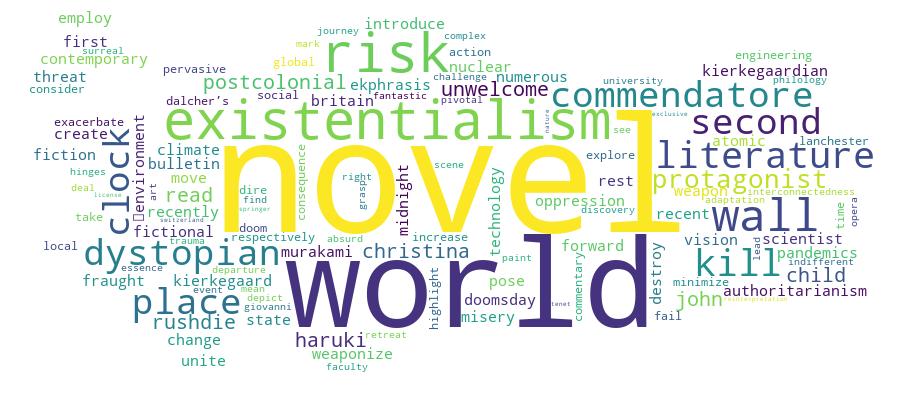
Competency Cloud

GCRIS Competency Cloud

Scholarly Output Search Results

Now showing 1 - 3 of 3
  • Article
    Citation - WoS: 1
    Citation - Scopus: 1
  • Article
    Unwelcome Consequences: Christina Dalcher’s Vox and John Lanchester’s the Wall
    (Faculty of Philology, University of Bialystok, 2022) Rundholz, A.
    The Bulletin of the Atomic Scientistsʼ Doomsday Clock, first introduced in 1947, recently moved the fictional clock forward; it now rests at 100 seconds to midnight, or 100 seconds from destroying our-selves. The numerous threats posed by nuclear weapons, pandemics, weaponized technology, and cata-strophic climate change create an ʻenvironment of miseryʼ in which all action—and all inaction—is fraught with risk. Two recent novels employ dystopian visions of the United States and Britain, respectively, and explore the consequences of social engineering that takes place to minimize (perceived) risks and increase safety. Dalcherʼs Vox (2018) and Lanchesterʼs The Wall (2019) are two novels that are a commentary on a world in which risk is pervasive and in which (in)action can exacerbate dire circumstances. At the same time, the novels highlight that local (national) action is doomed to fail if it does not also consider the global interconnectedness of challenges and risks. © 2022, Faculty of Philology, University of Bialystok. All rights reserved.
  • Book Part
    The Art of Being: Haruki Murakami’s Killing Commendatore and Kierkegaardian Existentialism
    (Springer Science+Business Media, 2025) Rundholz, A.; Kirca, M.
    The protagonist of Killing Commendatore retreats to deal with the trauma of divorce. Pivotal to the protagonist’s journey is his discovery of a painting. Depicting a scene from Mozart’s opera, Don Giovanni, the painting marks the protagonist’s departure to finding meaning in a complex world. His self-discovery hinges on the arts, leading the protagonist to grasp his essence and place in an indifferent and absurd universe. Fantastic and surreal events in the novel can be seen as an adaptation of Kierkegaard’s existentialism, a reinterpretation of the philosopher’s tenets to fit the twenty-first century. © 2025 The Editor(s) (if applicable) and The Author(s), under exclusive license to Springer Nature Switzerland AG.