Bilgilendirme: Kurulum ve veri kapsamındaki çalışmalar devam etmektedir. Göstereceğiniz anlayış için teşekkür ederiz.
 

Kalfa, Başak

Loading...
Profile Picture
Name Variants
Kalfa, Basak
Kalfa Ataklı, Başak
Job Title
Arş. Gör.
Email Address
kalfa@cankaya.edu.tr
Main Affiliation
Mimarlık
Status
Current Staff
Scopus Author ID
Turkish CoHE Profile ID
Google Scholar ID
WoS Researcher ID

Sustainable Development Goals

13

CLIMATE ACTION
CLIMATE ACTION Logo

0

Research Products

8

DECENT WORK AND ECONOMIC GROWTH
DECENT WORK AND ECONOMIC GROWTH Logo

0

Research Products

3

GOOD HEALTH AND WELL-BEING
GOOD HEALTH AND WELL-BEING Logo

0

Research Products

15

LIFE ON LAND
LIFE ON LAND Logo

0

Research Products

17

PARTNERSHIPS FOR THE GOALS
PARTNERSHIPS FOR THE GOALS Logo

0

Research Products

14

LIFE BELOW WATER
LIFE BELOW WATER Logo

0

Research Products

4

QUALITY EDUCATION
QUALITY EDUCATION Logo

0

Research Products

11

SUSTAINABLE CITIES AND COMMUNITIES
SUSTAINABLE CITIES AND COMMUNITIES Logo

4

Research Products

6

CLEAN WATER AND SANITATION
CLEAN WATER AND SANITATION Logo

0

Research Products

10

REDUCED INEQUALITIES
REDUCED INEQUALITIES Logo

0

Research Products

9

INDUSTRY, INNOVATION AND INFRASTRUCTURE
INDUSTRY, INNOVATION AND INFRASTRUCTURE Logo

0

Research Products

12

RESPONSIBLE CONSUMPTION AND PRODUCTION
RESPONSIBLE CONSUMPTION AND PRODUCTION Logo

1

Research Products

2

ZERO HUNGER
ZERO HUNGER Logo

0

Research Products

1

NO POVERTY
NO POVERTY Logo

0

Research Products

7

AFFORDABLE AND CLEAN ENERGY
AFFORDABLE AND CLEAN ENERGY Logo

0

Research Products

5

GENDER EQUALITY
GENDER EQUALITY Logo

0

Research Products

16

PEACE, JUSTICE AND STRONG INSTITUTIONS
PEACE, JUSTICE AND STRONG INSTITUTIONS Logo

0

Research Products
Documents

1

Citations

0

h-index

0

Documents

1

Citations

0

Scholarly Output

5

Articles

3

Views / Downloads

1269/3761

Supervised MSc Theses

0

Supervised PhD Theses

0

WoS Citation Count

0

Scopus Citation Count

0

WoS h-index

0

Scopus h-index

0

Patents

0

Projects

0

WoS Citations per Publication

0.00

Scopus Citations per Publication

0.00

Open Access Source

3

Supervised Theses

0

Google Analytics Visitor Traffic

JournalCount
GRID - Architecture, Planning and Design Journal1
ICONARCH - International Congress of Architecture and Planning1
International Journal of Cultural Policy1
Mimarlık1
SanArt 3.Estetik Kongresi Bildiri Kitabı1
Current Page: 1 / 1

Scopus Quartile Distribution

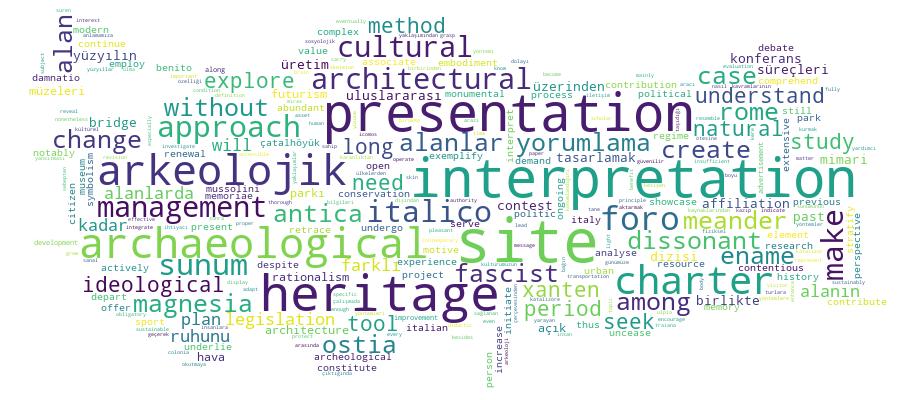
Competency Cloud

GCRIS Competency Cloud

Scholarly Output Search Results

Now showing 1 - 5 of 5
  • Conference Object
  • Conference Object
    Interpretation and Presentation of Archaeological Sites as a Tool for Creating Bridge between Past and Present: Case of Magnesia on the Meander
    (2017) Kalfa, Başak; Özgönül, Nimet
    Cultural heritage sites are in increasing demands among people. Developments in advertisement along with the improvements in transportation make these sites more accessible and thrilling. Tools and approaches of displaying cultural and natural heritage sites, in our case archaeological sites, have changed skin eventually to adapt contemporary situation. Nonetheless this change has become insufficient and been in need of revision since the growing interest in archaeological sites enhances audience’s expectations. This condition reveals that new methods of interpretation and presentation should be sought for effective, pleasant and didactic experience. Besides, legislations and charters encourage and even make obligatory to have interpretation and presentation methods in the cultural and natural heritage sites. Especially ICOMOS Charter for the Interpretation and Presentation of Cultural Heritage Sites, known as the Ename Charter (2007) is the most thorough charter on the topic, with its definitions and principles. The interpretation and presentation of archaeological sites is an important asset for an archaeological site to be fully grasped by the visitors and scholars, and sustainably protected for a long period of time. This is mainly because the subject matter represents “the past” in “the present” time and without any interpretation, no one would understand what messages the heritage site has been carrying for centuries. However, interpretation and presentation approach is not enough by itself. Every archaeological site needs a “site management plan” for an integrated and sustainable planning. As it is indicated in charters and legislations, site management plan is the leading authority where interpretation and presentation is a sub-brunch of it. It can be resembled to human structure. If the management plan would be the brain, interpretation would be the skeleton and presentation would be the muscles. They are all creating one body and they cannot operate without each other’s absence. In this paper, a specific case, that is Magnesia on the Meander, will be investigated in the light of the principles of Ename Charter and evaluations will be made for the benefit of proper interpretation and presentation of the site.
  • Article
    Affiliation of Archaeological Sites and People:Case Studies on Interpretation and Presentation Approaches
    (Cankaya University Press, 2018) Kalfa Ataklı, Başak
    Archaeological heritage sites are one of the most trustworthy sources of our cultural and sociological history. Thus, once the archaeological heritage comes to daylight after centuries of darkness, they would like to connect with people immediately to pass the information they have been carrying. Hence, the bonding needs a catalyst in order to reflect the spirit of the place. This catalyst is called “interpretation and presentation”. Many approaches from excavating and presenting to virtual off-site tours have been used from the first archaeological excavation to now. These methods go beyond the physical representation of the site solely but help its audience to comprehend its spirit. In this study, three archaeological sites from different countries are investigated in terms of their interpretation and presentation methods. These sites are Colonia UlpiaTraiana (Archaeological Park Xanten) in Germany, Ostia Antica in Italy and Çatalhöyük in Turkey. Having both distinct and common methods, these three sites provide an understanding how interpretation and presentation approaches place themselves as a communication tool between people and the archaeological site.
  • Article
    The Making of a Dissonant Heritage: the Foro Italico in Rome
    (Routledge Journals, Taylor & Francis Ltd, 2024) Kalfa, Basak; Serin, Ufuk
    Italy's long and stratified history offers abundant heritage resources, with Rome serving as a showcase for the architectural embodiment of political and ideological changes over time. Among these periods, the Fascist regime under Benito Mussolini initiated extensive urban and architectural renewal projects, notably exemplified by the Foro Italico, a monumental sports complex that is still actively used. The present contribution retraces the elements constituting Fascist architectural heritage in Italy and explores how Italian people comprehend and interpret the dissonant heritage site of the Foro Italico. Departing from previous approaches, this research employs a conservation perspective, exploring, among others, architectural and socio-cultural values associated with the complex. By analysing the motives underlying its unceasing use, this study seeks to understand why citizens continue to create new experiences and memories at the site despite its contentious ideological symbolism, without undergoing modern damnatio memoriae or de-commemoration processes, thus contributing to ongoing debates on heritage management and the politics of memory.