
B.coussens, Catherine
Loading...
Profile URL
Name Variants
Coussens, Catherine
Job Title
Yrd. Doç. Dr.
Email Address
cathy@cankaya.edu.tr
Main Affiliation
İngiliz Dili ve Edebiyatı
Status
Former Staff
Website
ORCID ID
Scopus Author ID
Turkish CoHE Profile ID
Google Scholar ID
WoS Researcher ID
Sustainable Development Goals
 1
1NO POVERTY
0
Research Products
 2
2ZERO HUNGER
0
Research Products
 3
3GOOD HEALTH AND WELL-BEING
0
Research Products
 4
4QUALITY EDUCATION
0
Research Products
 5
5GENDER EQUALITY
0
Research Products
 6
6CLEAN WATER AND SANITATION
0
Research Products
 7
7AFFORDABLE AND CLEAN ENERGY
0
Research Products
 8
8DECENT WORK AND ECONOMIC GROWTH
0
Research Products
 9
9INDUSTRY, INNOVATION AND INFRASTRUCTURE
0
Research Products
 10
10REDUCED INEQUALITIES
0
Research Products
 11
11SUSTAINABLE CITIES AND COMMUNITIES
1
Research Products
 12
12RESPONSIBLE CONSUMPTION AND PRODUCTION
0
Research Products
 13
13CLIMATE ACTION
0
Research Products
 14
14LIFE BELOW WATER
0
Research Products
 15
15LIFE ON LAND
2
Research Products
 16
16PEACE, JUSTICE AND STRONG INSTITUTIONS
0
Research Products
 17
17PARTNERSHIPS FOR THE GOALS
0
Research Products

This researcher does not have a Scopus ID.

This researcher does not have a WoS ID.
No records found in other affiliations.

Scholarly Output
5
Articles
5
Views / Downloads
3048/45
Supervised MSc Theses
0
Supervised PhD Theses
0
WoS Citation Count
0
Scopus Citation Count
0
Patents
0
Projects
0
WoS Citations per Publication
0.00
Scopus Citations per Publication
0.00
Open Access Source
1
Supervised Theses
0
| Journal | Count |
|---|---|
| Çankaya Üniversitesi Fen Edebiyat Fakültesi Journal of Arts and Sciences | 2 |
| Çankaya Üniversitesi Fen-Edebiyat Fakültesi, Journal of Arts and Sciences | 1 |
| Çankaya Üniversitesi Journal of Arts and Sciences | 1 |
| Hacettepe Üniversitesi Edebiyat Fakültesi Dergisi | 1 |
Current Page: 1 / 1
Scopus Quartile Distribution
Quartile distribution chart data is not available
Competency Cloud
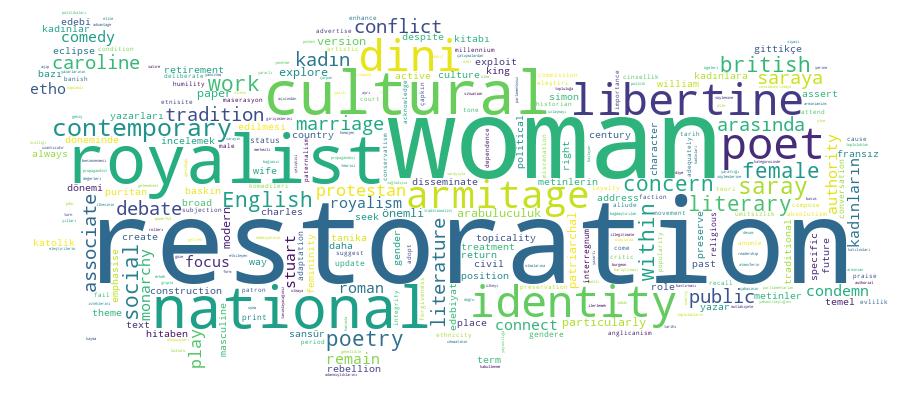
5 results
Scholarly Output Search Results
Now showing 1 - 5 of 5
Article Updating the restoration Libertine in Tanika Gupta’s contemporary adaptation of William Wycherley’s the country wife(Çankaya Üniversitesi, 2009) Coussens, CatherineThis paper analyses Tanika Gupta’s contemporary version of William Wycherley’s Restoration comedy, The Country Wife, particularly in terms of its treatment of the libertine character central to the genre described as ‘sex’ or ‘marriage’ comedy, popular during the 1660s and 1670s (Rosenthal 7-8). By resituating the play in contemporary multicultural London, Gupta enables a critique of contemporary gender and marital mores amongst young, ethnically-hybrid communities to emerge, problematising patriarchal, misogynist or aggressive versions of masculine identity, and asserting the right of individual men and women to choose their own marriage partners. However, she also gives place to the libertine ethos as it was valorised in early modern sex comedies. Critical debate concerning the social and moral implications of the libertine have remained active since the seventeenth century, with the libertine character generally interpreted as either a refreshing freedom-seeker or an anxious misogynist. While Wycherley’s play celebrates but finally limits and condemns the efforts of the libertine to disrupt patriarchal social structures, returning the rebellious upperclass ladies to patriarchal authority, and condemning Horner to future (teputedly impotent) oblivion, Gupta’s female libertines, Dolly and Daisy, remain fun-loving outsiders ready to embark on new adventures, while Hardeep/Horner succeeds in assisting the “country wife” to escape an unhappy marriage. Gupta’s version of the play draws parallels between Restoration social debate – particularly concerning morality, marriage, patriarchy and class – and the ethnically charged debates concerning cultural identity, marriage and gender rights which dominate twenty-first century urban Britain.Article British national identity, topicality and tradition in the poetry of Simon Armitage(Çankaya Üniversitesi, 2008) Coussens, CatherineThis paper explores the treatment of British national identity, topicality and tradition in the work of Simon Armitage, alongside broader issues concerning contemporary public poetry in Britain. Armitage, with Carol Ann Duffy, is a major candidate for the position of Poet Laureate in 2009. Both poets have explored constructions of national identity in their work, but it is Armitage who has located himself more assertively within the arena of public, national poetry. Despite his focus on modern life-styles and discourses, and deployment of the mass media to disseminate his poetry into non-literary public spaces, Armitage is particularly sensitive to literary and cultural tradition. Within his work, which is deliberately accessible and contemporary, tradition is always at play in terms of allusion, response and interrogation. In this sense, his poetry both occupies and challenges notions of canonicity and traditional conceptions of British national identity. His recent focus on the theme of conflict also works to expose the inadequacy of mainstream assertions of continuity and meaning when constructing national identity. Armitage places Britishness and British literature within a broader ‘Millennial’ schema of eclipse, destruction and regeneration. For Armitage the recurrence of the theme of conflict throughout literary history both connects the literature of the present day with that of the past and emphasises the future’s instability and eternal lack of resolution. Therefore, Armitage’s modern translations of canonical texts like the Odyssey and Sir Gawain and the Green Knight foreground the fact that disharmony and conflict are, and have always been, national preoccupationsArticle “Virtue’s commonwealth”: gendering the royalist cultural rebellion in the English interregnum (1649-1660)(Çankaya Üniversitesi, 2006) Coussens, CatherineHistorians and literary critics have acknowledged the ways in which royalism during the English civil war period came to be associated with the “feminisation” of Stuart court culture, and of the king’s cause as a whole. However, they have failed to attend adequately to the deliberate focus on women and female cultural authority within the literature associated with the “royalist cultural rebellion” (the movement that sought to preserve and recall the ethos and identity of the banished Stuart court). While male poets adopted a self-mocking tone when advertising their artistic dependence on female patrons, alluding self-consciously to their own “feminised” retirement, women’s active role in commissioning, preserving, disseminating and composing royalist literature suggests that their cultural importance was enhanced by the conditions of the Interregnum. Both royalist and parliamentarian propagandists exploited anti-feminist satire to condemn what they saw as illegitimate forms of government. However, royalist traditionalists overtly connected elite royalist women with the ethos and situation of the eclipsed Stuart monarchy, and sought to address a burgeoning female readership by stressing women’s advantages under the Crown. Royalist women in turn responded to these cultural constructions of royalism and femininity, creating powerful authorial identities that would remain potent after the Restoration in 1660Article “Under our Cedar’s shadow”: royalist women poets and the English restoration(Çankaya Üniversitesi, 2007) Coussens, CatherineThis paper compares the work of three lesser-known royalist women poets (Rachel Jevon, Ann Lee, and the anonymous female author of The Sacred Historie) to explore the subtle ways in which these writers connect their personal literary projects to the specific requirements of the Restoration regime. Despite the strategic emphasis on masculine authority within the numerous panegyrics addressed to the king in the aftermath of the Restoration in 1660, an alternative impulse in female-authored texts configures the return of the monarchy as an event which women are especially qualified to celebrate. In elevating conventionally feminine values, these poets were able to associate themselves with the social and political agenda of the Restoration government, which aimed to reconcile the English people to their past, and ease tensions associated with the Restoration Settlement, the General Pardon, and the Act of Oblivion. Since the civil wars had created distrust and resentment concerning politics and polemic, women poets could exploit their position as literary and political “outsiders” to justify their rehearsal of the role of “public” poet. However, in promoting their own specific interests, as loyalists whose families had suffered for the Crown, women poets also assert their own hopes for the future path of the monarchy, reminding the king of the significance of his traditional supporters, and emphasising his duty to subordinate himself to God and the English ChurchArticle Conversations With a Lady: Women and the Religious Debate in Caroline Print Culture(2009) Coussens, CatherineCaroline sarayıyla bağdaştırılan kadınların yayıncılığa katılımları, genellikle Charles I’in politikaları ve Avrupa’yı etkileyen dini çatışmalardan bağımsız, özel bir edebiyat tarihi kategorosinde incelenir. Charles I’in krallığı döneminde, 1629-1640 yılları arasında ülkeyi Parlamentosuz yönetme, dini ve politik eleştirilerin sansür edilmesi ve İlahi Hak Teorisi ilkesinin benimsenmesi gibi olaylarda görüldüğü gibi, mutlakiyete doğru bir kayma görülür. Kral’ın Arminian Anglikanizm’i kabullenme çelişkisi ve Roman Katolik’lerin cezalandırılmaya devam edilmesi bazı toplulukların saraya yabancılaştığını kanıtlar. Kadınları ayrı bir grupta incelemek yerine bu atmosferin yarattığı daha geniş kapsamlı basım kültürü içindeki rolleri açısından incelemek daha yararlı olacaktır. Gittikçe kadın merkezli olmaya başlayan saray, bazı kadınların geleneksel değerleri aşıp yazar olmalarına imkan sağladıysa da, saray homojen bir topluluktan oluşmuyordu. Kadın ve erkek yazarlı tüm metinler yazarlarının belli bir dini ve siyasi topluluğa temel adanmışlıklarını ve ilerlemek için sarayın temel baskın söylemlerine uyma isteklerini yansıtma eğilimindeydi. Yine de, dini uzlaşmayı dile getiren yazılı metinlerin yazarları ya da okuyucuları olarak kadınlar gittikçe Caroline edebiyatının göze çarpan ögeleri olmuşlardır. “Bir hanımla söyleşiler” diye tanımlayacağımız edebi tür hem saray propagandası hem de saray söylemine dahil olma girişimlerini kapsar. Kral’ın John Cosin’e (1627) bir kadın için dua kitabı bastırması, onun Protestan İngiliz cemaatinin Arminianizm ile barıştırması çabasının bir uzantısıdır, ancak bu kraliçenin Fransız maiyetinin gösterişli Roman Katolizm’ine karşı Protestan kadınlar tarafından Henrietta Maria’nın sarayında tanıtılmıştır. Puritan yazarlar saraya anti-feminist ve anti-katolik eleştirileriyle veryansın ederken, iki kadın tarafından saraya hitaben yazılan iki metin baskın kralcı düşünceyle farklı dini gruplar arasında arabuluculuk yapmayı hedefler. İlk olarak, Protestan Alice Sutcliffe’in yazdığı, şiirsel düşünceler serisi (1634) dua kitabı projesi’ne bir yanıt ve saray çevresi ile Puritan duyarlılık arasında arabuluculuk yapma girişimi olarak ele alınabilir. İkincisi ise Susan DuVerger’in, Fransız reform karşıtı yazar Jean Paul Camus’un (1639) Roman Katolik dini romanslarının çevirisidir ve popüler Katolik edebiyatı Protestan İngiliz okurlar arasında yayma girişimidir. İç Savaş dönemi ve öncesinde önemli kadınlarla ve önemli kadınlara hitaben basılan metinler de kadınlara dini konularda tarafsız yargılama, arabuluculuk ve yorumcu rollerini yükler. Saray kültüründe kadınların görünmesi, onların Caroline döneminde giderek saraya hitap eden politik-dini metinlerin yazarları, sorumluları ve hatipleri oldukları anlamına gelmekteydi, sansür ve siyasileşmeden kaçınmanın bir yolu olarak cinsiyet önemli bir dini tartışma silahı olarak kullanılmıştır.