
Arpali, Çağlar
Loading...
Profile URL
Name Variants
Arpali, Caglar & Arpali, C. Caglar & Arpali, C. & Arpalı, Çağlar & Arpali, Çağlar & Arpali, Çağlar & Arpali, Çağlar & Arpali, Çağlar
Job Title
Doç. Dr.
Email Address
c.arpali@cankaya.edu.tr
Main Affiliation
06.08. Mekatronik Mühendisliği
06. Mühendislik Fakültesi
01. Çankaya Üniversitesi
06.08. Mekatronik Mühendisliği
Mekatronik Mühendisliği
06. Mühendislik Fakültesi
01. Çankaya Üniversitesi
06. Mühendislik Fakültesi
01. Çankaya Üniversitesi
06.08. Mekatronik Mühendisliği
Mekatronik Mühendisliği
06. Mühendislik Fakültesi
01. Çankaya Üniversitesi
Status
Current Staff
Website
ORCID ID
Scopus Author ID
Turkish CoHE Profile ID
Google Scholar ID
WoS Researcher ID
Files
Sustainable Development Goals
 1
1NO POVERTY
0
Research Products
 2
2ZERO HUNGER
0
Research Products
 3
3GOOD HEALTH AND WELL-BEING
0
Research Products
 4
4QUALITY EDUCATION
0
Research Products
 5
5GENDER EQUALITY
0
Research Products
 6
6CLEAN WATER AND SANITATION
0
Research Products
 7
7AFFORDABLE AND CLEAN ENERGY
0
Research Products
 8
8DECENT WORK AND ECONOMIC GROWTH
0
Research Products
 9
9INDUSTRY, INNOVATION AND INFRASTRUCTURE
1
Research Products
 10
10REDUCED INEQUALITIES
0
Research Products
 11
11SUSTAINABLE CITIES AND COMMUNITIES
0
Research Products
 12
12RESPONSIBLE CONSUMPTION AND PRODUCTION
0
Research Products
 13
13CLIMATE ACTION
0
Research Products
 14
14LIFE BELOW WATER
0
Research Products
 15
15LIFE ON LAND
0
Research Products
 16
16PEACE, JUSTICE AND STRONG INSTITUTIONS
0
Research Products
 17
17PARTNERSHIPS FOR THE GOALS
0
Research Products

Scopus data could not be loaded because of an error. Please refresh the page or try again later.

Documents
22
Citations
399
No records found in other affiliations.

Scholarly Output
30
Articles
20
Views / Downloads
1212/504
Supervised MSc Theses
3
Supervised PhD Theses
0
WoS Citation Count
399
Scopus Citation Count
413
Patents
0
Projects
0
WoS Citations per Publication
13.30
Scopus Citations per Publication
13.77
Open Access Source
5
Supervised Theses
3
| Journal | Count |
|---|---|
| Journal of Modern Optics | 3 |
| Applied Physics B | 2 |
| Optics Express | 2 |
| Optical Review | 2 |
| Conference on Atmospheric Propagation of Electromagnetic Waves III -- JAN 26-27, 2009 -- San Jose, CA | 1 |
Current Page: 1 / 5
Scopus Quartile Distribution
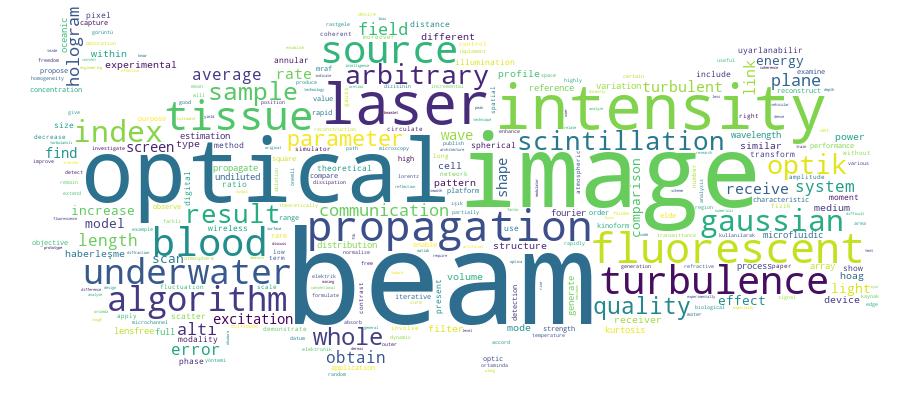
Competency Cloud
30 results
Scholarly Output Search Results
Now showing 1 - 10 of 30
Article High-throughput screening of large volumes of whole blood using structured illumination and fluorescent on-chip imaging(Royal Soc Chemistry, 2012) Altay Arpalı, Serap; Arpalı, Çağlar; Coşkun, Ahmet F.; Chiang, Hsin-Hao; Özcan, AydoğanUndiluted blood samples are difficult to image in large volumes since blood constitutes a highly absorbing and scattering medium. As a result of this limitation, optical imaging of rare cells (e.g., circulating tumour cells) within unprocessed whole blood remains a challenge, demanding the use of special microfluidic technologies. Here we demonstrate a new fluorescent on-chip imaging modality that can rapidly screen large volumes of absorbing and scattering media, such as undiluted whole blood samples, for detection of fluorescent micro-objects at low concentrations (for example <= 50-100 particles/mL). In this high-throughput imaging modality, a large area microfluidic device (e.g., 7-18 cm(2)), which contains for example similar to 0.3-0.7 mL of undiluted whole blood sample, is directly positioned onto a wide-field opto-electronic sensor-array such that the fluorescent emission within the microchannel can be detected without the use of any imaging lenses. This microfluidic device is then illuminated and laterally scanned with an array of Gaussian excitation spots, which is generated through a spatial light modulator. For each scanning position of this excitation array, a lensfree fluorescent image of the blood sample is captured using the opto-electronic sensor-array, resulting in a sequence of images (e.g., 144 lensfree frames captured in similar to 36 s) for the same sample chip. Digitally merging these lensfree fluorescent images based on a maximum intensity projection (MIP) algorithm enabled us to significantly boost the signal-to-noise ratio (SNR) and contrast of the fluorescent micro-objects within whole blood, which normally remain undetected (i.e., hidden) using conventional uniform excitation schemes, involving plane wave illumination. This high-throughput on-chip imaging platform based on structured excitation could be useful for rare cell research by enabling rapid screening of large volume microfluidic devices that process whole blood and other optically dense media.Master Thesis Su Altı Türbülanslı Ortamda Uyarlanabilir Optik Kullanarak Görüntü Düzeltmesi(2025) Turan, Mehmet Furkan; Baykal, Yahya Kemal; Arpali, ÇağlarOptik haberleşme yöntemleri veri iletim hızından dolayı ve gecikmenin az olmasından dolayı önemli bir haberleşme yöntemidir. Optik haberleşme yöntemlerinden su altı optik haberleşme önemli bir haberleşme yöntemidir ancak su altı ortamında görüntüleme bozulmaktadır. Bu bozulmanın önemli nedenlerinden biri türbülanstır ve su altı haberleşmenin performansını etkilemektedir. Bu tezde, uyarlanabilir optik yöntemi ile su altı ortamında bozulan görüntülerin düzeltilmesi incelenmiştir. Bilinen ve yeni geliştirilen kaynak profillerinin kullanılarak tanımlanmasıyla rastgele optik ışınların yayılımı su altı ortamında incelenmiş ve ortalama yoğunlukları elde edilerek sunulmuştur. Su altı türbülanslı ortamda rastgele optik ışınlarının, alıcıdaki yoğunluğu bulunarak analiz edilmiştir. Rastgele optik ışınların kaynak alan profilleri kaynak alanının piksellere bölünmesi ve piksellere faz ve genlik bilgisinin eklenmesiyle elde edilmiştir. Işın yoğunluklarının su altı türbülanslı ortamda alıcı düzleminde dağılımları gösterilirken, bilinen Gauss ışını, satranç tahtası şeklinde olan rastgele ışınlar ve Çankaya Üniversitesi baş harflerinin kısaltmasından oluşan Ç.Ü. ışını gibi farklı ışın tipleri kullanılmıştır. Dalga boyu, bağlantı uzunluğu, ortalama kare sıcaklığın dağılma oranı, sıcaklık ve tuzluluğun kırılma indisi spektrumuna katkı oranı, sıvı birim kütlesi başına kinetik enerjinin dağılma oranı, iç ölçek, alıcı açıklık çapı ve kaynak boyutu gibi su altı türbülans parametrelerinin ışın şiddetine olan etkisi incelenmiştir. Optik ışınlarının su altı türbülansı sonucunda bozulan görüntülerinin düzeltilmesinde, uyarlanabilir optik düzeltmesinin piston, eğim ve astigmatizma bileşenleri kullanılmıştır. Türbülans sonucu oluşan bozulma, uyarlanabilir optik yöntemi kullanılarak ve kullanılmayarak etkinliği karşılaştırılmıştır. MATLAB programı kullanılarak hesaplamalar yapılmış ve grafikler elde edilmiştir. Su altı türbülansının neden olduğu görüntü bozulmasının düzeltilmesi için kalite ölçütü belirlenmiş ve düzeltme miktarı incelenerek, uyarlanabilir optik yardımıyla ne kadar görüntü düzeltmesi sağlandığı incelenmiştir. Bu tezde, uyarlanabilir optik düzeltme yöntemi ile su altı ortamında türbülansın neden olduğu görüntü bozulmasının etkisinin en aza indirilmesi amaçlanmıştır. Bu tezde yapılan çalışma, su altı optik görüntüleme sistemleri, su altı kablosuz optik haberleşme ve elektro optik sistemlerin su altı performanslarının artırılması gibi alanlarda kullanılabilir.Article Citation - WoS: 48Citation - Scopus: 50High-Throughput Screening of Large Volumes of Whole Blood Using Structured Illumination and Fluorescent On-Chip Imaging(Royal Soc Chemistry, 2012) Arpali, Serap Altay; Arpali, Caglar; Coskun, Ahmet F.; Chiang, Hsin-Hao; Ozcan, AydoganUndiluted blood samples are difficult to image in large volumes since blood constitutes a highly absorbing and scattering medium. As a result of this limitation, optical imaging of rare cells (e.g., circulating tumour cells) within unprocessed whole blood remains a challenge, demanding the use of special microfluidic technologies. Here we demonstrate a new fluorescent on-chip imaging modality that can rapidly screen large volumes of absorbing and scattering media, such as undiluted whole blood samples, for detection of fluorescent micro-objects at low concentrations (for example <= 50-100 particles/mL). In this high-throughput imaging modality, a large area microfluidic device (e.g., 7-18 cm(2)), which contains for example similar to 0.3-0.7 mL of undiluted whole blood sample, is directly positioned onto a wide-field opto-electronic sensor-array such that the fluorescent emission within the microchannel can be detected without the use of any imaging lenses. This microfluidic device is then illuminated and laterally scanned with an array of Gaussian excitation spots, which is generated through a spatial light modulator. For each scanning position of this excitation array, a lensfree fluorescent image of the blood sample is captured using the opto-electronic sensor-array, resulting in a sequence of images (e.g., 144 lensfree frames captured in similar to 36 s) for the same sample chip. Digitally merging these lensfree fluorescent images based on a maximum intensity projection (MIP) algorithm enabled us to significantly boost the signal-to-noise ratio (SNR) and contrast of the fluorescent micro-objects within whole blood, which normally remain undetected (i.e., hidden) using conventional uniform excitation schemes, involving plane wave illumination. This high-throughput on-chip imaging platform based on structured excitation could be useful for rare cell research by enabling rapid screening of large volume microfluidic devices that process whole blood and other optically dense media.Article Citation - WoS: 138Citation - Scopus: 137Flat Topped Beams and Their Characteristics in Turbulent Media(Optical Soc Amer, 2006) Eyyuboglu, Halil Tanyer; Arpali, Caglar; Baykal, Yahya KemalThe source and receiver plane characteristics of flat topped ( FT) beam propagating in turbulent atmosphere are investigated. To this end, source size, beam power and M(2) factor of source plane FT beam are derived. For a turbulent propagation medium, via Huygens Fresnel diffraction integral, the receiver plane intensity is found. Power captured within an area on the receiver plane is calculated. Kurtosis parameter and beam size variation along the propagation axis are formulated. Graphical outputs are provided displaying the variations of the derived source and receiver plane parameters against the order of flatness and propagation length. Analogous to free space behavior, when propagating in turbulence, the FT beam first will form a circular ring in the center. As the propagation length increases, the circumference of this ring will become narrower, giving rise to a downward peak emerging from the center of the beam, eventually turning the intensity profile into a pure Gaussian shape. (c) 2006 Optical Society of America.Conference Object Citation - WoS: 2Citation - Scopus: 3Ber for Higher Order Laser Modes in Optical Wireless Underwater Communications(Ieee, 2016) Arpali, Serap Altay; Baykal, Yahya; Arpali, CaglarAverage bit error rate (<BER>) of an underwater optical communication system is analyzed for higher order laser beams. For this purpose, the effects of oceanic turbulence parameters and link parameters on single mode higher order laser beams are investigated.Article A comparison of iterative Fourier transform algorithms for image quality estimation(Optical Soc Japan, 2018) Alsaka, Dina Yaqoob; Arpali, Çağlar; Arpali, Serap AltayA comparison was established between two iterative Fourier transform algorithms (IFTAs), such as the original Gerchberg–Saxton (GS) and the mixed-region amplitude freedom (MRAF) algorithms, for the hologram reconstruction of different target images through the full reference image quality estimation (IQE) and pixel homogeneity in the Fourier plane presented theoretically and experimentally. The comparison was applied depending upon both algorithms based on a computer-generated hologram (CGH) implemented utilizing a reflective phase-modulated liquid-crystal spatial light modulator (LC-SLM) to obtain the digital kinoform holograms of the desired intensity distributions. These digital holograms were applied to reconstruct the intensity patterns for 852 nm, which represents a laser beam source. The theoretical and experimental results of the reconstructed patterns obtained using the MRAF algorithm were found to be smoother and better than the patterns obtained using the GS algorithm. Unmodulated light beam (dc term) is removed from the reconstructed patterns attributed to digital kinoform holograms of MRAF algorithm as an alternative to the theoretical and experimental results without using any additional optic equipment at the light path. Moreover, this paper discussed the full reference objective quality estimations, such as mean square error (MSE), peak signal-to-noise ratio (PSNR), structural content (SC), normalized absolute error (NAE), normalized cross correlation (NK), and homogeneity of pixels, through the contrast (Cont) and inverse difference moment (IDM) for numerical and experimental results. According to the two desired intensity distributions processed theoretically and experimentally, the results of MRAF algorithm were found to be in the highly accurate recovered phase, the quality of image was enhanced, and the dc term was decreased. Image quality estimation of full reference objective relay on the feedback algorithms experimental attestation has not been implemented yet.Article Citation - WoS: 77Citation - Scopus: 73Simulator for General-Type Beam Propagation in Turbulent Atmosphere(Optical Soc Amer, 2006) Arpali, Caglar; Yazicioglu, Canan; Eyyuboglu, Halil Tanyer; Arpali, Serap Altay; Baykal, YahyaA simulator is designed in MATLAB code which gives the propagation characteristics of a general-type beam in turbulent atmosphere. When the required source and medium parameters are entered, the simulator yields the average intensity profile along the propagation axis in a video format. In our simulator, the user can choose the option of a "user defined beam" in which the source and medium parameters are selected as requested by the user by entering numerical values in the relevant menu boxes. Alternatively, the user can proceed with the option of "pre-defined beam" in which the average intensity profiles of beams such as annular, cos-Gaussian, sine-Gaussian, cosh-Gaussian, sinh-Gaussian, their higher-order counterparts and flat-topped can be observed as they propagate in a turbulent atmosphere. Some samples of the simulator output are presented. (c) 2006 Optical Society of AmericaArticle Citation - WoS: 22Citation - Scopus: 20Scintillation Index of Optical Spherical Wave Propagating Through Biological Tissue(Taylor & Francis Ltd, 2017) Baykal, Yahya; Arpali, Caglar; Arpali, Serap AltayEffects of the tissue turbulence on the propagation of an optical spherical wave are analysed. For this purpose, scintillation index of an optical spherical wave which is propagating in a soft tissue is formulated and evaluated in weakly turbulent soft tissue. Scintillation index of the optical spherical wave is examined against the changes in the tissue parameters which are the tissue length between the optical spherical wave source and the detector, random variations in the refractive index of the tissue and the outer scale of the tissue turbulence. According to our graphical outputs, it is observed that increase in the random variations of the refractive index of the tissue results in an increase in the scintillation index at a certain realization of the turbulence spectrum. On the other hand, larger outer scales and longer tissue lengths yield larger scintillations. The variation of the scintillation index of the optical spherical wave versus the wavelength is also investigated. It is found that at small tissue lengths, wavelength has almost no effect on the scintillations; however, when the tissue length reaches a certain value, shorter wavelengths give rise to larger intensity fluctuations.Article Propagation Characteristics of Higher-Order Annular Gaussian Beams in Oceanic Turbulence(Institute of Physics, 2025) Arpali, S.A.; Arpali, Ç.; Baykal, Y.This study aims to explore the propagation characteristics of higher-order annular Gaussian (HOAG) beams in oceanic turbulence. We provide an analytical derivation of the average intensity at the receiver plane based on excitation from a HOAG source field. Additionally, we conduct a detailed analyses of various beam intensity moments including kurtosis parameter, power-in-the-bucket (PIB) and the beam size variation. As oceanic turbulence strength increases, the HOAG beam gradually transforms into a pure Gaussian beam. As the strength of turbulence increases, PIB values for all modes of HOAG beams gradually decrease in an exponential manner until they stabilize, exhibiting behavior similar to that of Gaussian beams. It is also observed that modes of HOAG beams having larger mode numbers carry less energy to the receiver compared to lower-order modes as turbulence strength increases. Analyses of the kurtosis parameter for HOAG beams indicate that during propagation over intermediate distances, there is a tendency for more beam energy to be distributed toward the wings rather than to the center. In contrast, at longer distances, the beam redistributes its energy, resulting in a lower energy concentration in the wings compared to the center. This research can enhance our understanding of the effects of higher-order laser beams, thereby potentially facilitating longer communication distances in underwater wireless optical communication technologies. © 2025 IOP Publishing Ltd.Article Citation - WoS: 7Citation - Scopus: 6Dynamic Flat-Topped Laser Beam Shaping Method Using Mixed Region Amplitude Freedom Algorithm(Springer Heidelberg, 2022) Arpali, Caglar; Arpali, Serap Altay; Altemimi, Mohammed Fawzi; Alsaka, Dina YaqoobA dynamic beam shaping method is proposed for the generation of flat-top beams (FTBs) in the far field. Using the mixed-region amplitude freedom algorithm, this new method is used to design the required phase distribution encoded on a spatial light modulator for the generation of FTB profiles. The characteristics of these new beam shaping methods are used as beam parameters, such as the laser beam size, the beam intensity of square FTBs, and the root-mean-square error (RMSE). Using our proposed method, the theoretical performance of beam intensity shaping is improved to an RMSE < 0.02 with a minimum number of iterations of phase reconstruction. Using the phase hologram of dynamic beam shaping, theoretical and experimental comparisons of edge steepness and plateau uniformity were established for the square FTBs of variable beam sizes. It is shown that the dynamic beam shaping of FTBs can produce high intensity uniformity in the plateau region with steep edges, which makes it an effective tool, especially for laser machining applications.
- «
- 1 (current)
- 2
- 3
- »