Aral, Halide

Loading...
Name Variants
Job Title
Öğr. Gör.
Email Address
Main Affiliation
İngiliz Dili ve Edebiyatı
Status
Former Staff
Website
ORCID ID
Scopus Author ID
Turkish CoHE Profile ID
Google Scholar ID
WoS Researcher ID

Sustainable Development Goals

NO POVERTY1
NO POVERTY
0
Research Products
ZERO HUNGER2
ZERO HUNGER
0
Research Products
GOOD HEALTH AND WELL-BEING3
GOOD HEALTH AND WELL-BEING
0
Research Products
QUALITY EDUCATION4
QUALITY EDUCATION
0
Research Products
GENDER EQUALITY5
GENDER EQUALITY
0
Research Products
CLEAN WATER AND SANITATION6
CLEAN WATER AND SANITATION
0
Research Products
AFFORDABLE AND CLEAN ENERGY7
AFFORDABLE AND CLEAN ENERGY
0
Research Products
DECENT WORK AND ECONOMIC GROWTH8
DECENT WORK AND ECONOMIC GROWTH
0
Research Products
INDUSTRY, INNOVATION AND INFRASTRUCTURE9
INDUSTRY, INNOVATION AND INFRASTRUCTURE
0
Research Products
REDUCED INEQUALITIES10
REDUCED INEQUALITIES
0
Research Products
SUSTAINABLE CITIES AND COMMUNITIES11
SUSTAINABLE CITIES AND COMMUNITIES
0
Research Products
RESPONSIBLE CONSUMPTION AND PRODUCTION12
RESPONSIBLE CONSUMPTION AND PRODUCTION
0
Research Products
CLIMATE ACTION13
CLIMATE ACTION
0
Research Products
LIFE BELOW WATER14
LIFE BELOW WATER
0
Research Products
LIFE ON LAND15
LIFE ON LAND
0
Research Products
PEACE, JUSTICE AND STRONG INSTITUTIONS16
PEACE, JUSTICE AND STRONG INSTITUTIONS
2
Research Products
PARTNERSHIPS FOR THE GOALS17
PARTNERSHIPS FOR THE GOALS
0
Research Products
This researcher does not have a Scopus ID.
This researcher does not have a WoS ID.
No records found in other affiliations.
Scholarly Output

4

Articles

3

Views / Downloads

1547/273

Supervised MSc Theses

0

Supervised PhD Theses

0

WoS Citation Count

0

Scopus Citation Count

0

Patents

0

Projects

0

WoS Citations per Publication

0.00

Scopus Citations per Publication

0.00

Open Access Source

1

Supervised Theses

0

JournalCount
Çankaya Üniversitesi Fen-Edebiyat Fakültesi, Journal of Arts and Sciences1
Çankaya Üniversitesi Journal of Arts and Sciences1
Eskilerin Bilgeliği1
Journal of Jungian Scholarly Studies1
Current Page: 1 / 1

Scopus Quartile Distribution

Quartile distribution chart data is not available

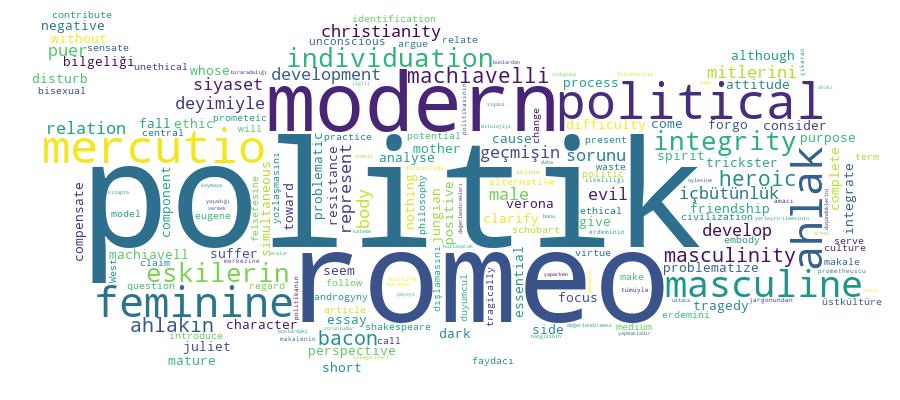
Competency Cloud

GCRIS Competency Cloud

Scholarly Output Search Results

Now showing 1 - 4 of 4
  • Article
    İçbütünlük Sorunu ve Modern Politik Ahlak
    (2008) Aral, Halide
    Bu makale, modern politik ahlakın içbütünlük erdemini dışlamasını ve yozlaşmasını Machiavelli’nin faydacı politik felsefesine; Sorokin’in deyimiyle, Duyumcul üstkültüre ve Schubart’ın deyimiyle, Prometheuscu kültüre bağlar. Makalenin amacı, ilkeliliği ve dürüstlüğü politikanın jargonundan tümüyle çıkaran güç politikasının aksine, içbütünlük erdeminin politik ahlakın merkezine yerleştirilmesinin gereğini savunmaktır.
  • Other
    Eskilerin Bilgeliği
    (Bilge Su Yayıncılık, 2018) Aral, Halide
    Eskilerin Bilgeliği'ni Bacon 1609'da yayımlar. Bu kitapta Bacon'ın yaşadığı çağı siyasi ve ahaki bakımdan değerlendirmesi sözkonusudur. Bunu da öylesine ustaca yapmaktadır ki bunlardan hangisinin daha önemli olduğuna karar vermek güçleşiyor. Bacon, siyaset ile ahlakın biraradalığı zorunludur demektedir. Oi bu değerlendirmeleri yaparken de geçmişin mitlerini kullanır. Geçmişin mitlerini örten peçeyi aralar; bunlardaki allegorileri ortaya koymaya çalışır. Bacon Eskilerin Bilgeliği'nde mitolojiyi kullanarak siyaset felsefesiyle ilgili düşündüklerini de kaleme almıştır.
  • Article
    İçbütünlük sorunu ve modern politik ahlak
    (Çankaya Üniversitesi, 2015) Aral, Halide
    This article is about the question of integrity in modern political ethics. It regards modern political practice as unethical and relates it to the change in political philosophy introduced by Machiavelli;the sensate civilization of the West in Sorokin’s terms; and the prometeic culture which developed, as Schubart claims, with the Renaissance. Then, it argues that making integrity the central virtue in politics will contribute to the development of ethical political practice.
  • Article
    Male Friendship As Masculine Individuation in Romeo and Juliet
    (2016) Aral, Halide
    The purpose of this essay is to analyse from a Jungian perspective how heroic masculinity and Christianity, due to their negative attitude toward the feminine, problematize masculine individuation and cause tragedy in Romeo and Juliet. Although all male characters in Verona fall short of the mature masculinity that could come with developing a relation to the feminine, I focus on Romeo and Mercutio whose problematic development clarifies man’s difficulty with integrating the feminine without forgoing the masculine structure. Romeo, the puer, who represents the spirit, suffers from a positive mother complex. Mercutio, the trickster, the dark side of the puer, represents the body which is considered evil by Christianity, and has a disturbed relation to the feminine. Hence he compensates for, completes, and gives body to Romeo who is otherwise nothing but the spirit. Being the evil component, Mercutio is essential to the individuation process, and with his simultaneous resistance to and what seems to be an unconscious identification with the feminine, Mercutio serves as a medium through which Shakespeare presents what we may now call, following Eugene Monick’s model, bisexual androgyny as an alternative to heroic masculinity. But this potential as embodied in Mercutio is wasted tragically by the heroic masculinity in Verona.