
Doğanay, Mehmet Mete
Loading...
Profile URL
Name Variants
Doğanay, Mete
Doganay, M. Mete
Doğanay, M. Mete
Doğanay, Mete M.
Mete Doǧanay, M.
Doganay, M. Mete
Doğanay, M. Mete
Doğanay, Mete M.
Mete Doǧanay, M.
Job Title
Prof. Dr.
Email Address
mdoganay@cankaya.edu.tr
Main Affiliation
İşletme
Status
Current Staff
Website
ORCID ID
Scopus Author ID
Turkish CoHE Profile ID
Google Scholar ID
WoS Researcher ID
Files
Sustainable Development Goals
11
SUSTAINABLE CITIES AND COMMUNITIES

0
Research Products
3
GOOD HEALTH AND WELL-BEING

0
Research Products
9
INDUSTRY, INNOVATION AND INFRASTRUCTURE

0
Research Products
6
CLEAN WATER AND SANITATION

0
Research Products
14
LIFE BELOW WATER

0
Research Products
12
RESPONSIBLE CONSUMPTION AND PRODUCTION

0
Research Products
8
DECENT WORK AND ECONOMIC GROWTH

0
Research Products
1
NO POVERTY

0
Research Products
4
QUALITY EDUCATION

0
Research Products
5
GENDER EQUALITY

0
Research Products
10
REDUCED INEQUALITIES

3
Research Products
16
PEACE, JUSTICE AND STRONG INSTITUTIONS

0
Research Products
15
LIFE ON LAND

0
Research Products
7
AFFORDABLE AND CLEAN ENERGY

0
Research Products
13
CLIMATE ACTION

0
Research Products
17
PARTNERSHIPS FOR THE GOALS

1
Research Products
2
ZERO HUNGER

0
Research Products

Documents
5
Citations
194
h-index
5

Documents
0
Citations
0

Scholarly Output
20
Articles
14
Views / Downloads
2370/675
Supervised MSc Theses
1
Supervised PhD Theses
1
WoS Citation Count
163
Scopus Citation Count
203
WoS h-index
5
Scopus h-index
6
Patents
0
Projects
0
WoS Citations per Publication
8.15
Scopus Citations per Publication
10.15
Open Access Source
4
Supervised Theses
2
| Journal | Count |
|---|---|
| Expert Systems with Applications | 3 |
| İktisat İşletme ve Finans | 2 |
| The IUP Journal of Applied Finance | 2 |
| Finansal Piyasalar ve Kurumlar | 1 |
| İMKB Dergisi | 1 |
Current Page: 1 / 3
Scopus Quartile Distribution
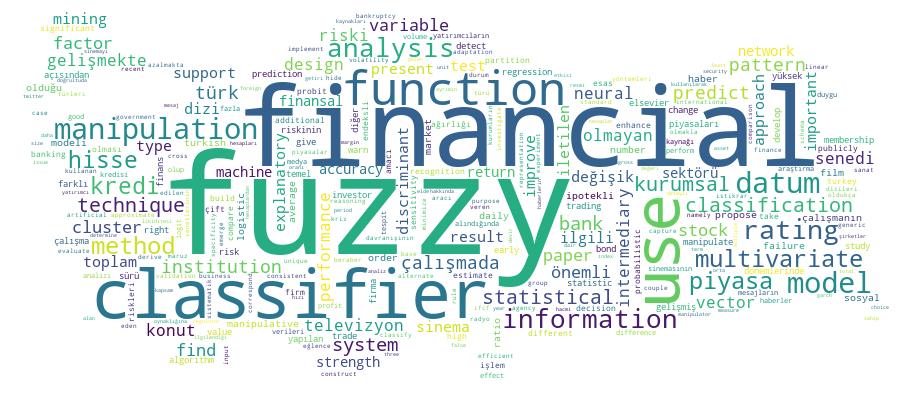
Competency Cloud
20 results
Scholarly Output Search Results
Now showing 1 - 10 of 20
Article Fama-French üç faktör varlık fiyatlama modelinin İMKB’de uygulanması(2006) Doğanay, M. MeteArticle Towards Predicting Financial Information Manipulation(2007) Aktaş, Ramazan; Alp, Ali; Doğanay, Mehmet MeteManipulation is one of the important issues in securities markets because manipulative actions send false signals to the investors and make them buy or sell securities they otherwise would not buy or sell. There are different types of manipulations that can deceive investors. One type of manipulation is financial information manipulation. Manipulators, who use this type of manipulation, distort information in the financial statements in order to give false information about the prospects of the issuing firms. This paper attempts to predict financial information manipulation by using the multivariate statistical techniques and neural networks. A number of financial ratios are used as explanatory variables. The multivariate statistical techniques used are discriminant analysis, logistics regression (logit), and probit. Unlike other studies, the present study takes multicollinearity between financial ratios into account and conclude that the estimated multivariate statistical models rather than the neural networks can be used as early warning systems to detect possible financial information manipulations.Publication A new classifier design with fuzzy functions(Springer-Verlag Berlin, 2007) Celikyılmaz, Aslı; Türkşen, I. Burhan; Aktaş, Ramazan; Doğanay, M. Mete; Ceylan, N. BaşakThis paper presents a new fuzzy classifier design, which constructs one classifier for each fuzzy partition of a given system. The new approach, namely Fuzzy Classifier Functions (FCF), is an adaptation of our generic design on Fuzzy Functions to classification problems. This approach couples any fuzzy clustering algorithm with any classification method, in a unique way. The presented model derives fuzzy functions (rules) from data to classify patterns into number of classes. Fuzzy c-means clustering is used to capture hidden fuzzy patterns and a linear or a non-linear classifier function is used to build one classifier model for each pattern identified. The performance of each classifier is enhanced by using corresponding membership values of the data vectors as additional input variables. FCF is proposed as an alternate representation and reasoning schema to fuzzy rule base classifiers. The proposed method is evaluated by the comparison of experiments with the standard classifier methods using cross validation on test patterns.Article The intermediary institutions which are preferred for manipulative trading: Evidence from an emerging market(2017) Doğanay, Mete; Aktaş, Ramazan; Somuncu, KartalThis research investigates the type of intermediary institutions chosen by the manipulators for their manipulative trading. Univariate and multivariate analyses are performed and three variables having significant effect on the manipulators’ choice of intermediary institution for their manipulative trading are found. These variables are being publicly traded, size in terms of total assets, and gross profit margin. Being publicly traded and size are positively; gross profit margin is negatively related to the manipulators’ choice of intermediary institution for their manipulative trading. Managers of the intermediary institutions and regulators should be aware of these results and regulators should scrutinize high volume transactions conducted through this type of intermediary institutions more closely.Doctoral Thesis The Relationship of Social Media Messages With Stock Returns and Volatility(2024) Dilik, Mustafa Bora; Solakoğlu, Mehmet Nihat; Doğanay, Mehmet MeteBu çalışmanın amacı sosyal medyada iletilen mesajların hisse senedi getirilerine ve oynaklığına olan etkilerini araştırmaktır. Bu doğrultuda BIST30 ve Alt Pazar segmentinde yer alan şirketler kapsam dahiline alınmıştır. Türkiye'de faaliyet gösteren lisans sahibi aracı kurumların resmi Twitter hesapları ve araştırma periyodu içinde sosyal medyadan kapsam dahilindeki şirketler ile ilgili en fazla mesaj iletilen ve en fazla takipçi sayılarına sahip özel kişilere ait Twitter hesapları mesaj kaynağı olarak tercih edilmiştir. Resmi hesaplar, kurumsal haber kaynakları diğer hesaplar ise kurumsal olmayan haber kaynakları olarak ayrıştırılmıştır. Elde edilen mesajların duygu analizi yapılarak, duygu polarizasyonuna göre gelen haberlerin hisse senedi getiri ve oynaklığına olan etkisi GARCH modeli kullanılarak analiz edilmiştir. Kurumsal ve kurumsal olmayan haber kaynaklarınca iletilen mesajların duygu durumlarının veri analizi gerçekleştirilmiş ve bu sayede haber kaynağı ayrışmasına bağlı olan farklılıklar tespit edilmiştir. GARCH modeli çerçevesinde, ilgili şirketlere dair gelen haberler neticesinde getiri ve oynaklığın etkilendiği tespit edilmiştir. Kurumsal yatırımcıların, kurumsal hesaplardan iletilen haberler ile ilgilendiği, kurumsal olmayan yatırımcıların ise kurumsal ve daha fazla kurumsal olmayan hesaplardan iletilen haberler ile ilgilendiği varsayımı doğrultusunda; iki farklı yatırımcı tipi açısından yatırımcı davranışlarının ayrışması ve davranışsal finans kapsamında bu ayrışmanın açıklanması hususunda bulgular elde edilmiştir. Bu çalışma, sosyal medya haberlerinin hisse senetlerine olan etkisi incelenirken, kurumsal ve kurumsal olmayan kaynaklardan iletilen haberlerin etkilerinin farklı olup olmadığına dair literatüre katkı sunmaktadır. Bu doğrultuda sosyal medya verilerinin edinimi ve haber kaynaklarının ayrıştırılması noktasında verimli bir yöntem önerilmektedir. Bu araştırma çalışmasının, sosyal medya sentiment fonlarının oluşmasına ve gelişmesine fayda sağlayabilecek bir ampirik araştırma çalışması olduğu düşünülmektedir.Article Citation - WoS: 42Citation - Scopus: 40Prediction of Bank Financial Strength Ratings: the Case of Turkey(Elsevier Science Bv, 2012) Ogut, Hulisi; Doganay, M. Mete; Ceylan, Nildag Basak; Aktas, RamazanBank financial strength ratings have gained widespread popularity especially after the recent financial turmoil. Rating agencies were criticized because of their ratings and failure to predict the bankruptcy of the banks. Based on this observation, we investigate whether the forecast of the rating of bank's financial strength using publicly available data is consistent with those of the credit rating agency. We use the data of Turkish banks for this investigation. We take a country-specific approach because previous studies found that proxies used for environmental factors (political, economic, and financial risk of the country) did not have any explanatory power and it is hard to find international data for other important factors such as franchise value, concentration, and efficiency. We use two popular multivariate statistical techniques (multiple discriminant analysis and ordered logistic regression) to estimate a suitable model and we compare their performances with those of two mostly used data mining techniques (Support Vector Machine and Artificial Neural Network). Our results suggest that our predictions are consistent with those of Moody's financial strength rating in general.. The important factors in rating are found to be profitability (measured by return on equity), efficient use of resources, and funding the businesses and the households instead of the government that shows efficient placement of the funds. (C) 2012 Elsevier B.V. All rights reserved.Article Citation - WoS: 2Citation - Scopus: 9Predicting Financial Failure of the Turkish Banks(World Scientific Publ Co Pte Ltd, 2006) Doganay, M. Mete; Ceylan, Nildag Basak; Aktas, Ramazan; Akta, RamazanBanks are the most important financial institutions in Turkey because other financial institutions are not developed efficiently yet. Turkish banks experienced financial difficulties and a substantial amount of banks failed in the past. This event urged the government to initiate measures to prevent banks from getting into financial difficulties. As a result of these measures, Turkish banking system currently seems to be very attractive for the foreign investors willing to invest in this sector. One of the main concerns of the foreign investors is a possibility of a new banking crisis although it is very remote at this time. The purpose of this study is to develop early warning systems predicting the financial failure at least three years ahead of financial date. A number of multivariate statistical models such as multiple regression, discriminant analysis, logit, probit are used. We found that the most appropriate model is logit. The significant variables obtained from the models explain very well the causes of the bank failures. Our models can be used to assist interested parties to predict the probability of financial failure of Turkish banks.Article Hisse senetlerinde risk ayrışımı ve İstanbul Menkul Kıymetler Borsası’nda bir uygulama(2006) Doğanay, M. Mete; Aktaş, Ramazan; Ban, ÜnsalBu çalışmada İMKB’de işlem gören hisse senetlerinin toplam riskleri, 1997-2004 dönemi esas alınarak piyasa riski, endüstri riski ve firma riski bileşenlerine ayrılmıştır. Toplam risk içinde piyasa riskinin ağırlığı kriz dönemlerinde artmakta, istikrar dönemlerinde azalmakta, firma riskinin ağırlığı ise kriz dönemlerinde azalmakta, istikrar dönemlerinde artmaktadır. Yapılan analizlerde toplam risk içindeki en ağırlıklı bileşenin tüm dönemlerde firma riski olduğu belirlenmiştir. Bu durum, sistematik olmayan riski ortadan kaldırmak için, finans yazınında tavsiye edildiği gibi iyi çeşitlendirilmiş bir portföy oluşturmanın oldukça zor olduğunu ortaya koymaktadır. Çalışmada ortaya çıkan diğer bir sonuç ise, toplam riski içinde firma riskinin ağırlığı yüksek olan hisse senetlerinin getirilerinin de yüksek olduğudur. Bu durum, yatırımcıların sistematik olmayan riski almalarından dolayı da ödüllendirildiklerini göstermektedir.Article Citation - WoS: 20Citation - Scopus: 28Prediction of Financial Information Manipulation by Using Support Vector Machine and Probabilistic Neural Network(Pergamon-elsevier Science Ltd, 2009) Ogut, Hulisi; Aktas, Ramazan; Alp, Ali; Doganay, M. MeteDifferent methods have been used to predict financial information manipulation that can be defined as the distortion of the information in the financial statements. The purpose of this paper is to predict financial information manipulation by using support vector machine (SVM) and probabilistic neural network (PNN). A number of financial ratios are used as explanatory variables. Test performance of classification accuracy, sensitivity and specificity statistics for PNN and SVM are compared with the results of discriminant analysis, logistics regression (logit), and probit classifiers, which have been used in other studies. We have found that the performance of SVM and PNN are higher than that of the other classifiers analyzed before. Thus, both classifiers can be used as automated decision support system for the detection of financial information manipulation. (C) 2008 Elsevier Ltd. All rights reserved.Article Citation - WoS: 70Citation - Scopus: 88Detecting Stock-Price Manipulation in an Emerging Market: the Case of Turkey(Pergamon-elsevier Science Ltd, 2009) Ogut, Hulisi; Doganay, M. Mete; Aktas, Ramazan; Mete Doǧanay, M.This paper aims to develop methods that are capable of detecting manipulation in the Istanbul Stock Exchange. We take the difference between manipulated stock's and index's average daily return, average daily change in trading volume and average daily volatility and used these statistics as explanatory variables. The data in post-manipulation and pre-manipulation periods are used as non-manipulated instances while the data in the manipulation period are used as manipulated instances. Test performance of classification accuracy, sensitivity and specificity statistics for Artificial Neural Networks (ANN) and Support Vector Machine (SVM) are compared with the results of discriminant analysis and logistics regression (logit). We found that the data mining techniques (ANN and SVM) are better suited to detect stock-price manipulation than multivariate statistical techniques (discriminant analysis, logistics regression) as the performances of the data mining techniques in terms of total classification accuracy and sensitivity statistics are better than those of multivariate techniques. We also found that unit change in difference between average daily return of manipulated stock and the index has the largest effect while unit change in difference between average daily change in trading volume of manipulated stock and index has the least effect on multivariate classifiers' decision functions. (C) 2009 Elsevier Ltd. All rights reserved.
