Bilgilendirme: Kurulum ve veri kapsamındaki çalışmalar devam etmektedir. Göstereceğiniz anlayış için teşekkür ederiz.
 

Tileylioğlu, Salih

Loading...
Profile Picture
Name Variants
Tileyoglu, Salih
Tileylioglu, Salih
Job Title
Dr. Öğr. Üyesi
Email Address
Main Affiliation
İnşaat Mühendisliği
Status
Former Staff
Website
ORCID ID
Scopus Author ID
Turkish CoHE Profile ID
Google Scholar ID
WoS Researcher ID

Sustainable Development Goals

SDG data is not available
This researcher does not have a Scopus ID.
This researcher does not have a WoS ID.
Scholarly Output

3

Articles

2

Views / Downloads

253/9

Supervised MSc Theses

0

Supervised PhD Theses

0

WoS Citation Count

24

Scopus Citation Count

27

WoS h-index

1

Scopus h-index

1

Patents

0

Projects

0

WoS Citations per Publication

8.00

Scopus Citations per Publication

9.00

Open Access Source

1

Supervised Theses

0

Google Analytics Visitor Traffic

JournalCount
28th Signal Processing and Communications Applications Conference (SIU) -- OCT 05-07, 2020 -- ELECTR NETWORK1
International Journal of Engineering Science Invention1
Soil Dynamics and Earthquake Engineering1
Current Page: 1 / 1

Scopus Quartile Distribution

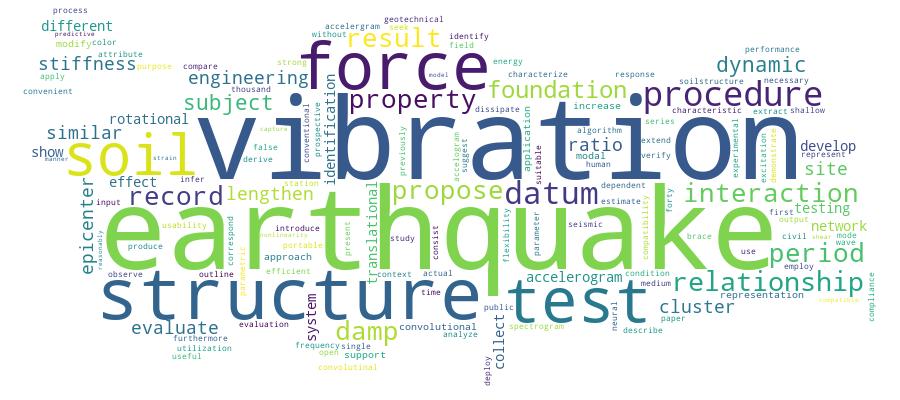
Competency Cloud

GCRIS Competency Cloud

Scholarly Output Search Results

Now showing 1 - 3 of 3
  • Article
    Citation - WoS: 24
    Citation - Scopus: 27
    Evaluation of Soil-Structure Interaction Effects From System Identification of Structures Subject To Forced Vibration Tests
    (Elsevier Sci Ltd, 2019) Tileylioglu, Salih; Givens, Michael J.; Mylonakis, George; Stewart, Jonathan P.; Star, Lisa M.
    We describe procedures to evaluate the dynamic properties of test structures subject to forced vibration testing. We seek modal vibration periods and damping ratios corresponding to the actual flexible-based response of the structure (incorporating the effects of compliance in the soil medium supporting the foundation) and similar attributes for a fixed-base condition in which only the flexibility of the structure is represented. Our approach consists of using suitable input and output time series with conventional parametric system identification procedures, and as such extends previously developed procedures for use with earthquake recordings. We verify the proposed approach and demonstrate its application using data from two test structures supported on shallow foundations that have been used in forced vibration tests and that have recorded earthquakes. The structures were tested with and without braces to modify their stiffness and were deployed at two sites with different soil conditions. We analyze the results to evaluate experimental period lengthening ratios and foundation damping. The results show (1) strong increases in period lengthening and foundation damping with the wave parameter (dimensionless ratio of structure-to-soil stiffness), (2) compatibility between modal properties from forced vibration testing and earthquake excitation, (3) soil nonlinearity increases period lengthening and modifies foundation damping in a manner that can be reasonably captured in predictive models using equivalent-linear soil properties compatible with a proposed shear strain index.
  • Conference Object
    Representing Earthquake Accelerogram Records for Cnn Utilization
    (Ieee, 2020) Cikis, Melis; Tileyoglu, Salih; Akagunduz, Erdem
    In this study, a spectrogram based false color representation of earthquake accelergrams is proposed and its usability for both human investigation and its application in convolutional networks are discussed. By using more than forty two thousand earthquake records open to the public, an epicenter clustering algorithm was employed, and it was observed that earthquakes in similar clusters produce similar representations. The prospective purpose of the proposed representation is to estimate the epicenter of an earthquake by processing the accelerograms recorded in a single station using convolutional networks.
  • Article
    Force-Displacement and Moment-Rotation Relationships in the Context of Dynamic Soil-Structure Interaction
    (2018) M. Star, Lisa; Givens, Michael J.; Tileylioglu, Salih
    In this paper, we evaluate force-displacement and moment-rotation relationships to characterize dynamic soil stiffness and damping properties of structures subject to forced vibration loading. We first introduce a procedure to extract the necessary data to develop such relationships from forced vibration testing data. This procedure is then applied to data collected from forced vibration tests on a portable test structure at two different soil sites in California. The results show that the outlined procedure is useful in identifying soilstructure interaction characteristics and is a convenient way of presenting field performance data from forced vibration testing. For the data from the two sites collected, the derived relationships infer that rotational stiffness is more frequency dependent than the translational stiffness. Furthermore, the results suggest that the translational mode was more efficient in dissipating energy compared to the rotational mode.