
Bayrak, Özlem
Loading...
Profile URL
Name Variants
Bayrak, Ö.T. & Türker, Özlem & Bayrak, Ozlem Tuker & Bayrak, Özlem Türker & Türker Bayrak, Özlem & Bayrak, Ozlem Turker & Bayrak, Oezlem Tuerker & Bayrak, O.T. & Bayrak, O. Turker
Job Title
Doç. Dr.
Email Address
ozlemt@cankaya.edu.tr
Main Affiliation
Ortak Dersler Bölümü
Status
Current Staff
Website
ORCID ID
Scopus Author ID
Turkish CoHE Profile ID
Google Scholar ID
WoS Researcher ID
Files
Sustainable Development Goals
 1
1NO POVERTY
0
Research Products
 2
2ZERO HUNGER
0
Research Products
 3
3GOOD HEALTH AND WELL-BEING
0
Research Products
 4
4QUALITY EDUCATION
1
Research Products
 5
5GENDER EQUALITY
0
Research Products
 6
6CLEAN WATER AND SANITATION
0
Research Products
 7
7AFFORDABLE AND CLEAN ENERGY
1
Research Products
 8
8DECENT WORK AND ECONOMIC GROWTH
0
Research Products
 9
9INDUSTRY, INNOVATION AND INFRASTRUCTURE
0
Research Products
 10
10REDUCED INEQUALITIES
0
Research Products
 11
11SUSTAINABLE CITIES AND COMMUNITIES
0
Research Products
 12
12RESPONSIBLE CONSUMPTION AND PRODUCTION
0
Research Products
 13
13CLIMATE ACTION
0
Research Products
 14
14LIFE BELOW WATER
1
Research Products
 15
15LIFE ON LAND
0
Research Products
 16
16PEACE, JUSTICE AND STRONG INSTITUTIONS
0
Research Products
 17
17PARTNERSHIPS FOR THE GOALS
0
Research Products

This researcher does not have a Scopus ID.

This researcher does not have a WoS ID.
No records found in other affiliations.

Scholarly Output
28
Articles
13
Views / Downloads
2717/233
Supervised MSc Theses
1
Supervised PhD Theses
0
WoS Citation Count
69
Scopus Citation Count
70
Patents
0
Projects
0
WoS Citations per Publication
2.46
Scopus Citations per Publication
2.50
Open Access Source
7
Supervised Theses
1
| Journal | Count |
|---|---|
| Applied Acoustics | 2 |
| 1st International Symposium on Fuzzy Systems -- OCT 01-02, 2009 -- Ankara, TURKEY | 1 |
| 35th International Conference on Computers and Industrial Engineering | 1 |
| 35. Ulusal Yöneylem Araştırması ve Endüstri Mühendisliği Kongresi | 1 |
| 58th World Statistical Congress | 1 |
Current Page: 1 / 6
Scopus Quartile Distribution
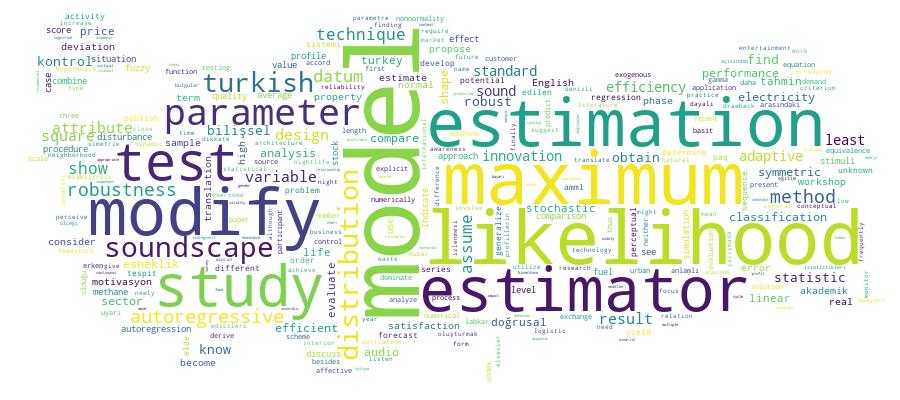
Competency Cloud
28 results
Scholarly Output Search Results
Now showing 1 - 10 of 28
Article Citation - WoS: 8Citation - Scopus: 12Estimating Parameters of a Multiple Autoregressive Model by the Modified Maximum Likelihood Method(Elsevier, 2010) Bayrak, Oezlem Tuerker; Akkaya, Aysen D.We consider a multiple autoregressive model with non-normal error distributions, the latter being more prevalent in practice than the usually assumed normal distribution. Since the maximum likelihood equations have convergence problems (Puthenpura and Sinha, 1986) [11], we work Out modified maximum likelihood equations by expressing the maximum likelihood equations in terms of ordered residuals and linearizing intractable nonlinear functions (Tiku and Suresh, 1992) [8]. The solutions, called modified maximum estimators, are explicit functions of sample observations and therefore easy to compute. They are under some very general regularity conditions asymptotically unbiased and efficient (Vaughan and Tiku, 2000) [4]. We show that for small sample sizes, they have negligible bias and are considerably more efficient than the traditional least Squares estimators. We show that Our estimators are robust to plausible deviations from an assumed distribution and are therefore enormously advantageous as compared to the least squares estimation. We give a real life example. (C) 2009 Elsevier B.V. All rights reserved.Conference Object Citation - Scopus: 3Autoregressive Models With Stochastic Design Variables and Nonnormal Innovations(2011) Bayrak, O.T.; Akkaya, A.D.In autoregression models the design variable has traditionally been assumed to be non-stochastic and innovations are normal. In most real life situations, however, the design variable is stochastic having a non-normal distribution as the innovations. Modified maximum likelihood method is utilized to estimate unknown parameters in such situations. Closed form estimators are obtained and shown to be efficient and robust.Conference Object Global Krizler için Doğrusal Profillere Dayalı Kontrol Şemaları ile Oluşturulan Erken Uyarı Sistemi(2015) Türker Bayrak, Özlem; Aytaçoğlu, Burcu; Yüksel Haliloğlu, EbruConference Object Citation - WoS: 2Citation - Scopus: 1Inter-Laboratory Comparison Scheme for Fuel Sector, Labkar in Turkey(Springer, 2009) Bayrak, Ozlem Turker; Okandan, Ender; Uckardes, HaleFuel sector is one of the powerful sectors in Turkish industry. The implementation of a new law for regulating the fuel sector had enforced the quality control of fuels sold to public. This resulted in several accredited fuel-testing laboratories to emerge. Thus, a scheme to evaluate their proficiency in measurements became an important requirement. The inter-laboratory comparison scheme LABKAR for gasoline, diesel oil, LPG, lubricating oil and biodiesel samples have evolved to fulfill this need. In this paper, LABKAR is introduced; the results obtained from the program are analyzed and discussed. The kernel densities of the participants' results show that the use of robust mean as a consensus value is appropriate for fuel samples. Although the number of rounds is not enough to derive strict conclusions, it is seen that the performance of the scheme based on the standard deviations and coefficient of variations is improving in each round. It has been observed that the number of laboratories receiving "action" or "warning" is decreasing, which indicates that they are benefiting from the scheme.Article Citation - WoS: 1Citation - Scopus: 1Coexistence of Urban Nightlife Activities With Residential Areas: a Mixed-Use Neighborhood Case From Denizli, Türkiye(American Society of Civil Engineers (ASCE), 2025) Orhan, Ezgi; Yilmaz, Gokce; Bayrak, Ozlem Turker; Türker Bayrak, Özlem; Yllmaz, GökçeSince the relationship between work and leisure has been reorganized as an outcome of postmodern everyday life, the nighttime has been a brightened subject for the local development agenda and revitalization policies of decayed urban centers. Even though the night activities accompanied by the leisure and entertainment industry have been prioritized to meet the increasing demand, their amalgamation with residential uses tends to lead to contradictory consequences, and the preservation of residents' quality of life needs tailored policies. Departing from the conflictive demands on urban nightscape, this study aims to reveal the satisfaction of entrepreneurs and residents coexisting in a neighborhood. To show the social, spatial, and temporal impacts of the extension of nocturnal activities, empirical research was conducted at the neighborhood level in Denizli, T & uuml;rkiye, data from 50 firms through snowball sampling were gathered through in-depth interviews and questionnaires, and a sample of 140 households were selected through stratified random sampling. For the analytical procedure, in addition to the descriptive statistics indicating business and household profiles, satisfaction levels with doing night business and residing in the neighborhood were inquired. Findings suggested that entertainment enterprises tended to cluster in newly developed areas to benefit from the proximity advantages to customers and support the expansion of central districts, and residents showed high satisfaction levels from the vitality ignited by night activities. Also, residents' overall satisfaction was found to be associated with the economic effects of nightlife and their attachment to the neighborhood. A policy frame is presented for socially sustainable nighttime activities targeting potential investors and decision makers and for preventing the old core's decay.Conference Object Estimation of AR(1) Model Having Generalized Logistic Disturbances(2020) Akkaya, Ayşen; Türker Bayrak, ÖzlemNon-normality is becoming a common feature in real life applications. Using non-normal disturbances in autoregressive models induces non-linearity in the likelihood equations so that maximum likelihood estimators cannot be derived analytically. Thus, modified maximum likelihood estimation (MMLE) technique is introduced in literature to overcome this difficulty. However, this method assumes the shape parameter to be known which is not realistic in real life. Recently, for unknown shape parameter case, adaptive modified maximum likelihood estimation (AMMLE) method that combines MMLE with Huber estimation method is suggested in literature. In this study, we adopt AMMLE method to AR(1) model where the disturbances are Generalized Logistic distributed. Although Huber M-estimation is not applicable to skew distributions, the AMMLE method extends Huber type work to skew distributions. We derive the estimators and evaluate their performance in terms of efficiArticle Adaptive Estimation of Autoregression Models Under Long-Tailed Symmetric Distribution(Taylor & Francis inc, 2024) Yentur, Begum; Akkaya, Aysen D.; Bayrak, Ozlem TurkerNon-normal innovations in autoregression models frequently occur in practice. In this situation, least squares (LS) estimators are known to be inefficient and non-robust, and maximum likelihood (ML) estimators need to be solved numerically, which becomes a daunting task. In the literature, the modified maximum likelihood (MML) estimation technique has been proposed to obtain the estimators of model parameters. While an explicit solution can be found via this method, the requirement of knowing the shape parameter becomes a drawback, especially in machine learning. In this study, we use the adaptive modified maximum likelihood (AMML) methodology, which combines the MML with Huber's M-estimation so that this assumption is relaxed. The performance of the method in terms of efficiency and robustness is analyzed via simulation and compared to LS, MML and ML estimates that are obtained numerically via the Expectation Conditional Maximization (ECM) algorithm. Test statistics are proposed for the crucial parameters of the model. The results show that the AMML estimators are preferable in most of the settings according to the mean squared error (MSE) criterion and the test statistics based on AMML method are more robust than the others. Furthermore, both real life and synthetic data examples are given.Article Citation - WoS: 1Citation - Scopus: 1Effect of Estimation Under Nonnormality on the Phase Ii Performance of Linear Profile Monitoring Approaches(Wiley, 2019) Aytacoglu, Burcu; Bayrak, Ozlem Turker; Türker Bayrak, ÖzlemThe number of studies about control charts proposed to monitor profiles, where the quality of a process/product is expressed as function of response and explanatory variable(s), has been increasing in recent years. However, most authors assume that the in-control parameter values are known in phase II analysis and the error terms are normally distributed. These assumptions are rarely satisfied in practice. In this study, the performance of EWMA-R, EWMA-3, and EWMA-3(d(2)) methods for monitoring simple linear profiles is examined via simulation where the in-control parameters are estimated and innovations have a Student's t distribution or gamma distribution. Instead of the average run length (ARL) and the standard deviation of run length, we used average and standard deviation of the ARL as performance measures in order to capture the sampling variation among different practitioners. It is seen that the estimation effect becomes more severe when the number of phase I profiles used in estimation decreases, as expected, and as the distribution deviates from normality to a greater extent. Besides, although the average ARL values get closer to the desired values as the amount of phase I data increases, their standard deviations remain far away from the acceptable level indicating a high practitioner-to-practitioner variability.Article Citation - Scopus: 1Linear Contrasts in One-Way Classification Ar(1) Model With Gamma Innovations(Hacettepe Univ, Fac Sci, 2016) Senoglu, Birdal; Bayrak, Ozlem TurkerIn this study, the explicit estimators of the model parameters in oneway classification AR(1) model with gamma innovations are derived by using modified maximum likelihood (MML) methodology. We also propose a new test statistic for testing linear contrasts. Monte Carlo simulation results show that the MML estimators have higher efficiencies than the traditional least squares (LS) estimators and the proposed test has much better power and robustness properties than the normal theory test.Article Citation - WoS: 2Citation - Scopus: 2Evaluation of the Turkish Soundscape Circumplex Model, and the Effects of Sound Source Dominance, Sequence, and Gender on the Perceived Affective Quality(Elsevier Sci Ltd, 2024) Yorukoglu, Papatya Nur Dokmeci; Bayrak, Ozlem Turker; Coban, Nilguen Akbulut; Osma, Ugur Beyza Ercakmak; Nur Dökmeci Yörükoğlu, Papatya; Beyza Erçakmak Osma, Uğur; Türker Bayrak, Özlem; Akbulut Çoban, NilgünThe International Standard Organization (ISO) standards series on soundscape for the identification, data collection and data analysis present a general framework for the soundscape studies that are conducted globally. Perceived Affective Qualities (PAQs) including 8 soundscape perceptual attributes in ISO/TS 12913-2:2018 and ISO/TS 12913-3:2019 are published in English language. Therefore, the 'Soundscape Attributes Translation Project' focuses on the reliable standardized translations of the PAQs in other languages. In the previously published Turkish translation and validation study, the PAQs were presented as; 'hareketli' (eventful), 'coskulu' (vibrant), 'keyifli' (pleasant), 'sakin' (calm), 'dura.gan' (uneventful), 'tekduze' (monotonous), 'rahatsiz edici' (annoying), and 'karmas ik' (chaotic). Within the scope of this follow-up study, firstly, sound sources in each audio stimulus are identified according to their dominance to explore their relation with the Soundscape Circumplex Model (SCM) quadrants and found that the human dominant audio stimuli are evaluated as 'vibrant' in SCM. Other noise dominating audio stimuli are categorized as 'monotonous' while traffic combined with other noise audio stimuli are evaluated as 'chaotic'. When the audio stimuli evaluated as 'calm' are investigated, they are either purely dominated by natural sounds or mixture of each category dominated by natural sounds. Secondly, a comparison between the Turkish and the English participants' evaluation of audio stimuli according to the SCM is done and found that they are similar except two audio stimuli. Furthermore, the effect of audio stimulus sequence and gender on 8 PAQs are statistically analysed through Kruskall-Wallis and Mann-Whitney tests; respectively and found that both are significant. The sequences shifting from 'chaotic' to 'calm' or vice versa frequently are seen to be evaluated with higher scores whereas more homogenous ones in sequence, i.e. audio stimuli having the same dominating sound source are sequenced together mostly are graded with lower scores of 8 PAQs except 'chaotic' compared to drastic changes in the sound source and found that men grade 'cos kulu' (vibrant), 'dura.gan' (uneventful), 'tekduze' (monotonous), 'rahatsiz edici' (annoying) and 'karmasik' (chaotic) more than women by 5, 11, 24, 8 and 10 points, respectively according to the median values. Finally, conformance to the SCM is evaluated by the principal component analysis (PCA) and found that it can be reduced to two dimensions named as "pleasantness" and "eventfulness" in expected order but the main PAQs pleasant-annoying and eventful-uneventful are not aligned indicating the lack of achieving the ideal circumplexity. It is believed that the results of this study could contribute to both national and international future soundscape research with a focus on listening tests applying PAQs.
- «
- 1 (current)
- 2
- 3
- »