Bilgilendirme: Kurulum ve veri kapsamındaki çalışmalar devam etmektedir. Göstereceğiniz anlayış için teşekkür ederiz.
 

Özmen, Cengiz

Loading...
Profile Picture
Name Variants
Ozmen, Cengiz
Job Title
Doç. Dr.
Email Address
cengizozmen@cankaya.edu.tr
Main Affiliation
05.02. Mimarlık
Mimarlık
05. Mimarlık Fakültesi
01. Çankaya Üniversitesi
Status
Current Staff
Website
Scopus Author ID
Turkish CoHE Profile ID
Google Scholar ID
WoS Researcher ID

Sustainable Development Goals

4

QUALITY EDUCATION
QUALITY EDUCATION Logo

2

Research Products

8

DECENT WORK AND ECONOMIC GROWTH
DECENT WORK AND ECONOMIC GROWTH Logo

1

Research Products

11

SUSTAINABLE CITIES AND COMMUNITIES
SUSTAINABLE CITIES AND COMMUNITIES Logo

2

Research Products

12

RESPONSIBLE CONSUMPTION AND PRODUCTION
RESPONSIBLE CONSUMPTION AND PRODUCTION Logo

2

Research Products
Documents

6

Citations

59

h-index

4

Documents

8

Citations

93

Scholarly Output

8

Articles

6

Views / Downloads

401/93

Supervised MSc Theses

1

Supervised PhD Theses

0

WoS Citation Count

10

Scopus Citation Count

8

WoS h-index

2

Scopus h-index

2

Patents

0

Projects

0

WoS Citations per Publication

1.25

Scopus Citations per Publication

1.00

Open Access Source

3

Supervised Theses

1

Google Analytics Visitor Traffic

JournalCount
Current Page: 1 / NaN

Scopus Quartile Distribution

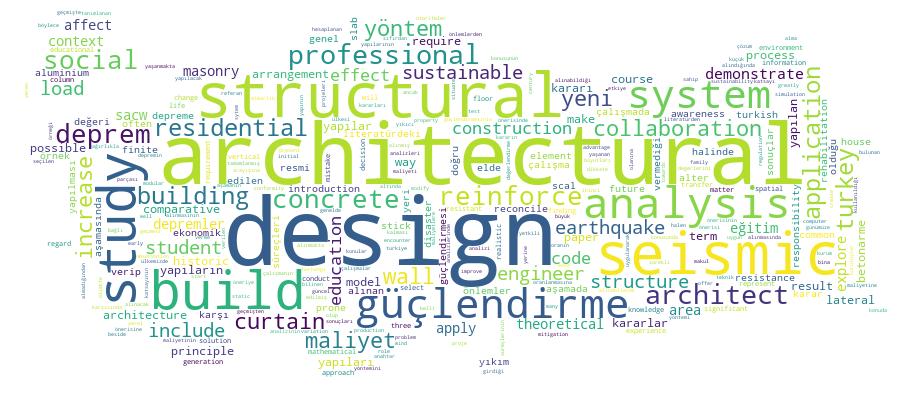
Competency Cloud

GCRIS Competency Cloud

Scholarly Output Search Results

Now showing 1 - 8 of 8
  • Article
    Architectural Design - Structural System Conformity Problems Encountered in the Design and Application Processes of Stick Aluminium Curtain Wall Systems in Turkey
    (Gazi Univ, Fac Engineering Architecture, 2022) Ozmen, Cengiz; Saban, Muge
    Stick aluminium curtain wall (SACW) systems are common curtain wall systems in Turkey. These sytems offer many advantages including architectural variation, modular design, ease of production and assembly. Beside their architectural properties SACW systems create significant load effects on structural systems. These load effects include lateral loads such as seismic and wind loads as well as static vertical loads. This load transfer is not one way. The vertical and lateral displacements of building structures also act on curtain walls. Healthy load transfer between the SACW and the building depends on architectural decisions during the design and construction process. Due to their wide use SACW systems are prone to architectural mistakes. These mistakes often represent themselves at latter stages of the construction and require solutions which will affect the architectural characteristics and structural behavior of buildings. This study focuses on SACW design and construction processes to find the effects of architectural decisions on curtain wall behavior. Case studies that include architectural design mistakes are selected to classify and study the reasons and the solutions of these mistakes. The importance of cooperation between all the stakeholders including the architects and engineers is emphasized for the prevention of these mistakes.
  • Conference Object
    A Comparative Structural, Architectural and Cost-Based Analysis of Seismic Design Principles Applied in Reinforced Concrete Residential Buildings in Turkey
    (Crc Press-taylor & Francis Group, 2010) Ozmen, C.; Özmen, Cengiz; Mimarlık
    This study demonstrates that it is possible to design earthquake resistant reinforced concrete residential structures without significant compromises in the spatial quality and economic viability of the building. The study addresses architects, structural engineers and private entrepreneurs who are the important players in the Turkish construction industry. In structural analyses, a set of four parametric mathematical models are used to demonstrate the effects of increased column cross-sections and use of shear-walls on the seismic performance of reinforced concrete structures. Architectural analyses are carried-out through three case-studies selected from the earthquake affected city of Bolu in Turkey. Cost-based analyses demonstrated that it is possible to design earthquake resistant reinforced concrete residential buildings with a 4-6% increase in the building cost and an economically acceptable 10% decrease in profits.
  • Article
    Increasing Social Awareness and Professional Collaboration in Architectural Education Towards a Sustainable and Disaster-Free Future
    (2013) Özmen, Cengiz
    The aim of this study is to explore ways of increasing the social and professional awareness of students of architecture to educate a new generation of architects who are familiar with the concepts of social responsibility, professional collaboration, sustainable development and disaster mitigation. Turkey experiences a rapid social change due to the urban regeneration, population movements, environmental changes, new technologies and professional diversification. These phenomenon affect all aspects of life. This study explores the possibilities for applying new methods of teaching in schools of architecture to train a generation of architects who will be in tune with this new, ever-changing socio-cultural environment in Turkey. A study lasting one educational term of 14 weeks was conducted on a group of 15 second year students of architecture. A structural design course which previously had a purely theoretical and mathematical approcah to the subject matter was altered to contain background information regarding social context such as the photos, videos and narratives of earthquake affected areas of Turkey. This was done to introduce the students with the reality of the built environment and professional life in Turkey. Additionally small-scale applied projects were given as semester tasks to the students where they can experience a scaled but realistic application of the theoretical knowledge into reality. These two approaches were supplemented with theoretical knowledge to prepare the students for professional life in a realistic manner. A sudden increase in student attention and participation to the course was observed both in matters concrening the professional application and social context of their architectural projects. These findings were consistent with a previous study conducted by the author. The findings of this experimental application have resulted in a revision of the educational curriculum concerning the structural design courses to permanently include information regarding the social context and practical application of theoretical projetcs.
  • Article
    Citation - WoS: 4
    Citation - Scopus: 4
    Architect - Structural Engineer Collaboration in Sustainable Structural System Design
    (Gazi Univ, 2011) Ozmen, Cengiz; Özmen, Cengiz; Unay, Ali Ihsan; Mimarlık
    This paper explores ways of collaboration between architects and structural engineers in the design of sustainable structural systems. Areas of collaboration are explored in terms of seismic design of new structures and rehabilitation of existing structures. Multidisciplinary design teams and an integrated design approach are critical to the process of sustainable building construction. The required group-work skills should be acquired by architects and engineers during their professional education. As a result, this paper also investigates ways in which the structural design education of architects and structural engineers can be redesigned to make their future professional collaboration more harmonious.
  • Article
    Citation - WoS: 5
    Citation - Scopus: 4
    Analysis of a Historic Masonry Building
    (Croatian Soc Civil Engineers-hsgi, 2011) Ozmen, Cengiz; Özmen, Cengiz; Akan, Asli Er; Akan, Aslı; Unay, Ali Ihsan; Mimarlık
    The paper starts from the observation that historic masonry buildings are often modified and altered to make them fit for present day use. A single-family masonry house in Turkey, situated in an earthquake prone area and built in the early 20(th) century, is studied. The analysis is made based on Turkish regulations for the initial building and for the building after alterations. Introduction of a reinforced-concrete slab has greatly improved seismic resistance of the building.
  • Article
    Citation - WoS: 1
    Reconciling Architectural Design With Seismic Codes a Comparative Architectural Analysis for Mid-Rise Reinforced Concrete Residential Buildings in Turkey
    (Univ Zagreb Fac Architecture, 2021) Ozmen, Cengiz
    Seismic codes include strict requirements for the design and construction of mid-rise reinforced concrete residential buildings. These requirements call for the symmetric and regular arrangement of the structural system, increased cross-sections for columns, and the introduction of shear walls to counteract the effects of lateral seismic loads. It is challenging for architects to reconcile the demands of these codes with the spatial arrangement and commercial appeal of their designs. This study argues that such reconciliation is possible through an architectural analysis. First, the effectiveness of applying the seismic design principles required by the codes is demonstrated with the comparative analysis of two finite element models. Then three pairs of architectural models, representing the most common floor plan arrangements for such buildings in Turkey, are architecturally analyzed before and after the application of seismic design principles in terms of floor area and access to view. The results demonstrate that within the context defined by the methodology of this study, considerable seismic achievement can be achieved in mid-rise reinforced concrete residential buildings by the application of relatively few, basic design features by the architects.
  • Master Thesis
    New Method Proposal for Cost Analysis of Earthquake Strengthening Processes of Reinforced Concrete Educational Buildings in Turkey: Example of Educational Buildings in Istanbul
    (2024) Serin, İshak Tunahan; Özmen, Cengiz
    Türkiye bir deprem ülkesi olup sürekli olarak depremler yaşamaktadır. Bu depremler küçük ve büyük ölçekte yıkıcı etkiye sahip olabilmektedirler. Geçmişte yaşanan ve halen yaşanmakta olan depremler dikkate alındığında Türkiye' nin depremler karşısında belli önlemler alma konusunda birçok kez çözüm arayışına girdiği görülmektedir. Bu önlemlerden yapılar için alınabilecek olanına deprem güçlendirmesi denilmektedir. Bu çalışmada, Türkiye' de depreme karşı alınan önlemler, depremin boyutları, deprem ve deprem güçlendirmesinin literatürdeki yeri, geçmişten günümüze genel ve yerel otoriteler, yetkili kurum ve kuruluşlar tarafından bu konuda yapılan çalışmalar ve betonarme yapıların güçlendirme, proje ve maliyet süreçleri gibi konular incelenecektir. Yapılan bu çalışma ile genel olarak literatürdeki yeri tanımlanan deprem konusunun bir parçası olan yapıların deprem güçlendirme maliyet süreçleri irdelenecektir. Ülkemizde teknik olarak depreme karşı güçlendirmesi uygun bulunan bir bina için güçlendirme veya yıkım kararı alınmasında son aşamanın maliyet analizinin yapılması olduğu bilinmektedir. Yapılan maliyet analizlerinde bu kararın alınmasının, yapının güçlendirme maliyetinin sıfırdan yapılması maliyetine oranlanmasına bağlı olduğu bilinmektedir. Genelde elde edilen bu oranın %40 'ı geçmesi halinde yapılar için yıkım kararı alınmakta, %40' ın altında kalması halinde ise yapılar için güçlendirme kararı alınabildiği bilinmektedir. Ancak bu yöntem herhangi bir ekonomik değerlendirme yöntemini referans almadığından, ağırlıkla doğru sonuçları vermemektedir. Bu çalışmada, karar aşamasında kullanıldığı bilinen %40 değeri ile karar verme yöntemi yerine yeni bir yöntem önerisinde bulunulacaktır. Yapılacak çalışma için güçlendirme projeleri tamamlanmış ve resmi kararları alınmış İstanbul'daki eğitim yapıları örnek olarak seçilmiştir. Çalışmanın ilk aşamasında örnek olarak seçilen yapıların güncel ekonomik değerlerini veren yeni bir yöntem önerisi incelenecektir. Ikinci aşamada, literatürden elde edilen bu öneriye ek olarak hesaplanan yeni bir katsayı önerilecektir. Son aşamada ise bu katsayının, maliyetlere uygulanarak makul sonuçlar verip vermediği incelencektir. Yeni yöntem önerisine göre alınacak kararlar, alınan resmi kararlar ve %40 değeri ile verilen kararlar ile kıyaslanacaktır. Böylece yeni yöntem önerisinin doğru sonuçlar verip vermediği test edilmiş olacaktır. Anahtar Kelimeler: Deprem, güçlendirme, güçlendirme maliyeti, maliyet analizi, betonarme eğitim yapıları