Bilgilendirme: Kurulum ve veri kapsamındaki çalışmalar devam etmektedir. Göstereceğiniz anlayış için teşekkür ederiz.
 

Büke, Z.Göknur

Loading...
Profile Picture
Name Variants
Buke, Goknur C.
Buke, Göknur Cambaz
Buke, Goknur Cambaz
Job Title
Yrd. Doç. Dr.
Email Address
goknur@cankaya.edu.tr
Main Affiliation
06.07. Malzeme Bilimi ve Mühendisliği
Malzeme Bilimi ve Mühendisliği
06. Mühendislik Fakültesi
01. Çankaya Üniversitesi
Status
Former Staff
Website
ORCID ID
Scopus Author ID
Turkish CoHE Profile ID
Google Scholar ID
WoS Researcher ID

Sustainable Development Goals

SDG data is not available
This researcher does not have a Scopus ID.
This researcher does not have a WoS ID.
Scholarly Output

3

Articles

2

Views / Downloads

604/14

Supervised MSc Theses

0

Supervised PhD Theses

0

WoS Citation Count

3

Scopus Citation Count

4

WoS h-index

1

Scopus h-index

1

Patents

0

Projects

0

WoS Citations per Publication

1.00

Scopus Citations per Publication

1.33

Open Access Source

0

Supervised Theses

0

Google Analytics Visitor Traffic

JournalCount
Carbon Nanomaterials, 2nd Edition1
Carbon Nanomaterials, Second Edition1
Journal of Materials Research1
Current Page: 1 / 1

Scopus Quartile Distribution

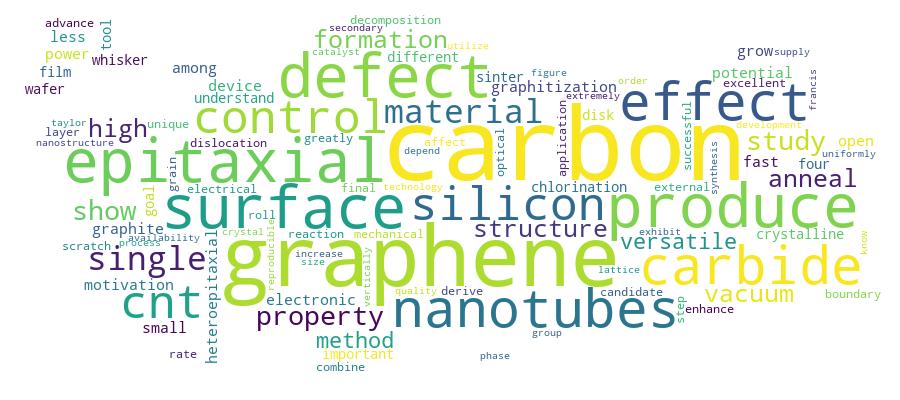
Competency Cloud

GCRIS Competency Cloud

Scholarly Output Search Results

Now showing 1 - 3 of 3
  • Book Part
    Epitaxial Graphene and Carbon Nanotubes on Silicon Carbide
    (Crc Press-taylor & Francis Group, 2014) Buke, Goknur C.; Buke, Goknur C.
    Graphene (i.e., a single layer of graphite) and carbon nanotubes (CNTs; i.e., graphene rolled into a cylinder) are excellent candidate materials for advanced applications because of their unique electrical, optical, and mechanical properties combined with a high surface area. The successful development of graphene-/CNT-based technology depends on large-scale availability of the high-quality, reproducible, and uniformly ordered material. One of the most versatile methods to produce vertically, self-aligned CNTs and epitaxial graphene is the vacuum annealing of silicon carbide single crystals [1,2]. This is a very versatile method because carbon is supplied from the carbide lattice as known from the synthesis of carbide-derived carbons (CDCs, see Figure 4.1) and, as no catalysts or secondary phases are utilized; the produced graphene and CNTs exhibit extremely high purity. However, to increase the grain/domain size and quality of these carbon nanostructures, further control of the process is needed. © 2014 by Taylor & Francis Group, LLC.
  • Article
    Citation - WoS: 3
    Citation - Scopus: 4
    Effect of Defects on Graphitization of Sic
    (Cambridge Univ Press, 2013) Buke, Goknur Cambaz; Yushin, Gleb; Mochalin, Vadym; Gogotsi, Yury
    Epitaxial graphene and carbon nanotubes (CNTs) grown on SiC have shown big potential in electronics. The motivation to produce faster and smaller electronic devices using less power opened the way to a study of how to produce controlled epitaxial graphene and CNTs on SiC. Since defects are among the important tools to control the properties of materials, the effects of defects on the carbon formation on SiC have been analyzed. In this study, the effects of defects on the carbon formation on SiC have been analyzed. We produced carbon films on the surface of four different SiC materials (polycrystalline sintered SiC disks, single crystalline SiC wafers, SiC whiskers, and nanowhiskers) by chlorination and vacuum annealing with the goal to understand the effects of surface defects on the carbon structure and the SiC decomposition rate. We have shown that grain boundaries, dislocations, scratches, surface steps, and external surfaces may greatly enhance the reaction rate and affect the final structure of carbon derived from SiC.
  • Article
    Epitaxial Graphene and Carbon Nanotubes on Silicon Carbide
    (CRC Press-Taylor & Francis Group, 2014) Buke, Göknur Cambaz