Bilgilendirme: Kurulum ve veri kapsamındaki çalışmalar devam etmektedir. Göstereceğiniz anlayış için teşekkür ederiz.
 

Ceylan, Emine Burcu

Loading...
Profile Picture
Name Variants
Eryılmaz, Burcu
Eryilmaz, E. Burcu
Job Title
Arş. Gör.
Email Address
burcueryilmaz@cankaya.edu.tr
Main Affiliation
İç Mimarlık
Status
Current Staff
Website
Scopus Author ID
Turkish CoHE Profile ID
Google Scholar ID
WoS Researcher ID

Sustainable Development Goals

1

NO POVERTY
NO POVERTY Logo

13

Research Products

2

ZERO HUNGER
ZERO HUNGER Logo

2

Research Products

3

GOOD HEALTH AND WELL-BEING
GOOD HEALTH AND WELL-BEING Logo

9

Research Products

4

QUALITY EDUCATION
QUALITY EDUCATION Logo

10

Research Products

5

GENDER EQUALITY
GENDER EQUALITY Logo

27

Research Products

7

AFFORDABLE AND CLEAN ENERGY
AFFORDABLE AND CLEAN ENERGY Logo

10

Research Products

8

DECENT WORK AND ECONOMIC GROWTH
DECENT WORK AND ECONOMIC GROWTH Logo

83

Research Products

9

INDUSTRY, INNOVATION AND INFRASTRUCTURE
INDUSTRY, INNOVATION AND INFRASTRUCTURE Logo

30

Research Products

10

REDUCED INEQUALITIES
REDUCED INEQUALITIES Logo

62

Research Products

11

SUSTAINABLE CITIES AND COMMUNITIES
SUSTAINABLE CITIES AND COMMUNITIES Logo

3

Research Products

12

RESPONSIBLE CONSUMPTION AND PRODUCTION
RESPONSIBLE CONSUMPTION AND PRODUCTION Logo

12

Research Products

13

CLIMATE ACTION
CLIMATE ACTION Logo

7

Research Products

14

LIFE BELOW WATER
LIFE BELOW WATER Logo

7

Research Products

15

LIFE ON LAND
LIFE ON LAND Logo

3

Research Products

16

PEACE, JUSTICE AND STRONG INSTITUTIONS
PEACE, JUSTICE AND STRONG INSTITUTIONS Logo

29

Research Products

17

PARTNERSHIPS FOR THE GOALS
PARTNERSHIPS FOR THE GOALS Logo

82

Research Products
This researcher does not have a Scopus ID.

Google Analytics Visitor Traffic

JournalCount
Current Page: 1 / NaN

Scopus Quartile Distribution

Competency Cloud

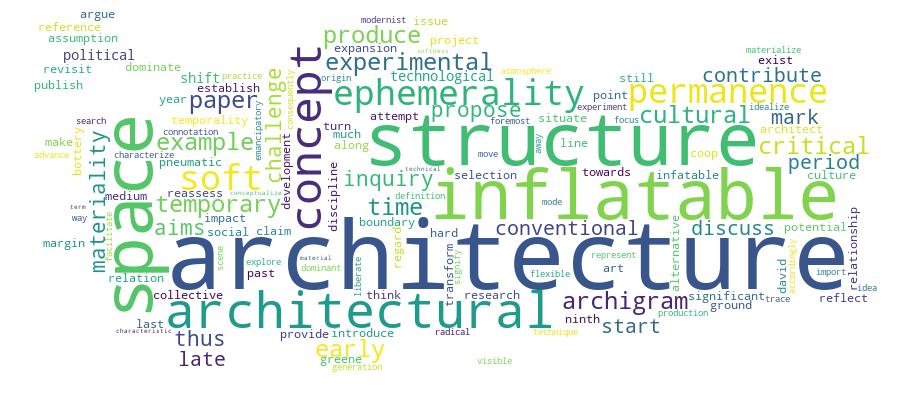
GCRIS Competency Cloud

Scholarly Output Search Results

Now showing 1 - 3 of 3
  • Book Part
    Soft Spaces: Towards a New Materiality in Architecture
    (Caleidoscopio Authors, 2021) Eryılmaz, Burcu
    The end of the 1960s signifies a shift regarding the materiality of architecture, facilitated by both the technological advances imported into the architectural scene and the emancipatory atmosphere of the 1960s marked with political and cultural upheavals. This shift represents a move away from the dominant modes of space production to the more flexible alternatives, and it is most visible in the experiments of counter-culture architects. During the late 1960s and the early 1970s, this new generation of architects characterized by their radical ideas had been searching for a new materiality to liberate the architectural space from conventional restrictions. Accordingly, the avant-garde architects of this period had started to explore alternative ways towards a “softer” architecture as a challenge to the hard connotations of modernist space. To materialize the shift from hard to soft definitions in architecture, this paper proposes an inquiry into the inflatable architecture idealized by the avant-gardes as the foremost technique for producing soft spaces. In this regard, this paper traces the origins and earlier practices of soft architecture, and thus it focuses on inflatable spaces that had been produced during this period. Consequently, it aims at conceptualizing the softness of architecture by discussing how the material characteristics of inflatable structures contributed to the “softening” of architectural space in terms of both technical and cultural spheres.
  • Article
    Revisiting the Concept of Ephemerality in the Counter-Culture Architecture of the 1960s: In!atable Structures
    (Editura Univ Ion Mincu, 2022) Eryilmaz, E. Burcu; Eryilmaz, E. Burcu
  • Article
    Revisiting the Concept of Ephemerality in the Counter-Culture Architecture of the 1960s: Infatable Structures
    (2022) Eryılmaz, Burcu
    In his 1969 project An Experimental Bottery, published in the ninth issue of Archigram, David Greene introduces time as a concept that has had a significant impact on the arts over the past few years, but not so much on architecture. Still, he proposed the temporary space as the example of “an architecture that exists only with reference to time” by pointing out its potential to last in memory. Along this line of thought, this paper aims to make inquiry into the critical examples of temporary architecture to reflect on how they challenge architecture’s long-standing claim to permanence and thus attempt to transform the conventional relationship between architecture and time. To do so, it discusses a selection of inflatable structures that had been produced by such avant-garde architecture collectives as Archigram, Haus-Rucker-Co, and Coop Himmelb(l)au between the late 1960s and early 1970s. Starting from the assumption that these experimental spaces contribute to the expansion of the established boundaries of the discipline as they are situated at the margins of dominating architectural culture, this research provides a ground to argue how inflatable structures turned into a critical medium to reassess architecture’s relation with time during this period which was marked by technological developments and social, political and cultural upheavals.In his 1969 project An Experimental Bottery, published in the ninth issue of Archigram, David Greene introduces time as a concept that has had a significant impact on the arts over the past few years, but not so much on architecture. Still, he proposed the temporary space as the example of “an architecture that exists only with reference to time” by pointing out its potential to last in memory. Along this line of thought, this paper aims to make inquiry into the critical examples of temporary architecture to reflect on how they challenge architecture’s long-standing claim to permanence and thus attempt to transform the conventional relationship between architecture and time. To do so, it discusses a selection of inflatable structures that had been produced by such avant-garde architecture collectives as Archigram, Haus-Rucker-Co, and Coop Himmelb(l)au between the late 1960s and early 1970s. Starting from the assumption that these experimental spaces contribute to the expansion of the established boundaries of the discipline as they are situated at the margins of dominating architectural culture, this research provides a ground to argue how inflatable structures turned into a critical medium to reassess architecture’s relation with time during this period which was marked by technological developments and social, political and cultural upheavals.