
Dinçkal, Çiğdem
Loading...
Profile URL
Name Variants
Dinckal, Cigdem & Dinckal, C.
Job Title
Dr. Öğr. Üyesi
Email Address
Main Affiliation
İnşaat Mühendisliği
Status
Former Staff
Website
ORCID ID
Scopus Author ID
Turkish CoHE Profile ID
Google Scholar ID
WoS Researcher ID
Sustainable Development Goals
 1
1NO POVERTY
0
Research Products
 2
2ZERO HUNGER
0
Research Products
 3
3GOOD HEALTH AND WELL-BEING
1
Research Products
 4
4QUALITY EDUCATION
0
Research Products
 5
5GENDER EQUALITY
0
Research Products
 6
6CLEAN WATER AND SANITATION
0
Research Products
 7
7AFFORDABLE AND CLEAN ENERGY
2
Research Products
 8
8DECENT WORK AND ECONOMIC GROWTH
0
Research Products
 9
9INDUSTRY, INNOVATION AND INFRASTRUCTURE
0
Research Products
 10
10REDUCED INEQUALITIES
0
Research Products
 11
11SUSTAINABLE CITIES AND COMMUNITIES
0
Research Products
 12
12RESPONSIBLE CONSUMPTION AND PRODUCTION
0
Research Products
 13
13CLIMATE ACTION
0
Research Products
 14
14LIFE BELOW WATER
0
Research Products
 15
15LIFE ON LAND
0
Research Products
 16
16PEACE, JUSTICE AND STRONG INSTITUTIONS
0
Research Products
 17
17PARTNERSHIPS FOR THE GOALS
0
Research Products

This researcher does not have a Scopus ID.

This researcher does not have a WoS ID.
No records found in other affiliations.

Scholarly Output
27
Articles
19
Views / Downloads
2884/937
Supervised MSc Theses
0
Supervised PhD Theses
0
WoS Citation Count
55
Scopus Citation Count
59
Patents
0
Projects
0
WoS Citations per Publication
2.04
Scopus Citations per Publication
2.19
Open Access Source
6
Supervised Theses
0
| Journal | Count |
|---|---|
| International Journal of Pure and Applied Mathematics | 2 |
| Turkish Journal of Electrical Engineering and Computer Sciences | 2 |
| World Congress on Engineering (WCE 2013) -- JUL 03-05, 2013 -- Imperial Coll London, London, ENGLAND | 2 |
| Journal of Innovative Research in Engineering and Science | 2 |
| Computer Applications in Engineering Education | 1 |
Current Page: 1 / 5
Scopus Quartile Distribution
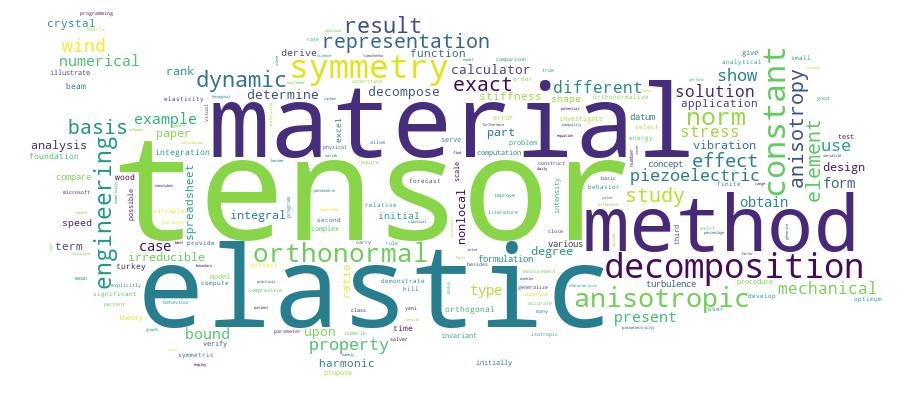
Competency Cloud
27 results
Scholarly Output Search Results
Now showing 1 - 10 of 27
Article Finite Element Modeling for Vibration of Initially Stressed Non-Local Euler-Bernoulli Beams(2016) Dinçkal, ÇiğdemThis paper is concerned with a precise finite element model for vibration analysis of initially stressed micro/nano beams based on nonlocal Euler-Bernoulli and Eringen's nonlocal elasticity theory. For this purpose analytical solutions for the exact dynamic shape functions has been derived by also use of Hamiltonian's principle for the governing equations. The solution is applicable to various initial stresses such as tensile and compressive and scaling effect. The exact dynamic shape functions have been constructed to obtain analytic expressions for the exact dynamic element stiffness matrix components. Numerical results are displayed to indicate the effects of initial stresses and scaling effect parameters on the vibration characteristics of initially stressed clamped nonlocal Euler-Bernoulli beams. For the first time in literature, this study presents such an element formulation that it provides adequate and accurate representation of the vibration behavior of initially stressed micro/nano beams based on nonlocal Euler-Bernoulli beam theory.Article Citation - WoS: 16Citation - Scopus: 15Free Vibration Analysis of Carbon Nanotubes by Using Finite Element Method(Springer, 2016) Dinckal, C.In the present study, an efficient and accurate finite element model for vibration analysis of carbon nanotubes (CNTs) with both Euler-Bernoulli and Timoshenko beam theory has been presented. For this purpose, an analytical solution for the exact dynamic shape functions of CNTs based on both Euler-Bernoulli and Timoshenko beam theories has been derived. The solution is general and is not restricted to a particular range of magnitudes of the nonlocal parameters. The exact dynamic shape functions have been utilized to derive analytic expressions for the coefficients of the exact dynamic (frequency-dependent) element stiffness matrix. Numerical results are presented to figure out the effects of nonlocal parameter, mode number and slenderness ratio on the vibration characteristics of CNTs. It is shown that these results are in good agreement with those reported in the literature. Present element formulation will be useful for structural analyses of nanostructures with complex geometries, loadings, material properties and boundary conditions.Article Lecture Notes in Engineering and Computer Science(Newswood Limited, 2012) Dinçkal, ÇiğdemA new procedure for representation of elastic constant tensor in terms of its orthonormal decomposed parts is presented. Form invariants and orthonormalized basis elements are used to generate this decomposition method. Numerical examples from various engineering materials serve to illustrate and verify the decomposition procedure. The norm concept of elastic constant tensor and norm ratios are used to study the anisotropy of these materials. It is shown that this method allows to investigate the elastic and mechanical properties of an anisotropic material possessing any material symmetry and determine anisotropy degree of that material. For a material given from an unknown symmetry, it is possible to determine its material symmetry type by this method.Article Studies on the Optimum Mechanical Response of Anısotropıc Materials Related to Elastıc Constants(2011) Dinçkal, ÇiğdemIn this paper, mechanical and elastic behaviour of anisotropic materials are investigated in order to understand the optimum mechanical behaviour of them in selected directions. For an anisotropic material with known elastic constants, it is possible to choose the best set of elastic constants (effective elastic constants) which determine the optimum mechanical and elastic properties of it. For this reason, bounds on the anisotropic elastic constants have been constructed symbollicaly for all anisotropic elastic symmetries. As illustrative examples, materials from different symmetries are selected and their elastic constants are used to compute bounds on the anisotropic elastic constants. Finally, by examining numerical results of bounds given in tables, it is seen that the materials selected from the same symmetry type which have larger interval between the bounds, are more anisotropic, whereas some materials which have smaller interval between the bounds, are closer to isotropy. The construction of bounds on anisotropic elastic constants is a significant and critical case in design of any engineering and structural materials.Book Part Harmonic Decomposition of Elastic Constant Tensor and Crystal Symmetry(2014) Dinçkal, ÇiğdemThis paper presents a new outlook on harmonic decomposition method for elastic constant tensor. Harmonic decomposition method is developed in such a way that it is applied to anisotropic engineering materials exhibiting different crystal symmetry. The explicit results for each crystal symmetry types are presented. Numerical examples serve to illustrate and verify the developed method. This new representation of elastic constant tensor is compared with other theories such as orthogonal and non-orthogonal irreducible decompositions in literature. The results demonstrate that there are significant relationships between harmonic, non-orthogonal irreducible and orthogonal irreducible decomposition methods. While in harmonic and non-orthogonal irreducible decomposition methods, decomposition of total scalar part is not orthogonal. It is proposed that it is possible to make these parts orthogonal to each other.Article Exact Forecasting for Covid-19 Data: Case Study for Turkey(World Scientific Publ Co Pte Ltd, 2021) Dinckal, CigdemThe novel coronavirus COVID-19 (SARS-CoV-2) with the first clinical case emerged in the city of Wuhan in China in December 2019. Then it has spread to the entire world in very short time and turned into a global problem, namely, it has rapidly become a pandemic. Within this context, many studies have attempted to predict the consequences of the pandemic in certain countries. Nevertheless, these studies have focused on some parameters such as reproductive number, recovery rate and mortality rate when performing forecasting. This study aims to forecast COVID-19 data in Turkey with use of a new technique which is a combination of classical exponential smoothing and moving average. There is no need for reproductive number, recovery rate and mortality rate computation in this proposed technique. Simulations are carried out for the number of daily cases, active cases (those are cases with no symptoms), daily tests, recovering patients, patients in the intensive care unit, daily intubated patients, and deaths forecasting and results are tested on Mean Absolute Percentage Error (MAPE) criterion. It is shown that this technique captured the system dynamic behavior in Turkey and made exact predictions with the use of real time dataset.Book Part Design of a Versatile and Rapid Calculator for Oncological Computations(Nova Science Publishers, Inc., 2019) Dinçkal, Ç.; Dinçkal, Çiğdem; İnşaat MühendisliğiIn oncology, there exists many complicated and time-consuming computations for students, clinicians and medical researchers. Although many programs generated in Microsoft Excel have been studied many times, the improvements in design of programs are still an issue of concern. So design of calculator becomes essential for practical use. The objective of this study is to design a rapid and versatile calculator named as TGTSCalculator in Microsoft Excel for comprehensive computation of clonogenic cells amount when growth and irradiation for tumor occurred for all tumor growth models and the total amount of relative cells outliving the treatment schedule (in other words; survival fraction) after radiotherapy. Microsoft Excel with Visual Basics for Applications (VBA) has been employed since it is a high versatile and extensively used special spreadsheet program and easily accessible and available for biomedical scientists and clinicians for a wide range of applications. TGTSCalculator is so transparent and practical that any kind of users requires only requires clicking its macro or CALCULATE button in spreadsheet to manage the all computations effectively and simultaneously. © 2020 by Nova Science Publishers, Inc. All rights reserved.Publication On the properties of piezoelectric materials based upon orthonormal representations(CRC Press-Taylor, 2013) Dinçkal, ÇiğdemFor piezoelectric tensor, the decomposition method based upon irreducible orthogonal representation is overviewed. Besides, orthonormal tensor basis method is improved to express any third rank tensors such as piezoelectric tensor showing the piezoelectric effect of the material properties on the structures. Numerical examples for materials from different crystal symmetry classes serve to illustrate and verify the orthonormal tensor basis method. The differences and similarities are stated by comparing the methods presented in this work and the others in literature. It is also demonstrated that for hexagonal symmetry, each decomposed parts obtained from orthonormal tensor basis method has physical meaning. Furthermore, the norm based upon orthonormal tensor basis representation of piezoelectric tensor is obtained explicitly for each crystal symmetry classes and those results are used to study the piezoelectric effect of different materials. It is also shown that one can determine in which material the piezoelectric effect is stronger by using the norm concept for any material from various crystal symmetry classes.Conference Object Citation - Scopus: 1An Innovative Description of Elastic Constant Tensor Based Upon Orthonormal Representations(Newswood Limited, 2012) Dinçkal, Ç.; Dinçkal, Çiğdem; İnşaat MühendisliğiA new procedure for representation of elastic constant tensor in terms of its orthonormal decomposed parts is presented. Form invariants and orthonormalized basis elements are used to generate this decomposition method. Numerical examples from various engineering materials serve to illustrate and verify the decomposition procedure. The norm concept of elastic constant tensor and norm ratios are used to study the anisotropy of these materials. It is shown that this method allows to investigate the elastic and mechanical properties of an anisotropic material possessing any material symmetry and determine anisotropy degree of that material. For a material given from an unknown symmetry, it is possible to determine its material symmetry type by this method. © 2012 Newswood Limited. All rights reserved.Conference Object Citation - WoS: 1Citation - Scopus: 4Orthonormal Decomposition of Third Rank Tensors and Applications(int Assoc Engineers-iaeng, 2013) Dinckal, Cigdem; Dinçkal, Çiğdem; İnşaat MühendisliğiA new procedure for representation of third rank tensors in terms of its orthonormal irreducible decomposed parts, namely as irreducible decomposition is presented. Orthonormal tensor basis method is developed by using the results of existing theory in the literature. As an example to third rank tensors, piezoelectricity tensor is decomposed by each method and results of this decomposition methods are compared for this tensor in hexagonal symmetry. As a result of comparison process, it is stated that the results for new method and other one are consistent and each decomposed parts have physical meaning. Moreover, the norm concept of piezoelectricity tensor is used to study the piezoelectric effect of some materials. It is also shown that one can determine in which material the piezoelectric effect is stronger by using the norm for different materials with the same symmetries.
- «
- 1 (current)
- 2
- 3
- »