
Dinçkal, Çiğdem
Loading...
Profile URL
Name Variants
Dinckal, Cigdem & Dinckal, C.
Job Title
Dr. Öğr. Üyesi
Email Address
Main Affiliation
İnşaat Mühendisliği
Status
Former Staff
Website
ORCID ID
Scopus Author ID
Turkish CoHE Profile ID
Google Scholar ID
WoS Researcher ID
Sustainable Development Goals
 1
1NO POVERTY
0
Research Products
 2
2ZERO HUNGER
0
Research Products
 3
3GOOD HEALTH AND WELL-BEING
1
Research Products
 4
4QUALITY EDUCATION
0
Research Products
 5
5GENDER EQUALITY
0
Research Products
 6
6CLEAN WATER AND SANITATION
0
Research Products
 7
7AFFORDABLE AND CLEAN ENERGY
2
Research Products
 8
8DECENT WORK AND ECONOMIC GROWTH
0
Research Products
 9
9INDUSTRY, INNOVATION AND INFRASTRUCTURE
0
Research Products
 10
10REDUCED INEQUALITIES
0
Research Products
 11
11SUSTAINABLE CITIES AND COMMUNITIES
0
Research Products
 12
12RESPONSIBLE CONSUMPTION AND PRODUCTION
0
Research Products
 13
13CLIMATE ACTION
0
Research Products
 14
14LIFE BELOW WATER
0
Research Products
 15
15LIFE ON LAND
0
Research Products
 16
16PEACE, JUSTICE AND STRONG INSTITUTIONS
0
Research Products
 17
17PARTNERSHIPS FOR THE GOALS
0
Research Products

This researcher does not have a Scopus ID.

This researcher does not have a WoS ID.
No records found in other affiliations.

Scholarly Output
27
Articles
19
Views / Downloads
2884/937
Supervised MSc Theses
0
Supervised PhD Theses
0
WoS Citation Count
55
Scopus Citation Count
59
Patents
0
Projects
0
WoS Citations per Publication
2.04
Scopus Citations per Publication
2.19
Open Access Source
6
Supervised Theses
0
| Journal | Count |
|---|---|
| International Journal of Pure and Applied Mathematics | 2 |
| Turkish Journal of Electrical Engineering and Computer Sciences | 2 |
| World Congress on Engineering (WCE 2013) -- JUL 03-05, 2013 -- Imperial Coll London, London, ENGLAND | 2 |
| Journal of Innovative Research in Engineering and Science | 2 |
| Computer Applications in Engineering Education | 1 |
Current Page: 1 / 5
Scopus Quartile Distribution
Competency Cloud
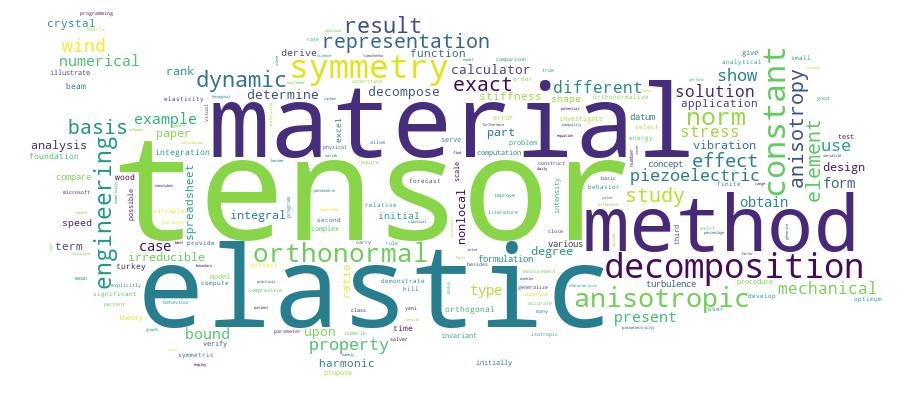
27 results
Scholarly Output Search Results
Now showing 1 - 10 of 27
Publication On the properties of piezoelectric materials based upon orthonormal representations(CRC Press-Taylor, 2013) Dinçkal, ÇiğdemFor piezoelectric tensor, the decomposition method based upon irreducible orthogonal representation is overviewed. Besides, orthonormal tensor basis method is improved to express any third rank tensors such as piezoelectric tensor showing the piezoelectric effect of the material properties on the structures. Numerical examples for materials from different crystal symmetry classes serve to illustrate and verify the orthonormal tensor basis method. The differences and similarities are stated by comparing the methods presented in this work and the others in literature. It is also demonstrated that for hexagonal symmetry, each decomposed parts obtained from orthonormal tensor basis method has physical meaning. Furthermore, the norm based upon orthonormal tensor basis representation of piezoelectric tensor is obtained explicitly for each crystal symmetry classes and those results are used to study the piezoelectric effect of different materials. It is also shown that one can determine in which material the piezoelectric effect is stronger by using the norm concept for any material from various crystal symmetry classes.Article Orthonormal decomposition of symmetric second rank tensors(2010) Dinçkal, ÇiğdemIn this paper, a new orthonormal decomposition method for symmetric second rank tensors namely as, orthonormal tensor basis is presented. Complex variable representation method is developed by using the existing theories in literature. For comparison purposes, a brief review of the spectral method is given. It is shown that stress tensor, as an example to symmetric second rank tensors, is decomposed into six orthonormal parts by orthonormal tensor basis and complex variable representation methods. The matrix forms of these decomposed parts are given. This is the first time in literature that physical meanings of each six decomposed parts which are obtained from the orthonormal decomposition of stress tensor by orthonormal tensor basis and complex variable representation methods, different from the traditionally form, are emphasized. Illustrative applications on orthonormal tensor basis and complex variable representation decomposition methods are given. Finally, it is proved that the spectral method is a non-linear decomposition method which yields three non-linear orthonormal decomposed parts. This case is a significant innovation in decomposition procedures for symmetric second rank tensors in literature.Article Citation - WoS: 1Citation - Scopus: 1Dynamics of a Beam-Column Element on an Elastic Foundation(Canadian Science Publishing, Nrc Research Press, 2016) Alemdar, Bulent N.; Gulkan, Polat H.; Dinckal, CigdemAn exact analytical solution of a harmonically vibrating beam-column element resting on an elastic Winkler foundation is derived. The solution covers four cases comprised of constant compressive or tensile axial force with the restrictions k(s) - m omega(2) < 0 and k(s) - m omega(2) > 0. The proposed solution is not restricted to a particular range of magnitudes of the foundation parameter. Closed form solutions of dynamic shape functions are explicitly derived for each sub-case to obtain frequency-dependent dynamic stiffness terms that constitute the exact dynamic stiffness matrices. Four numerical examples are provided to demonstrate the merits of the present study.Article Vibration of Initially Stressed Nonlocal Euler-Bernoulli Nano-Beams(2018) Dinçkal, ÇiğdemThis paper is pertinent to the analytical solutions for vibration analysis of initially stressed Nonlocal Euler-Bernoulli nano-beams. In order to take into account of small length scale effect, this vibration problem formulation is depending upon both nonlocal Euler-Bernoulli and also Eringen’s nonlocal elasticity theory. The boundary conditions and governing equation are obtained by use of Hamiltonian’s principle. These equations are solved analytically with different initial stresses (both compressive and tensile) and boundary conditions. The effect of small length scale and the initial stress on the fundamental frequency are investigated. The solutions obtained are compared with the ones depending upon both classical Euler-Bernoulli and Timoshenko beam theory to comprehend the responses of nano-beams under the effect of initial stress and small scale in terms of frequencies for both theories. The results supply a better declaration for vibration analysis of nano-beams which are short and stubby with initial stress.Article Citation - WoS: 32Citation - Scopus: 31Wind Energy Resource Assessment of Izmit in the West Black Sea Coastal Region of Turkey(Pergamon-elsevier Science Ltd, 2014) Kucukali, Serhat; Dinckal, CigdemThe wind energy potential of Izmit (41.19 N, 30.30 E), which is located in the West Black Sea Coastal Region of Turkey, is assessed with the statistical analysis of the gathered wind data at the 50-m height measurement mast covering the period of 06/2008-06/2009. The annual average wind speed is calculated as 6 m/s and the prevailing wind direction is ENE (60 degrees). The Weibull distribution parameters of shape and scale factor are found as 2.03 and 6.73 m/s, respectively. The measured wind speed data are compared with the data of nearby meteorological stations and the results show that there is a considerable difference between the onsite measurements and the measurements of the meteorological stations. Moreover, a turbulence analysis is carried out and the turbulence intensity is negatively correlated with the normalized height from ground level with canopy height. The energy generation performances of three different wind turbines are evaluated by using the onsite wind speed measurements and the assessment shows that the capacity factor increase by a factor of two from 17% to 34% depending on the type of the turbine. Furthermore, an economic analysis is carried out for a 50 MW wind energy project for the potential site and the proposed project benefit/cost ratio is calculated as 8. (C) 2013 Elsevier Ltd. All rights reserved.Article Studies on the Optimum Mechanical Response of Anısotropıc Materials Related to Elastıc Constants(2011) Dinçkal, ÇiğdemIn this paper, mechanical and elastic behaviour of anisotropic materials are investigated in order to understand the optimum mechanical behaviour of them in selected directions. For an anisotropic material with known elastic constants, it is possible to choose the best set of elastic constants (effective elastic constants) which determine the optimum mechanical and elastic properties of it. For this reason, bounds on the anisotropic elastic constants have been constructed symbollicaly for all anisotropic elastic symmetries. As illustrative examples, materials from different symmetries are selected and their elastic constants are used to compute bounds on the anisotropic elastic constants. Finally, by examining numerical results of bounds given in tables, it is seen that the materials selected from the same symmetry type which have larger interval between the bounds, are more anisotropic, whereas some materials which have smaller interval between the bounds, are closer to isotropy. The construction of bounds on anisotropic elastic constants is a significant and critical case in design of any engineering and structural materials.Book Part Harmonic Decomposition of Elastic Constant Tensor and Crystal Symmetry(2014) Dinçkal, ÇiğdemThis paper presents a new outlook on harmonic decomposition method for elastic constant tensor. Harmonic decomposition method is developed in such a way that it is applied to anisotropic engineering materials exhibiting different crystal symmetry. The explicit results for each crystal symmetry types are presented. Numerical examples serve to illustrate and verify the developed method. This new representation of elastic constant tensor is compared with other theories such as orthogonal and non-orthogonal irreducible decompositions in literature. The results demonstrate that there are significant relationships between harmonic, non-orthogonal irreducible and orthogonal irreducible decomposition methods. While in harmonic and non-orthogonal irreducible decomposition methods, decomposition of total scalar part is not orthogonal. It is proposed that it is possible to make these parts orthogonal to each other.Conference Object Citation - Scopus: 1An Innovative Description of Elastic Constant Tensor Based Upon Orthonormal Representations(Newswood Limited, 2012) Dinçkal, Ç.; Dinçkal, Çiğdem; İnşaat MühendisliğiA new procedure for representation of elastic constant tensor in terms of its orthonormal decomposed parts is presented. Form invariants and orthonormalized basis elements are used to generate this decomposition method. Numerical examples from various engineering materials serve to illustrate and verify the decomposition procedure. The norm concept of elastic constant tensor and norm ratios are used to study the anisotropy of these materials. It is shown that this method allows to investigate the elastic and mechanical properties of an anisotropic material possessing any material symmetry and determine anisotropy degree of that material. For a material given from an unknown symmetry, it is possible to determine its material symmetry type by this method. © 2012 Newswood Limited. All rights reserved.Conference Object Citation - WoS: 1Citation - Scopus: 4Orthonormal Decomposition of Third Rank Tensors and Applications(int Assoc Engineers-iaeng, 2013) Dinckal, Cigdem; Dinçkal, Çiğdem; İnşaat MühendisliğiA new procedure for representation of third rank tensors in terms of its orthonormal irreducible decomposed parts, namely as irreducible decomposition is presented. Orthonormal tensor basis method is developed by using the results of existing theory in the literature. As an example to third rank tensors, piezoelectricity tensor is decomposed by each method and results of this decomposition methods are compared for this tensor in hexagonal symmetry. As a result of comparison process, it is stated that the results for new method and other one are consistent and each decomposed parts have physical meaning. Moreover, the norm concept of piezoelectricity tensor is used to study the piezoelectric effect of some materials. It is also shown that one can determine in which material the piezoelectric effect is stronger by using the norm for different materials with the same symmetries.Article Novel Alternative Methods to Romberg Integration and Richardson’s Extrapolation with Matlab Package:Integral_Calculator(2020) Dinçkal, ÇiğdemThis paper introduces new integration methods for numerical integration problems in science and engineering applications. It is shown that the exact results of these integrals can be obtained by these methods with the use of only 2 segments. So no additional function and integrand evaluations are required for different levels of computation. This situation overcomes the computational inefficiency. A new Matlab Package; Integral_Calculator is presented. Integral_Calculator provides a user-friendly computational platform which requires only 3 data entries from the user and performs the integration and give the results for any functions to be integrated. This package has been tested for each numerical example considered below.
- «
- 1 (current)
- 2
- 3
- »