
Uzundemir, Özlem
Loading...
Profile URL
Name Variants
Uzundemir, Ozlem & Uzundemir, Özlem
Job Title
Prof. Dr.
Email Address
ozlemuzundemir@cankaya.edu.tr
Main Affiliation
İngiliz Dili ve Edebiyatı
Status
Current Staff
Website
ORCID ID
Scopus Author ID
Turkish CoHE Profile ID
Google Scholar ID
WoS Researcher ID
Files
Sustainable Development Goals
 1
1NO POVERTY
0
Research Products
 2
2ZERO HUNGER
0
Research Products
 3
3GOOD HEALTH AND WELL-BEING
0
Research Products
 4
4QUALITY EDUCATION
0
Research Products
 5
5GENDER EQUALITY
1
Research Products
 6
6CLEAN WATER AND SANITATION
0
Research Products
 7
7AFFORDABLE AND CLEAN ENERGY
1
Research Products
 8
8DECENT WORK AND ECONOMIC GROWTH
0
Research Products
 9
9INDUSTRY, INNOVATION AND INFRASTRUCTURE
0
Research Products
 10
10REDUCED INEQUALITIES
0
Research Products
 11
11SUSTAINABLE CITIES AND COMMUNITIES
0
Research Products
 12
12RESPONSIBLE CONSUMPTION AND PRODUCTION
0
Research Products
 13
13CLIMATE ACTION
0
Research Products
 14
14LIFE BELOW WATER
0
Research Products
 15
15LIFE ON LAND
0
Research Products
 16
16PEACE, JUSTICE AND STRONG INSTITUTIONS
0
Research Products
 17
17PARTNERSHIPS FOR THE GOALS
0
Research Products

Documents
4
Citations
1
h-index
1

Documents
3
Citations
0
No records found in other affiliations.

Scholarly Output
13
Articles
11
Views / Downloads
3774/1184
Supervised MSc Theses
1
Supervised PhD Theses
0
WoS Citation Count
0
Scopus Citation Count
0
Patents
0
Projects
0
WoS Citations per Publication
0.00
Scopus Citations per Publication
0.00
Open Access Source
4
Supervised Theses
1
| Journal | Count |
|---|---|
| Folklor/Edebiyat | 2 |
| Çankaya University Journal of Humanities and Social Sciences | 2 |
| Çankaya Univesity Journal of Arts and Sciences | 1 |
| Changing English | 1 |
| Complexities of Anger: Literary and Cultural Perspectives | 1 |
Current Page: 1 / 2
Scopus Quartile Distribution
Competency Cloud
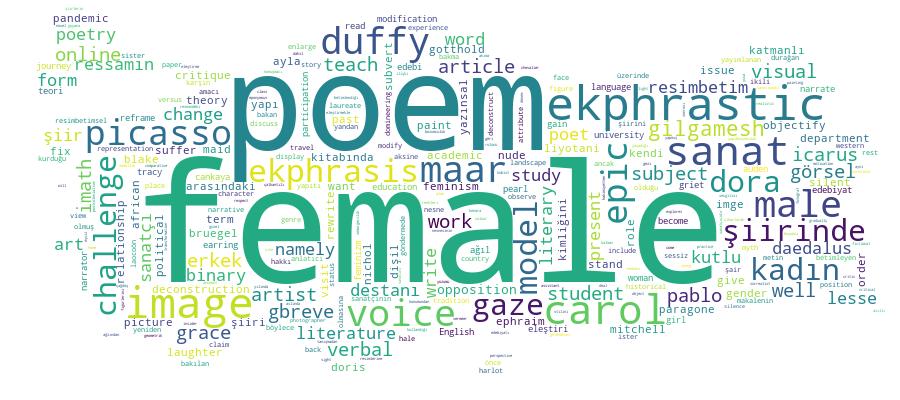
13 results
Scholarly Output Search Results
Now showing 1 - 10 of 13
Article Reframing Pablo Picasso And Dora Maar In Grace Nichols’s “Weeping Woman”(2018) Uzundemir, ÖzlemGuyana asıllı İngiliz şair Grace Nichols’ın 2009 yılında yayımlanan Picasso, I Want My Face Back (Picasso, Yüzümü Geri İstiyorum) adlı şiir kitabında yer alan ilk şiiri “Weeping Woman” (Ağlayan Kadın) çağdaş resimbetim (ekfrasis) örneklerindendir. Pablo Picasso’nun aynı adlı resmini betimleyen şiir, Picasso’nun yirminci-yüzyıl sanatındaki eşsiz rolünü bir dönem sevgilisi olmuş ve resimlerine modellik yapmış olan Dora Maar’ın ağzından sorgular. Maar aslında Picasso ile tanışmadan önce Sürrealist akıma dahil olmuş bir fotoğraf sanatçısıdır, ancak Picasso ile yaşadığı çalkantılı aşk süresince kendi sanatçı kimliğini bir kenara bırakır. Sessiz, durağan ve bakılan güzel sanat nesnesinin bir erkek konuşmacı tarafından betimlendiği geleneksel resimbetimsel şiirlerin aksine, Nichols şiirinde Dora Maar’ı Picasso’nun resmindeki nesne konumundan çıkartarak ona ressamın sanatını eleştirme hakkı verir. Maar Picasso’nun Kübist stilini, geometrik figürlerini ve kullandığı renkleri eleştirmekle kalmaz, ilişki boyunca ressamın üzerinde kurduğu hakimiyetten de yakınır. Maar ressamın sanatı ve kişisel ilişkisindeki baskın kişiliğinden kurtulduktan sonra kendi sanatçı kimliğini yeniden oluşturma sürecine girer. Bu makalenin amacı, Nichols’ın şiirinde erkek ressamın dişil imge üzerinde kurduğu hakimiyetin ne şekilde sorunsallaştırıldığını ve kadın sanatçının kendi kimliğini yeniden kurgulama çabalarını resimbetim çerçevesinde ele almaktır.Article Reframing Pablo Picasso and Dora Maar in Grace Nicols’s ‘Weeping Woman(Uluslararası Kıbrıs Üniversitesi, 2018) Uzundemir, ÖzlemThe Guyanese poet Grace Nichols’s ekphrastic poem “Weeping Woman” in her Picasso, I Want My Face Back challenges Pablo Picasso’s iconic status in twentieth-century art. Written in the form of a dramatic monologue, the poem gives voice to Picasso’s model, muse and lover, Dora Maar, who was a Surrealist photographer before she had an affair with Picasso. Unlike traditional ekphrastic poems which involve the description of a fixed, silenced and gazed beautiful image through a male persona who is also a gazer of that image in poetry, Nichols transforms Maar’s objectified position in Picasso’s painting into a subject by voicing her critique of the artist’s cubist art, his use of colors as well as his geometric figures, and of his maltreatment of her. Through this ekphrastic stance, Maar reconstructs her identity as a photographer and rids herself from the artist’s domination over her in his art and personal life. Hence, the aim of this article is to discuss in what ways Nichols’s poem problematizes the privileged status of the male artist over his silenced female model and acknowledges the artistic talent of the woman through the use of ekphrasis.Article Challenges to ekphrastic poetry: Carol Ann Duffy’s “standing female nude”(Çankaya Üniversitesi, 2013) Uzundemir, ÖzlemBir görsel sanat yapıtını betimleyen şiirler, yazınsal metinler ve görsel sanatlar arasındaki farkların ortaya çıkmasını sağlarlar. Gotthold Ephraim Lessing’in Laocoön adlı kitabında sözünü ettiği gibi sanat yapıtı sessiz ve durağan olmasına karşın, yazınsal metin söze ve harekete dayanır. W. J. T. Mitchell Picture Theory adlı kitabında söz ve imge arasındaki böylesi ikili karşıtlığı cinsiyet rollerini de içerecek şekilde genişletir. İmge dişil, söz ise eril olarak ele alınır. Dişil imge bakılan nesne olmasına karşın, erkek yazar/sanatçı özne ve bakan konumundadır. Carol Ann Duffy “Standing Female Nude” adlı şiirinde, bu tür ikili karşıtlıkları sorgulayabilmek için erkek sanatçı yerine kadın modele söz hakkı verir ve bakma edimini de model üstlenir. Böylece, Duffy anlatıcının ister sanat yapıtı sahibi, ister sanatçının kendisi, isterse de yapıta bakan bir erkek olduğu resimbetimsel şiir geleneğini reddederek sanatçı ve modeli arasındaki güç ilişkisini sorgular.Article Challenges to ekphrastic poetry: Carol Ann Duffy’s “Standing Female Nude”*(Çankaya Üniversitesi, 2013) Uzundemir, ÖzlemEkphrasis rests on the paragone between the sister arts, namely verbal and visual arts, the word and the image. Gotthold Ephraim Lessing in his Laocoön claims that the image is silent and fixed while the literary work is based on voice and action. W. J. T. Mitchell in his Picture Theory enlarges this binary opposition between the word and image in terms of gender roles: the female image versus the male word. The female image is objectified and gazed, while the male author/artist is the subject and the gazer. The poet laureate Carol Ann Duffy’s poem “Standing Female Nude” challenges such binary oppositions by giving voice not to the male artist but to his female model, and by attributing the role of gazing to her. Hence, the aim of this article is to display how Duffy deconstructs the ekphrastic tradition in her poem in order to subvert the domineering relationship between the artist and his modelArticle Ayla Kutlu’s kadın destanı and the modification of the epic(Çankaya Üniversitesi, 2005) Uzundemir, ÖzlemAyla Kutlu's Kadın Destanı and the Modification of the Epic:Ayla Kutlu uses historical events in her fiction to make a correspondence between the past and the present, because she sees the historical background as the determining factor of what happens at present (Kutlu 9). Kutlu's work Kadın Destanı (Woman's Epic), published in 1994, is a rewriting of Gilgamesh from the viewpoint of a harlot who is abused by Gilgamesh. The female narrator of Kutlu's epic, Liyotani, talks about her suffering at the temple of Gilgamesh, while she narrates his story. Like Gilgamesh, Liyotani emphasizes the significance of writing, but their aim is different: while Gilgamesh desires to become immortal by engraving his story on clay tablets, Liyotani wants to finish writing her story before she dies in order to share her suffering with other women. In terms of form, Kutlu modifies the epic genre, which can be defined as .A long narrative poem in elevated style presenting characters of high position in adventures forming an organic whole through their relation to a central heroic figure and through their development of episodes important to the history of a nation or race. (Holman and Harmon 171). Although Kutlu.s epic is a narrative written in the form of a poem, the main character is a harlot, not a hero of a nation. Kutlu changes some characteristics of the epic to include heroines and their suffering in a patriarchal society. The aim of this paper is to show how Ayla Kutlu rewrites Gilgamesh and modifies the epic genre to connect women.s experience in the past with their present situation.Article Challenges to Ekphrastic Poetry: Carol Ann Duffy’s “Standing Female Nude”(2013) Uzundemir, ÖzlemEkphrasis rests on the paragone between the sister arts, namely verbal and visual arts, the word and the image. Gotthold Ephraim Lessing in his Laocoön claims that the image is silent and fixed while the literary work is based on voice and action. W. J. T. Mitchell in his Picture Theory enlarges this binary opposition between the word and image in terms of gender roles: the female image versus the male word. The female image is objectified and gazed, while the male author/artist is the subject and the gazer. The poet laureate Carol Ann Duffy’s poem “Standing Female Nude” challenges such binary oppositions by giving voice not to the male artist but to his female model, and by attributing the role of gazing to her. Hence, the aim of this article is to display how Duffy deconstructs the ekphrastic tradition in her poem in order to subvert the domineering relationship between the artist and his model.Article Once an insider, now an outsider: Doris Lessing’s African laughter(Çankaya Üniversitesi, 2008) Uzundemir, ÖzlemDoris Lessing’s African Laughter is a travel book including her four visits in 1982, 1988, 1989 and 1992 to Africa, the place where her childhood memories belong to. Pleased to hear the end of the white man’s supremacy, she traveled to the country, not only to visit her friends and relatives but also to observe the social and political changes that took place after the country gained its independence. The aim of this article is to analyze the dynamism Lessing observes in Zimbabwe, namely the political controversies, the blending of cultures and the continuation of the colonial hatred in people’s attitudes and lifestyle as well as to evaluate her visits as inward journeys to her past through an emphasis on the fallibility of memory.Master Thesis Mohsin Hamid'in Gönülsüz Köktendinci ve Batı Çıkışı romanlarındaki eşiktelik ve aidiyet(2025) İnce, Nazan; Uzundemir, ÖzlemBu tez, Mohsin Hamid'in Gönülsüz Köktendinci (2007) ve Batı Çıkışı (2017) romanlarındaki eşiktelik, yerinden edilme ve bir yere ait hissedememe konularını incelemektedir. Her iki romanda da karakterler farklı coğrafyalarda gidip gelmekte, göç ve yurtsuzlaşmayı deneyimlemektedir. Sömürgecilik sonrası kuram çerçevesinde bu tez, coğrafi ve kültürel yurtsuzlaşmanın kimlik bütünlüğünü nasıl parçaladığını ve karakterlerin kendilerini aidiyetsiz hissetmelerine nasıl yol açtığını ele almaktadır. Frantz Fanon ve Homi Bhabha'nın yerinden edilme, yurtsuzluk ve bölünmüş kimlik üzerine fikirleri ve Victor Turner'ın liminalite (eşiktelik) kuramı bu romanlardaki ana karakterlerin parçalanmış öznelliklerini yorumlamak için kullanılacaktır. Bir yuva hissinin yokluğu, kültürel müzakerenin gerçekleştiği bir Üçüncü Alan ihtiyacını doğurur. Bu tez, Changez, Nadia, ve Saeed karakterlerinin bu süregelen yabancılaşma hissi durumuyla nasıl başa çıktıklarını araştırmaktadır. Sonuç olarak tez, yerinden edilmiş sömürge öznenin değişken ve eşikte var olduğunu ve kültürel müzakere ile sürekli olarak yeniden yapılandırıldığını savunmaktadır.Book Part Gazing Back in Anger: Forms of Aggression in A. S. Byatt’s Matisse Stories(Bloomsbury Publishing Plc., 2026) Uzundemir, ÖzlemArticle A Maid Came Free: From Sighting To Citing in Tracy Chevalier's Girl With a Pearl Earring(Routledge Journals, Taylor & Francis Ltd, 2018) Uzundemir, OzlemTracy Chevalier's ekphrastic novel Girl with a Pearl Earring explores the relationship between literature and art, as it narrates Jan Vermeer's paintings from the perspective of the story's narrator, Griet, who works as a maid in the Vermeers's house. In her fictional account, Griet gradually becomes the painter's assistant as well as his model, and subverts the gender issues in ekphrasis; the silent and gazed-upon female image in the eponymous painting gains a voice to critique Vermeer's art. This article will deal with Griet's transformation from a young maid into an art critic with respect to the issues in painting, namely colour, light and realistic representation, as well as the paragone between the viewing subject and the viewed object in ekphrasis.