
Çoğun, Can
Loading...
Profile URL
Name Variants
Cogun, Can & Çoğun, C. & Çoğun, Can & Çoğun, Can & Çoğun, Can & Cogun, C. & Çoǧun, C. & Çoǧun, Can & Çoğun, Can
Job Title
Prof. Dr.
Email Address
cogun@cankaya.edu.tr
Main Affiliation
06.08. Mekatronik Mühendisliği
06. Mühendislik Fakültesi
01. Çankaya Üniversitesi
06.08. Mekatronik Mühendisliği
Mekatronik Mühendisliği
06. Mühendislik Fakültesi
01. Çankaya Üniversitesi
06. Mühendislik Fakültesi
01. Çankaya Üniversitesi
06.08. Mekatronik Mühendisliği
Mekatronik Mühendisliği
06. Mühendislik Fakültesi
01. Çankaya Üniversitesi
Status
Current Staff
Website
ORCID ID
Scopus Author ID
Turkish CoHE Profile ID
Google Scholar ID
WoS Researcher ID
Files
Sustainable Development Goals
 1
1NO POVERTY
0
Research Products
 2
2ZERO HUNGER
0
Research Products
 3
3GOOD HEALTH AND WELL-BEING
0
Research Products
 4
4QUALITY EDUCATION
0
Research Products
 5
5GENDER EQUALITY
0
Research Products
 6
6CLEAN WATER AND SANITATION
0
Research Products
 7
7AFFORDABLE AND CLEAN ENERGY
0
Research Products
 8
8DECENT WORK AND ECONOMIC GROWTH
0
Research Products
 9
9INDUSTRY, INNOVATION AND INFRASTRUCTURE
19
Research Products
 10
10REDUCED INEQUALITIES
0
Research Products
 11
11SUSTAINABLE CITIES AND COMMUNITIES
0
Research Products
 12
12RESPONSIBLE CONSUMPTION AND PRODUCTION
0
Research Products
 13
13CLIMATE ACTION
0
Research Products
 14
14LIFE BELOW WATER
0
Research Products
 15
15LIFE ON LAND
0
Research Products
 16
16PEACE, JUSTICE AND STRONG INSTITUTIONS
0
Research Products
 17
17PARTNERSHIPS FOR THE GOALS
0
Research Products

This researcher does not have a Scopus ID.

This researcher does not have a WoS ID.
No records found in other affiliations.

Scholarly Output
33
Articles
26
Views / Downloads
1050/87
Supervised MSc Theses
1
Supervised PhD Theses
0
WoS Citation Count
249
Scopus Citation Count
280
Patents
0
Projects
0
WoS Citations per Publication
7.55
Scopus Citations per Publication
8.48
Open Access Source
14
Supervised Theses
1
| Journal | Count |
|---|---|
| Gazi Üniversitesi Mühendislik Mimarlık Fakültesi Dergisi | 3 |
| Makine Teknolojileri Elektronik Dergisi (Elektronik) | 2 |
| Journal of the Faculty of Engineering and Architecture of Gazi University | 2 |
| Machining Science and Technology | 2 |
| Arabian Journal for Science and Engineering | 1 |
Current Page: 1 / 6
Scopus Quartile Distribution
Competency Cloud
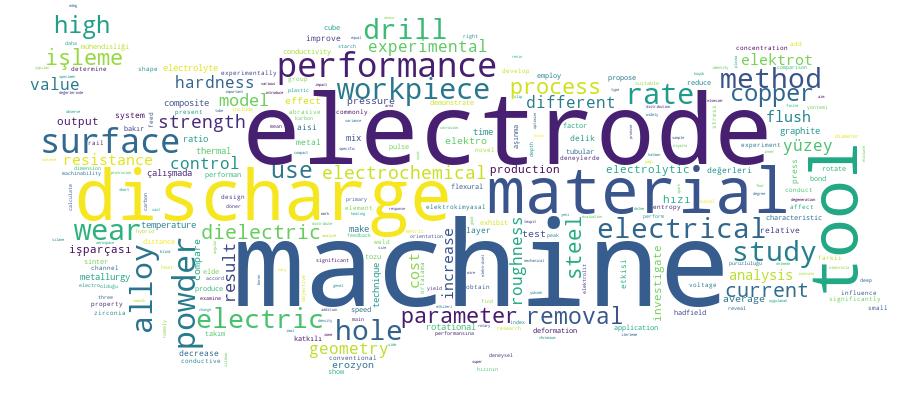
33 results
Scholarly Output Search Results
Now showing 1 - 10 of 33
Article Citation - WoS: 7Citation - Scopus: 7Development and Experimental Investigation of Electrochemical Drilling Method Using Rotary Tube Tool(Gazi Univ, Fac Engineering Architecture, 2013) Ozerkan, H. Bekir; Çoğun, Can; Cogun, Can; Mekatronik MühendisliğiIn this study, a new hybrid electrochemical drilling (ECD) method, based on electrochemical machining in nonconventional machining processes, was developed. In the developed method, tube tool makes rotary motion together with inner through hole flushing. A small scale prototype ECD machine has been designed and manufactured to test the developed method. One of the important features of the new system is the regulation of tool feed rate using current feedback control. The Hadfield (manganese) steel, whose strain hardening behavior makes it very difficult to machine with conventional methods, and AISI 1040 steel, whose machinability is fairly good, were drilled using the prototype machine and results were compared. Workpiece material removal rate increased with the increasing machining voltage, tool rotational speed, electrolyte concentration and flushing pressure in both types of steels. Average radial overcut values increased with the rotational speed of the tool. The AISI 1040 steel hole geometries were regular than that of Hadfield steel. Experimental results showed that deep holes can be drilled successfully with the proposed hybrid ECD method.Article Döner Tüp Takım Kullanarak Elektrokimyasal Delme Yönteminin Deneysel İncelenmesi ve Geliştirilmesi(2013) Çoğun, Can; Özerkan, H. BekirBu çalışmada, alışılmamış imal usullerinden elektrokimyasal işleme yöntemi esaslı yeni bir hibrit elektrokimyasal delik delme (EKD) yöntemi geliştirilmiştir. Geliştirilen yöntemde takımın dönme hareketi yanında içinden elektrolit püskürtmesi de uygulanmaktadır. Yöntemin denemelerinin gerçekleştirilebilmesi için küçük boyutlarda bir prototip EKD tezgâhı tasarlanmış ve üretilmiştir. Yeni sistemin önemli özelliklerinden biri işlemede takım ilerleme hızının akım geri besleme kontrolü ile ayarlanmasıdır. Prototip tezgâhta, talaşlı imal usulleriyle gerinme pekleşmesinden dolayı işlenmesi çok güç olan Hadfield (mangan) çeliği ve işlenebilirliği iyi olan AISI 1040 çeliği aynı işleme koşullarında delinmiş ve sonuçlar karşılaştırılmıştır. Her iki çelikle yapılan deneylerde işleme geriliminin, takım dönüş hızının, elektrolit konsantrasyonunun ve püskürtme basıncının artışıyla işparçası işleme hızı değerleri artmıştır. Ortalama yanal açıklık değerleri takım dönüş hızının artışı ile artmıştır. AISI 1040 çeliğine açılan deliklerin Hadfield çeliğine göre daha düzgün olduğu görülmüştür. Deneysel sonuçlar önerilen yeni hibrit EKD yöntemi ile işlenmesi güç malzemelere derin ve küçük çaplı deliklerin kolaylıkla açılabileceğini göstermiştir.Article Citation - WoS: 7Citation - Scopus: 7Thermo-Fluid Multi-Physics Modeling and Experimental Verification of Volumetric Workpiece Material Removal by a Discharge Pulse in Electric Discharge Machining Process(Iop Publishing Ltd, 2020) Cogun, Can; Uslan, Ibrahim; Erbas, Murat; Erdem, OguzThe volume of material removed from the workpiece by a pulse (V-v) in the electric discharge machining was quantitatively determined using a multi-physics simulation model in ANSYS CFX software. Electrical heating is used in the model to simulate the plasma channel formation by defining the boundary and time-controlled current density initial conditions. Time-dependent physical properties at plasma temperature were used to reflect the actual processing environment. The heat was transferred from the plasma channel to the workpiece by electrical heating from the electrode, and V(v)was calculated by means of the amount of heat transfer. The calculated V(v)values for AISI4140, Ti6Al4V and Inconel 718 workpieces were lower than the experimental results and the difference was observed to change between 38.3% and 46.9%.Article Citation - WoS: 30Citation - Scopus: 34Performance and Surface Alloying Characteristics of Cu-Cr and Cu-Mo Powder Metal Tool Electrodes in Electrical Discharge Machining(Taylor & Francis inc, 2016) Uslan, Ibrahim; Usta, Yusuf; Cogun, Can; Gulcan, OrhanThe main objective of this study is to investigate the effect of Cu-Cr and Cu-Mo powder metal (PM) tool electrodes on electrical discharge machining (EDM) performance outputs. The EDM performance measures used in the study are material removal rate (MRR), tool electrode wear rate (EWR), average workpiece surface roughness (R-a), machined workpiece surface hardness, abrasive wear resistance, corrosion resistance, and workpiece alloyed layer depth and composition. The EDM performance of Cu-Cr and Cu-Mo PM electrodes produced at three different mixing ratios (15, 25, and 35wt% Cr or Mo), compacting pressures (P-c = 600, 700, and 800MPa), and sintering temperatures (T-s = 800, 850, and 900 degrees C) are compared with those machined with electrolytic Cu and Cu PM electrodes when machining SAE 1040 steel workpiece. Analyses revealed that tool materials were deposited as a layer over the work surface yielding high surface hardness, strong abrasion, and corrosion resistance. Moreover, the mixing ratio, P-c, and T-s affect the MRR, EWR, and R-a values.Article Citation - WoS: 6Citation - Scopus: 6Design and Implementation of an Electrode Feed Rate Control System in the Electrochemical Drilling Process(Springer Heidelberg, 2022) Cogun, Can; Ozerkan, Haci BekirThe interelectrode gap distance control is essential for preventing short circuit and spark discharge occurrences in the machining gap and ensuring a constant distance between the tool electrode (shortly electrode) and the workpiece throughout the electrochemical drilling (ECD) process. In this study, a gap distance control system was designed and implemented in the constructed ECD machine tool. The gap distance control strategy was based on the machining current's discrete measurement (in microsecond intervals) and changing the gap distance according to a set current value by feeding the electrode towards the workpiece or retracting it during the ECD process. The small diameter deep hole ECD experiments were conducted using 0.5 mm diameter side insulated tubular rotational electrodes with through-hole electrolyte flushing to drill Hadfield and AISI 1040 steels. The experimental results demonstrated the success of the developed control system in ECD operations yielding uniform hole geometries and smooth hole surfaces. The use of the control system eliminated the undesirable formations of spark discharges and short circuit pulses.Article Citation - WoS: 10Citation - Scopus: 9The Effect of Powder Mixed and Heated Dielectric on Drilling Performance of Electric Discharge Machining (Edm)(Gazi Univ, Fac Engineering Architecture, 2016) Cogun, Can; Urtekin, Levent; Ozerkan, H. Bekir; Uslan, Ibrahim; Erdem, OguzIn this study, heated silicon oil with added carbon and starch powders was used as dielectric liquid, instead of common hydro-carbon based dielectrics, to obtain better hole surface quality with rotating brass tube electrode in electric discharge machining (EDM). The electro-rheometer tests were conducted to find out the suitable temperature and powder concentration values of the electro-rheological (ER) dielectric under the electric field. Higher workpiece material removal rates (MRR) was obtained in carbon powder added dielectrics than the starch powder added ones for rotating and non-rotating electrodes. The optical microscope observations of the machined hole surfaces indicated that the carbon powder added dielectrics reduced the diameter and depth of the discharge craters, thereby resulting in uniformly distributed and round top peaked surface topography. The starch powder addition to the carbon mixed dielectric further improved the surface quality for both rotating and non-rotating electrodes cases at 30 degrees C and 75 degrees C dielectric temperatures.Conference Object Elektro Erozyon İle İşlemede Döner Elektrot İle Delik Delmede Dielektrik Sıvısına Karıştırılan Tozların Ve Isıtmanın İşleme Performansına Etkisi(2013) Oğuz, Erdem; Çoğun, Can; Uslan, İbrahim; Urtekin, Levent; Özerkan, Hacı BekirArticle Citation - WoS: 2Citation - Scopus: 3The Entropy Method Integrated RSM Model to Evaluate Hole Geometries in Electrochemical Blind Hole Drilling(Taylor and Francis Ltd., 2025) Ayhan, Emre; Yurdakul, Mustafa; Çoǧun, Can; İç, Yusuf TanselThe electrochemical drilling (ECD) process enables the machining of conductive materials with a wide range of hardness, yield strength, and brittleness. In this study, the ECD experiments have been conducted on blind hole drilling in high-speed steel material using a tailor-made ECD machine. The hole geometries (cross-sectional profiles) at different machining parameters have been examined for the hole depth consistency (HDC), hole cross-sectional area (HCAC) and the hole profile length (HPLC) evaluation (response; output) metrics introduced. The relationships between the hole geometry evaluation metrics and machining parameters are obtained using the response surface method (RSM). Using the Entropy method, an optimisation model is also proposed to combine multiple responses into a single objective function. The effectiveness of the Entropy method is compared with the Analytical Hierarchical Process (AHP). The comparison showed that the Entropy model provides more robust and convenient results than the AHP approach. © 2025 Elsevier B.V., All rights reserved.Article Citation - WoS: 9Citation - Scopus: 10Effect of Use of Cu-Cr P/M Electrodes on Machining Performance of Electric Discharge Machining(Gazi Univ, Fac Engineering Architecture, 2015) Gulcan, Orhan; Çoğun, Can; Uslan, Ibrahim; Usta, Yusuf; Cogun, Can; Çoʇun, Can; Mekatronik MühendisliğiIn this study, the effect of use of Cu-Cr powder metal (P/M) electrodes on EDM performance outputs, namely material removal rate (MRR), electrode wear rate (EWR), mean and maximum roughness of machined surface (R-a and R-z) and workpiece surface recast layer thickness, was investigated experimentally. The Cu-Cr P/M electrodes produced at different mixing ratios, compacting pressures and sintering temperatures were used to machine SAE 1040 steel. The analyses performed have shown that the electrode material is deposited on to the work surface as a layer and the powder mixing ratio, the compaction pressure and sintering temperature affect the EDM performance outputs.Article Citation - WoS: 7Citation - Scopus: 9An Experimental Work on Using Conductive Powder-Filled Polymer Composite Cast Material as Tool Electrode in Edm(Springer London Ltd, 2014) Cogun, Can; Yaman, KemalThis paper introduces the composite tool electrodes made of electrical conductive powder-filled polyester resin matrix material, providing promise for the electrical discharge machining (EDM) process. The dendrite-shaped copper powder, graphite powder, and their mixture were used as conductive fillers. Six different types of composite electrodes, namely, plain copper-polyester, pressed copper-polyester, furnaced copper-polyester, plain copper-graphite-polyester, pressed copper-graphite-polyester, and furnaced copper-graphite-polyester were prepared. It is found experimentally that increasing v (f) improved workpiece material removal rate, tool wear rate, relative wear, and electrical conductivity of electrodes. The pressed copper-polyester electrodes were found to be promising in the ED finishing of workpieces at low machining current settings. The practical applicability of the proposed composite electrodes in the industry was also illustrated.