
Satır, Benhür
Loading...

Profile URL
Name Variants
Satir, Benhur
Job Title
Dr. Öğr. Üyesi
Email Address
Main Affiliation
06.04. Endüstri Mühendisliği
Endüstri Mühendisliği
06. Mühendislik Fakültesi
01. Çankaya Üniversitesi
Endüstri Mühendisliği
06. Mühendislik Fakültesi
01. Çankaya Üniversitesi
Status
Former Staff
Website
ORCID ID
Scopus Author ID
Turkish CoHE Profile ID
Google Scholar ID
WoS Researcher ID
Sustainable Development Goals
 1
1NO POVERTY
0
Research Products
 2
2ZERO HUNGER
0
Research Products
 3
3GOOD HEALTH AND WELL-BEING
0
Research Products
 4
4QUALITY EDUCATION
0
Research Products
 5
5GENDER EQUALITY
0
Research Products
 6
6CLEAN WATER AND SANITATION
0
Research Products
 7
7AFFORDABLE AND CLEAN ENERGY
1
Research Products
 8
8DECENT WORK AND ECONOMIC GROWTH
0
Research Products
 9
9INDUSTRY, INNOVATION AND INFRASTRUCTURE
0
Research Products
 10
10REDUCED INEQUALITIES
0
Research Products
 11
11SUSTAINABLE CITIES AND COMMUNITIES
0
Research Products
 12
12RESPONSIBLE CONSUMPTION AND PRODUCTION
0
Research Products
 13
13CLIMATE ACTION
0
Research Products
 14
14LIFE BELOW WATER
0
Research Products
 15
15LIFE ON LAND
0
Research Products
 16
16PEACE, JUSTICE AND STRONG INSTITUTIONS
0
Research Products
 17
17PARTNERSHIPS FOR THE GOALS
0
Research Products

This researcher does not have a Scopus ID.

This researcher does not have a WoS ID.

Scholarly Output
14
Articles
12
Views / Downloads
1081/1446
Supervised MSc Theses
0
Supervised PhD Theses
0
WoS Citation Count
66
Scopus Citation Count
74
Patents
0
Projects
0
WoS Citations per Publication
4.71
Scopus Citations per Publication
5.29
Open Access Source
7
Supervised Theses
0
| Journal | Count |
|---|---|
| European Journal of Operational Research | 2 |
| Arabian Journal for Science and Engineering | 2 |
| Çankaya University Journal of Science and Engineering | 1 |
| Energy Systems | 1 |
| International Journal of Production Research | 1 |
Current Page: 1 / 3
Scopus Quartile Distribution
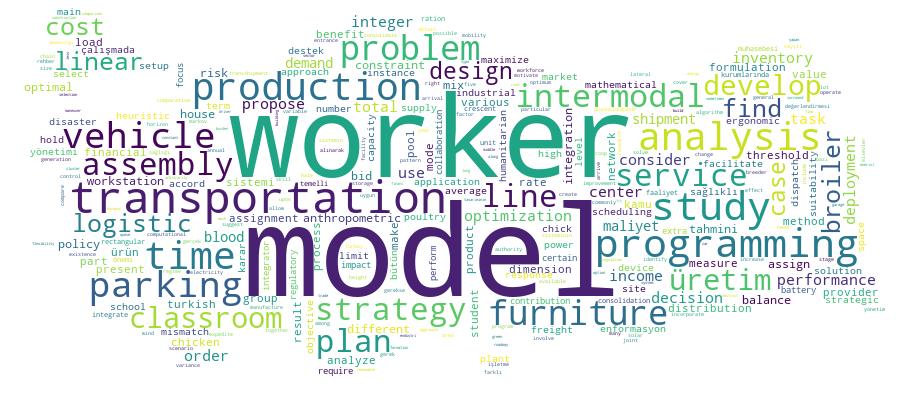
Competency Cloud
14 results
Scholarly Output Search Results
Now showing 1 - 10 of 14
Article Citation - WoS: 8Citation - Scopus: 9Intermodal Humanitarian Logistics Using Unit Load Devices(Springer Heidelberg, 2022) Kavlak, Hasan; Ertem, Mustafa Alp; Satir, BenhurIntermodal freight transportation facilitates today's global trade. The benefits of intermodal freight transportation have been studied and are more observable in commercial logistics; however, the potential benefits of humanitarian logistics have not been thoroughly investigated. This research aims to present a resilient transportation framework by modeling intermodal transportation utilizing interoperable loading devices during disaster responses. We developed an integer programming model based on a time-space network by considering route and vehicle availabilities that are allowed to change with time. We consider vehicles with varying capacities in three transportation modes (i.e., ground, maritime, and air). The contribution of this study is threefold: (1) Two compatible unit load devices are proposed for humanitarian logistics; (2) a mathematical model that includes integer variable representation for vehicle fleets in different transportation modes is developed; and (3) intermodal transportation is compared with single-mode transportation using a real-life dataset. Our main results are as follows: In terms of cost, intermodal transportation is effective when demand occurs in consecutive periods and response time is short. Inventory is held more in intermodal transportation when it is cost-effective to use transportation modes with large capacities. Thus, the benefits of the responsiveness of intermodal transportation outweigh the costs of mode interchange and inventory holding for sudden-onset disasters where quick responses are needed within a short time.Article Citation - WoS: 3Citation - Scopus: 4Comparison of Classroom Furniture To Anthropometric Measures of Turkish Middle School Students(Ios Press, 2021) Erdogan, Filiz Celikci; Satir, BenhurBACKGROUND: The match between classroom furniture and students' anthropometry is an important factor in students' academic performance. OBJECTIVE: Our aim was to investigate the ergonomic suitability of the classroom furniture to the students, and to propose design suggestions for both desks and chairs. METHODS: We analyzed the ergonomics of classroom furniture that students aged 10-14 years old in Turkey currently use. To this end, we selected Maltepe Primary Education School, one of the largest schools in the cankaya district of Turkey's capital city, Ankara, in which to conduct the study. A sample of 119 students was selected, and seven anthropometric measurements were taken for each of these students. We then calculated five relationships between the dimensions of the furniture and the students' anthropometric measures. RESULTS: We observed high levels of mismatch rates, with an average of 66.6% and high values of over 95% for the relations of two furniture measures, seat depth (related with buttock-popliteal length) and seat-to-desk height (related with elbow height, sitting). Each anthropometric measure was applied a fit probability distribution, and based on those distributions; we suggested the most appropriate classroom furniture dimensions in order to maximize suitability of the furniture to the anthropometric measures in terms of fixed-size (i.e., non-adjustable) classroom furniture. CONCLUSIONS: High mismatch rates can be reduced by 52.0% on average based on the classroom furniture dimensions suggested in this study.Article Broiler House Performance Analysis and Chick Entrance Planning for a Broiler Chicken Integration(2012) Satır, Benhür; Yıldırım, Gonca; Kırca, ÖmerIncreasing rates of chicken meat production has a substantial impact on the Turkish economy. Per capita production in Turkey is close to the average production of the top 20 countries in the world. The production is done by integrated organizations, incorporating an integrator chicken company affiliated with all aspects of the production in an organization. There are many complicated processes, stages and parties involved in a typical integration, bringing with them many interesting problems. In this paper, we focus on tactical and operational decisions required during the broiler growing stage, motivated by the requirements of a moderate-sized integrator in the Marmara Region of Turkey. We use analysis of variance to compare the performances of available broiler houses, and to find the factors effecting the performance measures. Then, we present a mixed-integer linear program which uses the results of our performance analysis to find the least costly set of broiler houses with which the integrator should work, and the chick entrance times into these houses over a planning period.Article Enformasyon Yönetimi Sistemi Tasarımının Üretim Yapan İşletmelerde Faaliyet Temelli Maliyet Muhasebesi için Önemi(2012) Satır, BenhürÜrün maliyetlerinin gerçek değerlerine yakın tahmini, ürün kârlılıkları ve işletmelerin pazarda rekabetçi olabilmeleri için çok önemlidir. İşletme bir üretim işletmesi ise, özellikle siparişe dayalı üretim yapıyor veya çok çeşitli tipte ürün üretiyorsa maliyet tahmini zorlaşmaktadır. Bunlara ek olarak, üretim koşulları zorlu bir işletme ise, ürün maliyeti için üretim sürecinden gelmesi gereken üretim enformasyonunun sağlıklı olması zorlaşmakta ve işletme için maliyet tahmini gerçek değerinden oldukça farklı olabilmektedir. Bazı ürünler için üretim ve teslimat süreci bittikten sonra, tahmini maliyete göre kâr beklenirken, gerçekleşen maliyetin fiyattan bile yüksek çıktığı ve aslında bu üretimden zarar edildiği çok geç olarak anlaşılabilmektedir. Bütün bu zorluklar aşılarak doğru bir maliyet tahmini yapılması için, enformasyon yönetim sisteminin maliyet muhasebesi sistemine uygun tasarlanmasının yanı sıra, sistemin sağlıklı ve güncel tutulması gerekmektedir. Bu çalışmada üretim koşullarının en zor olduğu işletmelerden birisi olan dökümhâneler için Faaliyet Temelli Maliyetlendirme Yöntemi uygulamaları esas alınarak, Enformasyon Yönetimi Sisteminin buna uygun nasıl tasarlanması gerektiği anlatılmıştır.Article Citation - WoS: 5Citation - Scopus: 3Optimum Bidding Strategy for Wind and Solar Power Plants in Day-Ahead Electricity Market(Springer Heidelberg, 2021) Keysan, Ozan; Satir, Benhur; Ozcan, MehmetThere are two possible strategies for wind power plants (WPPs) and solar power plants (SPPs) to maximize their income in day ahead markets (DAM) in the presence of imbalance cost: joint bidding (JB) via collaboration by participating to balancing groups and deployment of storage technologies. There are limited studies in the literature covering the comparative analysis of "JB strategy" with "battery deployment (BD) strategy". In the existence of balancing responsibility, the comparative analysis of these strategies is the main contribution of this study to the literature. Our Second contribution is the analysis of the impact of different regulatory regimes, which are set by the regulatory authority, on total income. JBM (joint bidding model), which is the model for joint bidding via different collaboration groups, is developed for the analysis of JB strategy, BDM (battery deployment model), which is the model covering the deployment of storage technology, is developed for the analysis of BD strategy. The impact of each strategy on total income is analyzed. According to the analysis of the results of the models, while JB strategy, which is sensitive to the regulatory regime, increases the total annual income of the collaboration groups up to 0.65%, BD strategy seems not feasible and financially viable. On the other hand, extra income values per MW of battery for SPP is between $218 and $400 /MW-year, while these values are between $2460 and $6795/MW-year for the group of 15 WPPs. Therefore, deployment of battery for WPPs creates extra income more than tenfold of that of SPP. BD strategy can be viable provided that the levelized cost of deployment of battery drops below the extra income values achieved per MW of battery.Article Kamu Kurumlarında Risk Değerlendirmesi İçin Karar Destek Sistemi Önerisi(2018) Tok, Elif Gülce; Satır, Benhür6331 Sayılı İş Sağlığı ve Güvenliği (İSG) Kanunu’nun 31.12.2012’de yürürlüğegirmesinden itibaren risk değerlendirmesi bütün işyerlerinde zorunlu halegelmiştir. Bu çalışmada iş sağlığı ve güvenliğinin önemli bir öğesi olan riskdeğerlendirmesinin kamu kurumlarında yapılmasını daha sağlıklı hale getirecekve kolaylaştıracak bir rehber hazırlanmıştır. Bu rehber bir kontrol listesi ve ilgilirisk tablosundan oluşmaktadır. Gerek ülkemizdeki 6331 Sayılı İSG Kanununda veilgili yönetmeliklerde, gerekse de OHSAS 18001 İSG Yönetim Sisteminde, sürekliiyileştirmenin önemi açıkça görülmektedir. Bu çalışmada hazırlanan rehberinuygulanmasında riskin kabul edilebilir seviyeye inene kadar risk değerlendirmesiniizlemeyi sistemli ve kolay hale getirerek sürekli iyileştirmenin gereklerini sağlamaküzere bir Karar Destek Sistemi önerilmiştir. Birim, kaynak ve tehlike parametreleribir bütün olarak ele alınarak BKT olarak değerlendirilmiş ve sistemin veri tabanıaltyapısı bunun üzerine kurulmuştur. Risk değerlendirmesinin ana öğeleri olan BKT,risk ve önlem ilişkilerinin Varlık-İlişki Çiziti hazırlanarak en büyük ve en küçükkardinallik oranları her ilişki arasında tanımlanmıştır. Fikir vermesi açısından bazı kullanıcı arayüzleri tasarlanmış ve önerilmiştir. Farklı sektörlerde yapılmış benzerçalışmalar mevcuttur ancak gerek kamu kurumları düşünüldüğünde gerekse deuygulama için önerilen karar destek sistemi düşünüldüğünde bu çalışma bilgimizdahilinde literatürdeki ilk çalışmadır.Article Citation - WoS: 20Citation - Scopus: 22Shipment Consolidation With Two Demand Classes: Rationing the Dispatch Capacity(Elsevier Science Bv, 2018) Erenay, Fatih Safa; Bookbinder, James H.; Satir, BenhurWe analyze the problem faced by a logistics provider that dispatches shipment orders (parcels or larger packages) of two order classes, viz. expedited and regular. Shipment orders arrive according to a compound Poisson process for each class. Upon an arrival, the logistics provider may continue consolidating arriving orders by paying a holding cost. Alternatively, the provider may dispatch, at a fixed cost, a vehicle containing (a portion of) the load consolidated so far. In addition, the provider must specify the composition of each dispatch by allocating (rationing) the volume of the vehicle between expedited and regular shipment orders. We model this problem as a continuous-time Markov Decision Process and minimize the expected discounted total cost. We prove the existence of quantity-based optimal threshold policies under particular conditions. We also structurally analyze the thresholds of these optimal policies. Based on these structural properties, we develop an efficient solution approach for large problem instances which are difficult to solve using the conventional policy-iteration method. For two real-life applications, we show that the quantity-based threshold policies derived using the proposed approach outperform the time policies used in practice. (C) 2018 Elsevier B.V. All rights reserved.Article Citation - WoS: 3Citation - Scopus: 5A General Production and Financial Planning Model: Case of a Poultry Integration(Springer Heidelberg, 2020) Satir, Benhur; Yildirim, GoncaWe propose a general linear programming formulation for a poultry integration to facilitate decision making in production and financial planning. The formulation is motivated by a medium-size application and by involving practitioners from the industry. It is a realistic and strategic model since we incorporate all divisions in a complex poultry integration, (including, but not limited to, feed mill, breeder coops, incubation house, broiler coops, slaughterhouse and distribution centers) as well as the interrelations among these divisions. The horizon we consider is in years, which makes the plan a strategic level plan in this fast-paced industry. Through extensive experimentation with various end-customer demand scenarios, we found out that the quantity of breeder chicks to buy at certain times during the planning horizon is the robust key decision variable in the overall system.Conference Object An optimization model for worker assignment of a mixed model vehicle production assembly line under worker mobility(2011) Karabak, Funda; Güner, Nizamettin Doğan; Satır, Benhür; Kandiller, Levent; Gürsoy, I.In this study, we consider the problem of worker assignment in a mixed model vehicle production assembly line. In particular, we focus on large size vehicles like busses and trucks that have multi zones in which workers can perform their assigned tasks simultaneously. This situation requires balancing the workloads of workers assigned in a certain set of workstations. Over the assembly line, it is allowed that workers may change their workstations during the same cycle. Moreover, each worker has a certain skill level which configures the possible set of tasks to be undertaken. Scale of the product, worker mobility and skill differences make the studied problem complicated. We propose a worker assignment model and develop a heuristic algorithm whose performance is to be evaluated against the optimal seeking methods in terms of small sized problems. We report on the validation of our heuristic algorithm in real …Conference Object Sector Selection for Cluster Formation at OSTİM Industrial Zone: An AHP Application(2009) Çetinkaya, Ferda Can; Kandiller, Levent; Satır, Benhür; Umutlu, Mehmet
