
Akın, Şeniz Reyhan
Loading...
Profile URL
Name Variants
Kuşhan Akın, Şeniz Reyhan & Akin, Seniz Reyhan Kushan & Akin, Seniz R. Kushan
Job Title
Doç. Dr.
Email Address
senizakin@cankaya.edu.tr
Main Affiliation
İnşaat Mühendisliği
Status
Current Staff
Website
ORCID ID
Scopus Author ID
Turkish CoHE Profile ID
Google Scholar ID
WoS Researcher ID
Files
Sustainable Development Goals
 1
1NO POVERTY
0
Research Products
 2
2ZERO HUNGER
0
Research Products
 3
3GOOD HEALTH AND WELL-BEING
0
Research Products
 4
4QUALITY EDUCATION
0
Research Products
 5
5GENDER EQUALITY
0
Research Products
 6
6CLEAN WATER AND SANITATION
0
Research Products
 7
7AFFORDABLE AND CLEAN ENERGY
1
Research Products
 8
8DECENT WORK AND ECONOMIC GROWTH
0
Research Products
 9
9INDUSTRY, INNOVATION AND INFRASTRUCTURE
1
Research Products
 10
10REDUCED INEQUALITIES
0
Research Products
 11
11SUSTAINABLE CITIES AND COMMUNITIES
0
Research Products
 12
12RESPONSIBLE CONSUMPTION AND PRODUCTION
0
Research Products
 13
13CLIMATE ACTION
0
Research Products
 14
14LIFE BELOW WATER
0
Research Products
 15
15LIFE ON LAND
0
Research Products
 16
16PEACE, JUSTICE AND STRONG INSTITUTIONS
0
Research Products
 17
17PARTNERSHIPS FOR THE GOALS
0
Research Products

This researcher does not have a Scopus ID.

This researcher does not have a WoS ID.
No records found in other affiliations.

Scholarly Output
9
Articles
7
Views / Downloads
1187/126
Supervised MSc Theses
0
Supervised PhD Theses
0
WoS Citation Count
35
Scopus Citation Count
7
Patents
0
Projects
0
WoS Citations per Publication
3.89
Scopus Citations per Publication
0.78
Open Access Source
1
Supervised Theses
0
| Journal | Count |
|---|---|
| Ceramics International | 5 |
| 18th International Metallurgy & Materials Congress | 1 |
| International Journal of Advanced Research | 1 |
| Journal of Ceramic Processing Research | 1 |
| Uluslararası Mühendislik Araştırma ve Geliştirme Dergisi | 1 |
Current Page: 1 / 1
Scopus Quartile Distribution
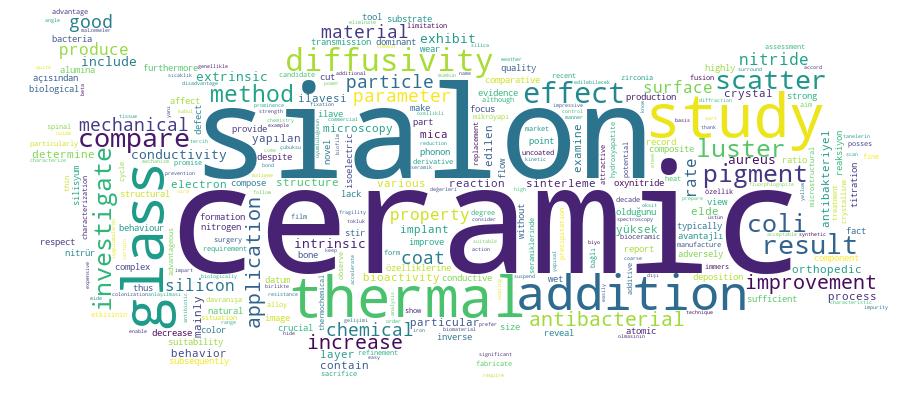
Competency Cloud
9 results
Scholarly Output Search Results
Now showing 1 - 9 of 9
Article Citation - WoS: 2Citation - Scopus: 2Coating of Si3n4 With Hap Via Atomic Layer Deposition(Korean Assoc Crystal Growth, inc, 2023) Akin, Seniz R. KushanSilicon nitride (Si3N4) is an attractive implant material, particularly in orthopedic surgery. Although it has only been on the market for spinal fusion surgery requirements so far, it is also a promising candidate for other implant applications where load-bearing is crucial. In this study, we aimed to examine the potential of making the material surface more advantageous for various implant applications by coating it with a very thin hydroxyapatite (HAp) layer using the atomic layer deposition (ALD) method. This was done to improve the material's bioactivity without sacrificing its mechanical properties. Characterization results showed that using a 3:1 CaO:PO4 ALD cycle ratio resulted in the formation of very fine crystalline HAp after heat treatment at 500 degrees C. The bioactivity assessment made by immersing the coated film in SBF revealed HAp formation on the surface, and it was observed that the bioactivity of this surface improved compared to the uncoated one.Article Citation - WoS: 17A Comparative Study of Silicon Nitride and Sialon Ceramics Against E. Coli(Elsevier Sci Ltd, 2021) Akin, Seniz R. Kushan; Garcia, Caterina Bartomeu; Webster, Thomas J.In recent decades, due to some limitations from alumina (Al2O3) and zirconia (ZrO2), silicon nitride (Si3N4) has been investigated as a novel bioceramic material, mainly in situations where a bone replacement is required. Si3N4 ceramics and its derivative form, SiAlON, possess advantages in orthopedics due to their mechanical properties and biologically acceptable chemistry, which accelerates bone repair. However, biological applications require additional properties, enabling stronger chemical bonding to the surrounding tissue for better fixation and the prevention of bacteria biofilm formation. Therefore, two commercial Si3N4 and SiAlON ceramics were investigated in this study and compared to each other according to their material properties (like wetting angles and surface chemistry) and their antibacterial behaviors using E. coli. Results provided evidence of a 15% reduction in E. coli colonization after just 24 h on Si3N4 compared to SiAlON which is impressive considering no antibiotics were used. Further, a mechanism of action is provided. In this manner, this study provides evidence that Si3N4 should be further studied for a wide range of antibacterial orthopedic, or other suitable biomaterial applications.Article Effects of Process Parameters on Fe2O3/α-Al2O3 Luster Pigments Produced By Precipitation Method(2020) Günhan, Büşra; Kaya, Güray; Kök, Mesut; Weinekotter, Çiğdem; Poyraz, H. Bogaç; Ceylantekin, Rasim; Kuşhan Akın, Şeniz ReyhanCommon known examples of substrate-based pigments are mica/TiO2 and mica/Fe2O3 luster pigments produced using wet chemical methods and gas-phase reaction techniques. Luster coatings, in particular those prepared using iron(III) oxide, come into prominence thanks to their characteristics of good hiding power and weather resistance, to name a few. Mica/Fluorphlogopite/Silica-based luster pigments have certain disadvantages due to following reasons: natural mica contains iron (Fe2O3) impurity which imparts a yellow color to the material, synthetic fluorphlogopite is quite expensive compared to natural mica and silica has a high production cost. In addition to these, fragility of mica bases due to their low mechanical strength adversely affects the luster effect. Reaction kinetics control is easier in wet chemical methods than in gas-phase reaction techniques since the coarse substrate particles can be kept suspended more easily by stirring. In this study, α-Al2O3/Fe2O3 luster pigments were produced using the wet chemical method/precipitation method by preferring plate-like alumina substrates in order to eliminate the afore-said problems. The pigments produced were characterized by X-ray diffraction (XRD), scanning electron microscopy (SEM), and energy-dispersive X-ray spectroscopy (EDX) methods and color analysis was performed. As a result, it was determined that the increase in titration flow rate and stirring rate in the production process of Fe2O3/α-Al2O3 luster pigment using the wet chemical method had no effect on the crystal structure of the resulting coating. However, while the stirring rate does not have a significant effect on the quality of coating, the increase in titration flow rate adversely affects the quality of coating.Article Effect of SiC addition on the thermal diffusivity of SiAlON ceramics(2017) Kuşhan Akın, Şeniz Reyhan; Turan, Servet; Gençoğlu, Pervin; Mandal, HasanDespite the fact that thermal conductivity is a crucial parameter for SiAlON ceramics with respect to their suitability in various applications, including high-temperature structural components, wear parts, and cutting tools, studies on SiAlON ceramics reported thus far mainly focus on the improvement of their mechanical properties. In view of the lack of sufficient studies on the thermal conductivity of SiAlON ceramics, this study investigates the improvement in the thermal diffusivity behaviour of SiAlON ceramics by the addition of highly conductive SiC particles. As solid-solution SiAlON ceramics exhibit complex crystal structures typically composed of defects, the phonon scattering increases, subsequently decreasing diffusivity. In particular, the improvement in the thermal diffusivity of both α- and β-SiAlONs was investigated by the addition of 0.25 wt% SiC. In addition, the effect of the SiC particle size on the thermal diffusivity of β-SiAlON was examined. Using inverse diffusivity data, intrinsic and extrinsic scattering parameters were determined, and compared to intrinsic scattering, extrinsic scattering was a dominant factor. Furthermore, transmission electron microscopy (TEM) images of SiCp-reinforced α and -β-SiAlON ceramics were recorded to examine the SiC particle distribution.Conference Object Microstructural Refinement of Ti-6Al-4V Alloy Fabricated by Additive Manufacturing Using Thermochemical Processes(2016) Bilgin, Güney Mert; Esen, Ziya; Kuşhan Akın, Şeniz Reyhan; Dericioğlu, Arcan FehmiArticle Citation - WoS: 5Citation - Scopus: 5Effect of Nitrogen on the Antibacterial Behavior of Oxynitride Glasses(Elsevier Sci Ltd, 2021) Akin, Seniz R. Kushan; Dolekcekic, Emrah; Webster, Thomas J.; Kushan Akin, Seniz R.The main drawback of bioglasses is their restricted use in load bearing applications and the consequent need to develop stronger glassy materials. This has led to the consideration of oxynitride glasses for numerous biomedical applications. This paper investigated two different types of glasses at a constant cationic ratio, with and without nitrogen (a N containing and a N-free glass composition) to better understand the effect of N on the biological properties of glasses. The results revealed that the addition of N increased the glass transition temperature, isoelectric point (IEP) and slightly increased wettability. Moreover, compared to N including glass, N-free glass exhibited better anti-bacterial activity against Escherichia coli (E. coli) and Staphylococcus aureus (S. aureus), two key bacteria that infect implants. In summary, these in vitro results indicated that amine functional groups existing in N containing glasses which are missing in N-free glasses, caused a slight difference in wetting behavior and a more obvious change in isoelectric point and in bacterial response. N-free glasses exhibited better inhibitory results both against E. coli and S. aureus compared to N including glass suggesting that oxygen rich glasses should be further studied for their novel antibacterial properties.Article Reaksiyon Bağlı Silisyum Nitrür Seramiklerinde Sinterleme İlavesinin Mikroyapı ve Antibakteriyel Davranışa Etkisinin İncelenmesi(2021) Kuşhan Akın, Şeniz ReyhanSilisyum Nitrür (Si3N4) genellikle yüksek sıcaklık ve yapısal uygulamalarda tercih edilen, üstün özellikli bir oksit dışı seramiktir. Çok sert bir malzeme olmasının yanı sıra, çubuksu beta () tanelerin gelişimi ile seramik malzemeler içinde yüksek kabul edilebilecek tokluk değerleri elde etmek mümkün olabilmektedir. Bu özelliklerine ilave olarak biyo uyumluluğunun da anlaşılması ile birlikte özellikle, bu malzemenin biyoseramik olarak kullanım potansiyelini arttırmak amacıyla son on yılda yapılan çalışmaların sayısı da artmıştır. Bu çalışmada da reaksiyon bağlama tekniği ile, çevre biyolojik dokularla entegrasyon açısından avantajlı olan gözenekli Si3N4 seramiklerinin üretilmesi amaçlanmıştır. Sinterleme ilavesi olarak sisteme yapılan CaO, Y2O3 ve CeO2 katkılarının, elde edilen Si3N4 seramiklerin fiziksel ve mikroyapısal özelliklerine ve bunların sonucu olarak antibakteriyel davranışlarına etkileri incelenmiştir. Elde edilen sonuçlar CeO2’in hem E. coli hem de S. aureus açısından dezavantajlı bir sinterleme ilavesi olduğunu, Y2O3’in ise en avantajlı ilave olduğunu görülmüştür. CaO ilavesi yapılan sistem ise E. coli için düşük, S. aureus için yüksek oranda bakteri üremesi ile sonuçlanmıştır.Correction A Comparative Study of Silicon Nitride and Sialon Ceramics Against E. Coli (Vol 47, Pg 1837, 2021)(Elsevier Sci Ltd, 2021) Akin, Seniz R. Kushan; Garcia, Caterina Bartomeu; Webster, Thomas J.; Bartomeu Garcia, Caterina; Kushan Akin, Seniz R.Article Citation - WoS: 11Effect of Sic Addition on the Thermal Diffusivity of Sialon Ceramics(Elsevier Sci Ltd, 2017) Akin, Seniz Reyhan Kushan; Turan, Servet; Gencoglu, Pervin; Mandal, HasanDespite the fact that thermal conductivity is a crucial parameter for SiAlON ceramics with respect to their suitability in various applications, including high-temperature structural components, wear parts, and cutting tools, studies on SiAlON ceramics reported thus far mainly focus on the improvement of their mechanical properties. In view of the lack of sufficient studies on the thermal conductivity of SiAlON ceramics, this study investigates the improvement in the thermal diffusivity behaviour of SiAlON ceramics by the addition of highly conductive SiC particles. As solid-solution SiAlON ceramics exhibit complex crystal structures typically composed of defects, the phonon scattering increases, subsequently decreasing diffusivity. In particular, the improvement in the thermal diffusivity of both alpha- and beta-SiAlONs was investigated by the addition of 0.25 wt% SiC. In addition, the effect of the SiC particle size on the thermal diffusivity of beta-SiAlON was examined. Using inverse diffusivity data, intrinsic and extrinsic scattering parameters were determined, and compared to intrinsic scattering, extrinsic scattering was a dominant factor. Furthermore, transmission electron microscopy (TEM) images of SiCp-reinforced a and -beta-SiAlON ceramics were recorded to examine the SiC particle distribution.