Bilgilendirme: Kurulum ve veri kapsamındaki çalışmalar devam etmektedir. Göstereceğiniz anlayış için teşekkür ederiz.
 

Altay, İsmail Fırat

Loading...
Profile Picture
Name Variants
Job Title
Okutman
Email Address
Main Affiliation
Yabancı Diller Bölümü
Status
Former Staff
Website
ORCID ID
Scopus Author ID
Turkish CoHE Profile ID
Google Scholar ID
WoS Researcher ID

Sustainable Development Goals

13

CLIMATE ACTION
CLIMATE ACTION Logo

0

Research Products

8

DECENT WORK AND ECONOMIC GROWTH
DECENT WORK AND ECONOMIC GROWTH Logo

0

Research Products

3

GOOD HEALTH AND WELL-BEING
GOOD HEALTH AND WELL-BEING Logo

0

Research Products

15

LIFE ON LAND
LIFE ON LAND Logo

0

Research Products

17

PARTNERSHIPS FOR THE GOALS
PARTNERSHIPS FOR THE GOALS Logo

0

Research Products

14

LIFE BELOW WATER
LIFE BELOW WATER Logo

0

Research Products

4

QUALITY EDUCATION
QUALITY EDUCATION Logo

1

Research Products

11

SUSTAINABLE CITIES AND COMMUNITIES
SUSTAINABLE CITIES AND COMMUNITIES Logo

0

Research Products

6

CLEAN WATER AND SANITATION
CLEAN WATER AND SANITATION Logo

0

Research Products

10

REDUCED INEQUALITIES
REDUCED INEQUALITIES Logo

0

Research Products

9

INDUSTRY, INNOVATION AND INFRASTRUCTURE
INDUSTRY, INNOVATION AND INFRASTRUCTURE Logo

0

Research Products

12

RESPONSIBLE CONSUMPTION AND PRODUCTION
RESPONSIBLE CONSUMPTION AND PRODUCTION Logo

0

Research Products

2

ZERO HUNGER
ZERO HUNGER Logo

0

Research Products

1

NO POVERTY
NO POVERTY Logo

0

Research Products

7

AFFORDABLE AND CLEAN ENERGY
AFFORDABLE AND CLEAN ENERGY Logo

0

Research Products

5

GENDER EQUALITY
GENDER EQUALITY Logo

0

Research Products

16

PEACE, JUSTICE AND STRONG INSTITUTIONS
PEACE, JUSTICE AND STRONG INSTITUTIONS Logo

0

Research Products
This researcher does not have a Scopus ID.
This researcher does not have a WoS ID.
Scholarly Output

1

Articles

1

Views / Downloads

140/165

Supervised MSc Theses

0

Supervised PhD Theses

0

WoS Citation Count

0

Scopus Citation Count

0

WoS h-index

0

Scopus h-index

0

Patents

0

Projects

0

WoS Citations per Publication

0.00

Scopus Citations per Publication

0.00

Open Access Source

1

Supervised Theses

0

Google Analytics Visitor Traffic

JournalCount
Journal of Language and Linguistic Studies1
Current Page: 1 / 1

Scopus Quartile Distribution

Quartile distribution chart data is not available

Competency Cloud

GCRIS Competency Cloud

Scholarly Output Search Results

Now showing 1 - 1 of 1
  • Article
    The evaluation of instructors’ views on the use of semiotics in English classrooms
    (2018) Altay, İsmail Fırat; Karaazmak, Fulda
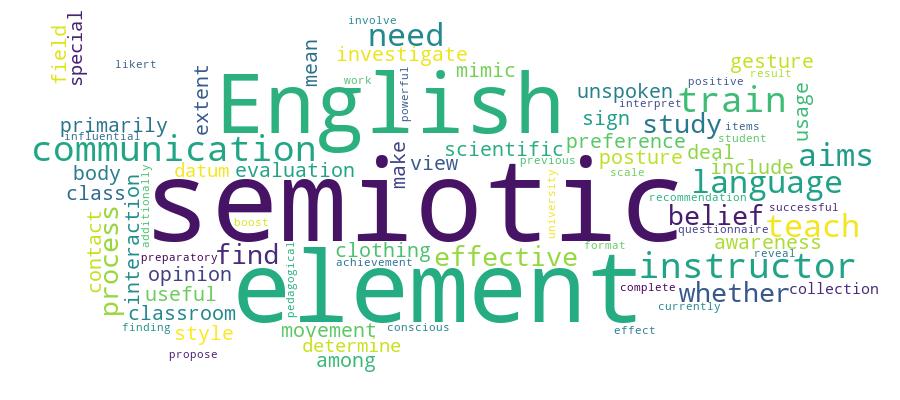
    Semiotics is the scientific field dealing with the meaning making process via signs and symbols. This study primarily aims at investigating the opinions and preferences of English instructors about the usage of semiotic elements such as mimics, gestures, body movements, posture, eye contact, and clothing in language teaching classrooms. Instructors’ awareness of the unspoken interaction in the class, to what extent they are using the semiotic elements in their teaching style, whether they find these elements useful or not are among the aims of this study. Further aims include determining whether or not language instructors need training about the effective use of non-verbal communication and which semiotic elements they may need special training in. In the data collection process, a questionnaire involving 20 items in a Likert scale format is completed by 40 English instructors, who are currently working in a university preparatory school. The results of the study reveal English instructors’ positive beliefs about the effective use of semiotic elements in their teaching and the powerful effect of successful non-verbal communication to boost student achievement and motivation. Additionally, having previous training on non-verbal communication use is found to be influential on instructors’ belief, which is interpreted as a need for training about the conscious use of semiotic elements in language teaching. Based on these findings, some pedagogical recommendations are proposed for further research.