
Derviş, Hamid
Loading...

Profile URL
Name Variants
Darvısh, Hamid
Darvish, Hamid
Darvish, Hamid R.
Darvish, Hamid
Darvish, Hamid R.
Job Title
Öğr. Gör. Dr.
Email Address
darvish@cankaya.edu.tr
Main Affiliation
Ortak Dersler Bölümü
Status
Former Staff
Website
ORCID ID
Scopus Author ID
Turkish CoHE Profile ID
Google Scholar ID
WoS Researcher ID
Sustainable Development Goals
 1
1NO POVERTY
0
Research Products
 2
2ZERO HUNGER
0
Research Products
 3
3GOOD HEALTH AND WELL-BEING
0
Research Products
 4
4QUALITY EDUCATION
0
Research Products
 5
5GENDER EQUALITY
0
Research Products
 6
6CLEAN WATER AND SANITATION
0
Research Products
 7
7AFFORDABLE AND CLEAN ENERGY
0
Research Products
 8
8DECENT WORK AND ECONOMIC GROWTH
0
Research Products
 9
9INDUSTRY, INNOVATION AND INFRASTRUCTURE
0
Research Products
 10
10REDUCED INEQUALITIES
0
Research Products
 11
11SUSTAINABLE CITIES AND COMMUNITIES
0
Research Products
 12
12RESPONSIBLE CONSUMPTION AND PRODUCTION
0
Research Products
 13
13CLIMATE ACTION
0
Research Products
 14
14LIFE BELOW WATER
0
Research Products
 15
15LIFE ON LAND
0
Research Products
 16
16PEACE, JUSTICE AND STRONG INSTITUTIONS
1
Research Products
 17
17PARTNERSHIPS FOR THE GOALS
0
Research Products

This researcher does not have a Scopus ID.

This researcher does not have a WoS ID.

Scholarly Output
6
Articles
5
Views / Downloads
883/365
Supervised MSc Theses
0
Supervised PhD Theses
0
WoS Citation Count
35
Scopus Citation Count
40
Patents
0
Projects
0
WoS Citations per Publication
5.83
Scopus Citations per Publication
6.67
Open Access Source
3
Supervised Theses
0
| Journal | Count |
|---|---|
| Bilgi Dünyası | 1 |
| Çankaya Üniversitesi Fen Edebiyat Fakültesi Journal of Arts and Sciences | 1 |
| Çankaya University Journal of Humanities and Social Sciences | 1 |
| Collnet Journal of Scientometrics and Information Management | 1 |
| Journal of Informetrics | 1 |
Current Page: 1 / 2
Scopus Quartile Distribution
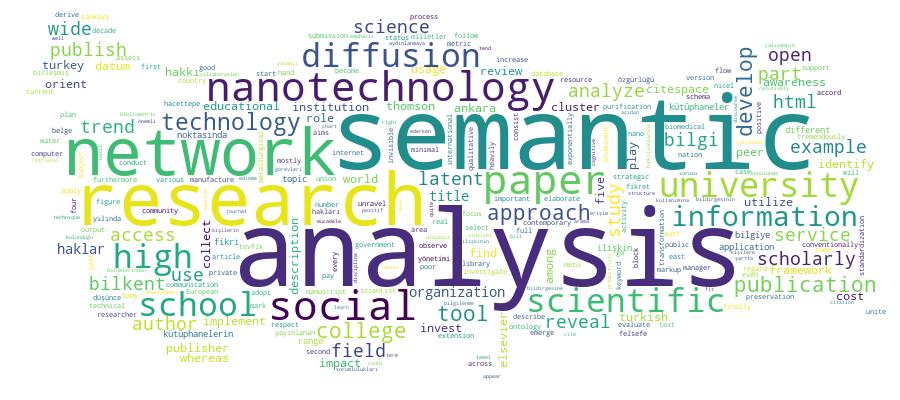
Competency Cloud
6 results
Scholarly Output Search Results
Now showing 1 - 6 of 6
Conference Object A Study of the Information Services on Turkish High Schools(Elsevier Science Bv, 2011) Darvish, Hamid R.The World Wide Web went public in 1989. Since then, every organization has come to utilize web-based technologies for their various purposes. Educational institutions have implemented web technology in their contemporary curriculums. The aim of this study is to investigate five private schools in Ankara, Turkey and to unravel the impact of information technology (internet usage, information services) in their programs. The five high schools were: Ari College, TED Ankara College, Tevfik Fikret High School, METU (Middle East Technical University) College and Bilkent High School. We conducted a qualitative research on the selected high schools by observing and collecting data. Research was done from March-May 2009. We found out that internet services in high schools are not utilized to their full capacity. (C) 2011 Published by Elsevier Ltd.Article “Is semantic web real or hype?(Çankaya Üniversitesi, 2007) Darvish, Hamid R.In this paper, first, I describe semantic web and second, I elaborate on four blocks of semantic web (XML, Resource Description Framework (RDF), RDF Schema, and Ontology) and finally some example of current semantic web tools and application. Semantic web is an extension of HTML (Hyper Text Mark up Language) and XML (Extensible Markup Language). XML and HTML play big part on semantic web implementation. The semantic web has been supported by W3C (www.w3c.org) organization, an international organization body for World Wide Web standardizationArticle Düşünce Özgürlüğü ve Kütüphaneler: Nicel bir İnceleme(2010) Darvısh, HamidBirleşmiş Milletler tarafından 1948 yılında yayınlanan İnsan Hakları Bildirgesinin en önemli bölümlerinden bir tanesi kişilere her şartta bilgi arama ve bilgi edinme hakkı tanınmasıdır. Bu açıdan, kütüphanelerin kişilerin bilgiye ulaşması noktasında ciddi görevleri ve sorumlulukları bulunmaktadır. Kütüphanelerin kullanımına ilişkin Haklar Bildirgesine (Library Bill of Rights) göre “kütüphaneler bilgilenme ve aydınlanmaya ilişkin fonksiyonlarını ifa ederken yasakçı zihniyet ile mücadele etmelidirler”. Bu çalışmanın temel sorusu; kütüphaneler fikri haklar ve bilgiye erişim hakkı noktasında nasıl bir rol üstlenmelidirler? Çalışmada kütüphaneler ile fikri haklar konusunda pozitif bir ilişkinin bulunduğu savunulmaktadır.Article Open Access Awareness in Scholarly Communication: The Case of Çankaya University(2011) Darvish, HamidThe Scholarly Communications processes consist of collecting and analyzing of data—including published information—through its transformation into publications or other output, and its usage or preservation by other users. In this respect, researchers, publishers, libraries and data managers play important roles in applying and implementing of scholarly communications.1 Conventionally, the flow of scientific papers’ publication starts by a research activity followed by manuscript submission, peer review, publishing cost by publisher and so on. Whereas, in open access publication, after peer review the cost of publication is paid by the author (See, Figure 1).Article Citation - WoS: 34Citation - Scopus: 40Diffusion of Latent Semantic Analysis as a Research Tool: a Social Network Analysis Approach(Elsevier, 2010) Tonta, Yasar; Darvish, Hamid R.Latent semantic analysis (LSA) is a relatively new research tool with a wide range of applications in different fields ranging from discourse analysis to cognitive science, from information retrieval to machine learning and so on. In this paper, we chart the development and diffusion of LSA as a research tool using social network analysis (SNA) approach that reveals the social structure of a discipline in terms of collaboration among scientists. Using Thomson Reuters' Web of Science (WoS), we identified 65 papers with "latent semantic analysis" in their titles and 250 papers in their topics (but not in titles) between 1990 and 2008. We then analyzed those papers using bibliometric and SNA techniques such as co-authorship and cluster analysis. It appears that as the emphasis moves from the research tool (LSA) itself to its applications in different fields, citations to papers with LSA in their titles tend to decrease. The productivity of authors fits Lotka's Law while the network of authors is quite loose. Networks of journals cited in papers with LSA in their titles and topics are well connected. (C) 2009 Elsevier Ltd. All rights reserved.Article Citation - WoS: 1Assessing the Diffusion of Nanotechnology in Turkey: a Social Network Analysis Approach(Taru Publications, 2012) Darvish, HamidAccording to the United Nations, nanotechnology is one of the emerging research fields which will have a positive impact on both developing and developed countries. For example, nanotechnology is used for water purification in poor countries. On the other hand, it is used in developed countries (rich) to manufacture better computer devices. Nanotechnology is a part of the strategic plan for each developing country. For example, the 7th European Union Scientific Framework (EUSF) has invested tremendously in nanotechnology since 2000. The Turkish government also has adopted a new approach by becoming part of the EUSF and has invested heavily in research and development. Focusing on an invisible college in the scientific community in Turkey, this study aims to evaluate the diffusion of nanotechnology among scientists. Using social network analysis metrics, we identified and analyzed the role and status of scientists in the two most prominent universities (Hacettepe University & Bilkent University) regarding nano-related technologies diffusion in Turkey. We found that co-authorship across the two universities is minimal, even in subject area research in both universities. However, the number of nano-related articles have increased exponentially in past decade in Turkey. Furthermore, a co-word analysis revealed the scientific trends in both universities. Keywords description revealed that the scientific trends in Hacettepe University are mostly nano biomedical research oriented whereas in Bilkent University scientific trends are metallurgical oriented in nano-related technologies. Data were derived from Thomson Reuters' Web of Science (WoS) version 4 database and CiteSpace was used to map the co-author network structure.
