
Bingöl, Hilal
Loading...
Profile URL
Name Variants
Bingol, Hilal
Job Title
Arş. Gör.
Email Address
hilalbingol@cankaya.edu.tr
Main Affiliation
Mekatronik Mühendisliği
Status
Current Staff
Website
ORCID ID
Scopus Author ID
Turkish CoHE Profile ID
Google Scholar ID
WoS Researcher ID
Files
Sustainable Development Goals
 1
1NO POVERTY
0
Research Products
 2
2ZERO HUNGER
0
Research Products
 3
3GOOD HEALTH AND WELL-BEING
1
Research Products
 4
4QUALITY EDUCATION
0
Research Products
 5
5GENDER EQUALITY
0
Research Products
 6
6CLEAN WATER AND SANITATION
0
Research Products
 7
7AFFORDABLE AND CLEAN ENERGY
0
Research Products
 8
8DECENT WORK AND ECONOMIC GROWTH
0
Research Products
 9
9INDUSTRY, INNOVATION AND INFRASTRUCTURE
0
Research Products
 10
10REDUCED INEQUALITIES
0
Research Products
 11
11SUSTAINABLE CITIES AND COMMUNITIES
0
Research Products
 12
12RESPONSIBLE CONSUMPTION AND PRODUCTION
0
Research Products
 13
13CLIMATE ACTION
0
Research Products
 14
14LIFE BELOW WATER
0
Research Products
 15
15LIFE ON LAND
0
Research Products
 16
16PEACE, JUSTICE AND STRONG INSTITUTIONS
0
Research Products
 17
17PARTNERSHIPS FOR THE GOALS
0
Research Products

This researcher does not have a Scopus ID.

Documents
5
Citations
6
No records found in other affiliations.

Scholarly Output
8
Articles
3
Views / Downloads
953/29
Supervised MSc Theses
1
Supervised PhD Theses
0
WoS Citation Count
6
Scopus Citation Count
6
Patents
0
Projects
0
WoS Citations per Publication
0.75
Scopus Citations per Publication
0.75
Open Access Source
2
Supervised Theses
1
| Journal | Count |
|---|---|
| 28th Signal Processing and Communications Applications Conference (SIU) -- OCT 05-07, 2020 -- ELECTR NETWORK | 1 |
| 31st IEEE Conference on Signal Processing and Communications Applications (SIU) -- JUL 05-08, 2023 -- Istanbul Tech Univ, Ayazaga Campus, Istanbul, TURKEY | 1 |
| 7th Enginnering and Technology Symposium | 1 |
| 7th International Congress on Human-Computer Interaction, Optimization and Robotic Applications-ICHORA -- MAY 23-24, 2025 -- Ankara, TURKIYE | 1 |
| IEEE Transactions on Intelligent Transportation Systems | 1 |
Current Page: 1 / 2
Scopus Quartile Distribution
Competency Cloud
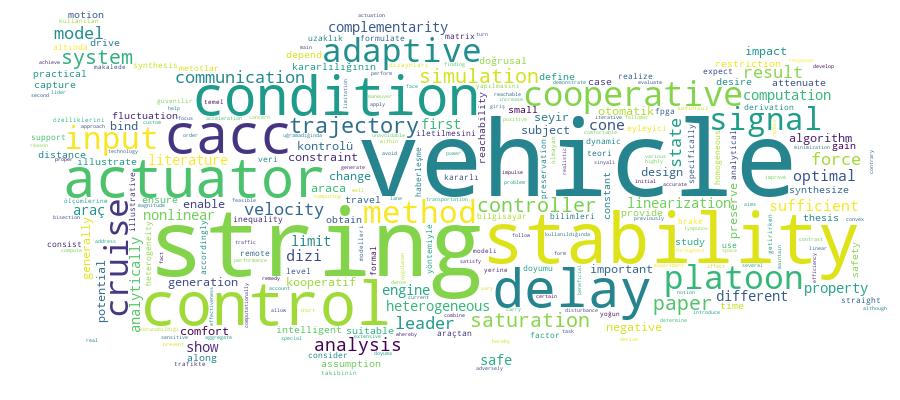
8 results
Scholarly Output Search Results
Now showing 1 - 8 of 8
Conference Object Controller Design for Cacc With Time-Varying Communication Delays(Ieee, 2023) Soysal, Gokhan; Schmidt, Klaus Werner; Bingol, HilalCooperative Adaptive Cruise Control (CACC) aims at the safe and comfortable travel of vehicles at short distances in the form of platoons. Hereby, it is generally desired to attenuate disturbances along vehicles in a platoon, which is captured by different string stability conditions. In this paper, we focus on L-infinity string stability. This condition ensures reducing the magnitude of the acceleration signal along the platoon, which helps to avoid actuator saturation and increases driving comfort. Since the performance of CACC is adversely affected by time-varying communication and actuator delays, we develop the first controller design method for L-infinity-string stability, combining the Lyapunov-Krasovskii method and our custom bisection algorithm. Simulation experiments demonstrate the effectiveness of our method.Conference Object Controller Synthesis With a Cone Complementarity Linearization Algorithm for CACC System Under Time-Varying Delay(IEEE, 2025) Bingol, HilalCooperative Adaptive Cruise Control (CACC) is an intelligent vehicle technology that enables vehicle follow-up in a small inter-vehicle distance. Stability is the main property of the CACC system that prevents any signal fluctuations throughout the vehicle string. In CACC system, time delay has a negative impact on string stability. The reason is that constant and varying time delays are unavoidable in real traffic. Here, controller gains should be synthesized under constant and time-varying communication delays to satisfy L-2-string stability conditions (in the Lyapunov sense). Contrary to previously studied convex method, controller gains are now synthesized with iterative nonlinear minimization algorithm and Cone Complementarity Linearization (CCL) method. The results show that the new CCL approach provides more accurate and practical stability bounds. Hence, this shows the potential of CCL to perform more sensitive analyses. The results obtained are evaluated by simulations with the heterogeneous CACC system.Master Thesis String stability analysis of Cooperative Adaptive Cruise Control (CACC) with actuator saturation(Çankaya Üniversitesi, 2017) Bingöl, HilalIntelligent transportation systems aim at improving the efficiency and safety of transportation. In dense traffic, vehicles are aggregated to vehicle strings that travel on the same lane, whereby it is desired to maintain a small but safe distance between the vehicles. In the literature, this task is captured by the notion of string stability: fluctuations that are introduced by maneuvers of the leader vehicle should be attenuated by the follower vehicles. The literature provides various methods for achieving string stability under the assumption that the vehicles are modeled as linear systems. In this thesis, we study the case where vehicles are modeled as nonlinear systems and hence face actuation constraints as well as state constraints. Different methods are employed. First, a reachability analysis based on the level-set method determines the states that are reachable under limitations on the engine force of vehicles. It turns out in the thesis that, although the reachability analysis is the proper method to analytically address the problem of saturation, it is computationally not feasible due to the large state space of the vehicle model. As a remedy, a further analysis of the model is carried out for the special case of maneuvers. Based on the realistic assumption that the impulse response of the vehicle following model is positive, several sufficient conditions for the input signal of the leader vehicle are derived in order to preserve string stability under actuator saturation. The first set of condition is concerned with the computation of maximum/minimum input signal that generated based on optimal control solution. These maximum/minimum input signals depend on the initial velocity of the vehicle string. The second set of conditions allows computing suitable input signals of the leader vehicle analytically and is hence highly beneficial in practice. The obtained results are illustrated by extensive simulation experiments.Conference Object Citation - WoS: 1Citation - Scopus: 2Trajectory Generation for Vehicle Platoons With Input and State Constraints(Ieee, 2020) Schmidt, Klaus Werner; Bingol, HilalThe motion of vehicle platoons depends on the motion of the platoon leader. The subject of this paper is the computation of minimum-time leader trajectories for velocity changes in platoons. In contrast to the current literature, input restriction is defined due to the fact that the engine power is within certain limits and condition restriction is defined for safe travelling. Applying cooperative adaptive cruise control, we ensure driving safety and comfort, and we account for practical limits on the input signal of all platoon vehicles. We show that suitable trajectories can be computed analytically and we illustrate our findings by a simulation study.Conference Object Image-Based Remote Control Using FPGA(2014) Bingöl, Hilal; Kısa Işık, Gizay; Başayar, Tuğba; Genç, Fatih; Yengel, EmreArticle Citation - WoS: 4Citation - Scopus: 4String Stability Under Actuator Saturation on Straight Level Roads: Sufficient Conditions and Optimal Trajectory Generation(Ieee-inst Electrical Electronics Engineers inc, 2022) Bingol, Hilal; Schmidt, Klaus WernerThe heterogeneity of vehicles is an important factor when realizing cooperative adaptive cruise control (CACC) in practice. Specifically, it has to be considered that platoons generally consist of vehicles with both different dynamic properties and actuator limits on the engine and braking force, which is expected to have a negative impact on important properties such as string stability. Accordingly, the subject of this paper is the preservation of string stability for CACC in heterogeneous vehicle strings with potential actuator saturation. To this end, the paper formulates a velocity-dependent force bound that enables the derivation of sufficient conditions for preserving string stability during velocity changes of heterogeneous platoons. These conditions are then used for the analytical computation of trajectories for time-optimal velocity changes. The formal results of the paper are supported by an illustrative simulation study.Article Citation - WoS: 1Eyleyici Doyumu Altında Dizi Kararlı Kooperatif Otomatik Seyir Kontrolü(2016) Çankaya, Erkam; Bingöl, Hilal; Schmidt, Klaus WernerKooperatif otomatik seyir kontrolü (CACC), araçtan araca haberleşme yöntemiyle veri iletilmesini ve uzaklık ölçümlerine göre yoğun trafikte güvenilir araç takibinin yapılmasını sağlar. Kullanılan CACC dizaynları dizi kararlılığının temel özelliklerini sorunsuz bir şekilde yerine getirirken doğrusal araç modelleri için sınırlıdır. Bu makalede ise, doğrusal olmayan araç modeli kullanıldığında ve lider araca uygulanan giriş sinyali doyuma uğramadığında dizi kararlılığının korunabildiği gösterilmiştir.Article String Stable Cooperative Adaptive Cruise Control under Actuator Saturation(Pamukkale Univ, 2016) Schmidt, Klaus Werner; Cankaya, Erkam; Bingol, HilalCooperative adaptive cruise control (CACC) enables safe vehicle following in dense traffic based on distance measurements and communicated data via vehicle-to-vehicle communication. Existing CACC designs achieve the essential property of string stability but are limited to linear vehicle models. In this paper, we show that string stability is preserved when using a nonlinear vehicle model if the input signal of the leader vehicle does not saturate.