Bilgilendirme: Kurulum ve veri kapsamındaki çalışmalar devam etmektedir. Göstereceğiniz anlayış için teşekkür ederiz.
 

Küçüksakallı, Nurgül

Loading...
Profile Picture
Name Variants
Gökgöz Küçüksakallı, Nurgül
Job Title
Öğr. Gör.
Email Address
ngokgoz@cankaya.edu.tr
Main Affiliation
Matematik
Status
Current Staff
Website
Scopus Author ID
Turkish CoHE Profile ID
Google Scholar ID
WoS Researcher ID

Sustainable Development Goals

11

SUSTAINABLE CITIES AND COMMUNITIES
SUSTAINABLE CITIES AND COMMUNITIES Logo

0

Research Products

3

GOOD HEALTH AND WELL-BEING
GOOD HEALTH AND WELL-BEING Logo

1

Research Products

9

INDUSTRY, INNOVATION AND INFRASTRUCTURE
INDUSTRY, INNOVATION AND INFRASTRUCTURE Logo

0

Research Products

6

CLEAN WATER AND SANITATION
CLEAN WATER AND SANITATION Logo

0

Research Products

14

LIFE BELOW WATER
LIFE BELOW WATER Logo

1

Research Products

12

RESPONSIBLE CONSUMPTION AND PRODUCTION
RESPONSIBLE CONSUMPTION AND PRODUCTION Logo

0

Research Products

8

DECENT WORK AND ECONOMIC GROWTH
DECENT WORK AND ECONOMIC GROWTH Logo

1

Research Products

1

NO POVERTY
NO POVERTY Logo

0

Research Products

4

QUALITY EDUCATION
QUALITY EDUCATION Logo

0

Research Products

5

GENDER EQUALITY
GENDER EQUALITY Logo

0

Research Products

10

REDUCED INEQUALITIES
REDUCED INEQUALITIES Logo

0

Research Products

16

PEACE, JUSTICE AND STRONG INSTITUTIONS
PEACE, JUSTICE AND STRONG INSTITUTIONS Logo

0

Research Products

15

LIFE ON LAND
LIFE ON LAND Logo

1

Research Products

7

AFFORDABLE AND CLEAN ENERGY
AFFORDABLE AND CLEAN ENERGY Logo

0

Research Products

13

CLIMATE ACTION
CLIMATE ACTION Logo

2

Research Products

17

PARTNERSHIPS FOR THE GOALS
PARTNERSHIPS FOR THE GOALS Logo

1

Research Products

2

ZERO HUNGER
ZERO HUNGER Logo

2

Research Products
This researcher does not have a Scopus ID.
This researcher does not have a WoS ID.
Scholarly Output

4

Articles

3

Views / Downloads

328/2587

Supervised MSc Theses

1

Supervised PhD Theses

0

WoS Citation Count

0

Scopus Citation Count

0

WoS h-index

0

Scopus h-index

0

Patents

0

Projects

0

WoS Citations per Publication

0.00

Scopus Citations per Publication

0.00

Open Access Source

4

Supervised Theses

1

JournalCount
Black Sea Journal of Engineering and Science2
Journal of Mathematical Sciences and Modelling (Online)1
Current Page: 1 / 1

Scopus Quartile Distribution

Quartile distribution chart data is not available

Competency Cloud

GCRIS Competency Cloud

Scholarly Output Search Results

Now showing 1 - 4 of 4
  • Article
    Forecasting Covid-19 Cases in Türkiye With the Help of Lstm
    (2023) Gokgoz, Nurgul
    Even though, it is thought that the pandemic has come to an end, the humanity is still under the danger of upcoming pandemics. In that sense, every effort to understand or predict the nature of an infectious disease is very precious since those efforts will provide experience for upcoming infectious disease epidemic/pandemic. Mathematical models provide a common way to analyze the nature of the pandemic. Apart from those mathematical models that mostly determine which variables should be used in the model to predict the nature of the epidemic and at which rate the disease will spread, deep learning models can also provide a fast and practical tool. Moreover, they can shed a light on which variables should be taken into account in the construction of a mathematical model. And also, deep learning methods give rapid results in the robust forecasting trends of the number of new patients that a country will deal with. In this work, a deep learning model that forecasts time series data using a long short-term memory (LSTM) network is used. The time series data used in this project is COVID-19 data taken from the Health Ministry of Republic of Türkiye. The weekend isolation and vaccination are not considered in the deep learning model. It is seen that even though the graph is consistent and similar to the graph of real number of patients, and LSTM is an effective tool to forecast new cases, those parameters, isolation and vaccination, must be taken into account in the construction of mathematical models and also in deep learning models as well.
  • Article
    A Chain Rule for Reduced Functional Differential Inclusions and Stability Theorems
    (2025) Gokgoz, Nurgul
    In order to represent real-world problems, modeling and stability concepts of a system are two essential steps, and functional differential inclusions become favorable among other methods because of their flexibility and robustness to handle those problems. Thus, functional differential inclusions (FDIs) provide a solid foundation for engineering problems, and the calculation of their derivatives becomes an important issue in checking the stability of them. Especially, to check the Lyapunov stability, various chain rules for FDIs are defined in the literature. In this work, a new chain rule is introduced in terms of the reduction procedure, a comparison with another one is represented, and the stability theorems in terms of Lyapunov are extended to the reduced functional differential inclusions.
  • Article
    For a Depensatory Fishery System Hybrid Modeling and Optimal Control of Harvest Policies
    (2025) Cıfdaloz, Oguzhan; Gokgoz, Nurgul
    Recent decades have brought an increasing concern for the sustainability of renewable resources, such as agricultural land, freshwater, forests, and fisheries. Management and control of them have been conducted through some institutions and governments, which mainly focus on efficiently managing those resources since they are affected by social and ecological uncertainties like climate change, difficulty in the application strategies, or uncertainties and noise in the data collection. Control engineering procedures represent a flexible and reasonable way to investigate and solve the difficulties, uncertainties, and noise listed above by formulating the problem mathematically. In this work, we investigate fisheries and revenue optimization by using a hybrid model. The harvest of the fishery is done during some seasons of the year, which suggests that the model should include both discrete and continuous dynamics. To investigate the bio-economic system, the problem is formulated by two-hybrid dynamical fishery models. Those formulations are used to investigate optimal control and the stability of the sustainability of the system. In this respect, we investigate the optimal effort for the maximization of the revenue where the continuation of sustainability is preserved. Moreover, which parameters should be taken into account to check the stability in this case are determined. Whenever the system is unstable, the optimal effort for the sustainability of the system is determined.
  • Master Thesis
    Stability and optimal control of hybrid models of fishery
    (2022) Gökgöz Küçüksakallı, Nurgül
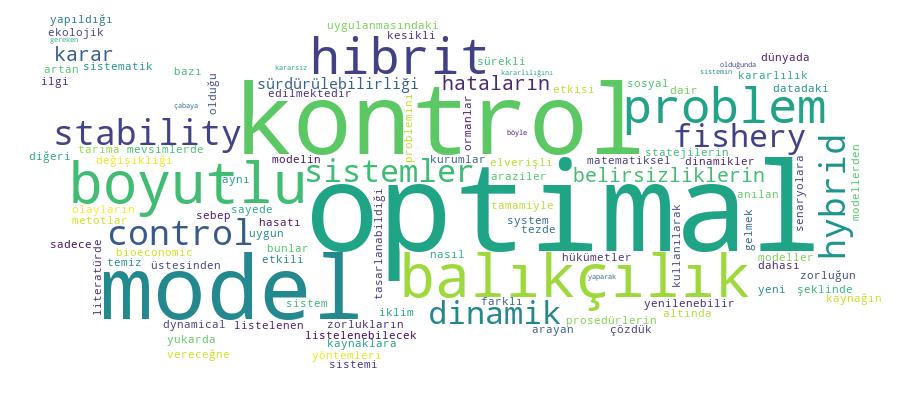
    Tüm dünyada, balıkçılık, ormanlar, tarıma elverişli araziler ve temiz su şeklinde listelenebilecek yenilenebilir kaynaklara artan bir ilgi bulunmaktadır. Bunlar, iklim değişikliği gibi sosyal ve ekolojik olayların sebep olduğu belirsizliklerin, statejilerin uygulanmasındaki prosedürlerin zorluğun ve datadaki hataların etkisi altında nasıl etkili karar vereceğne dair metotlar arayan kurumlar ve hükümetler tarafından kontrol edilmektedir ve yönetilmektedir. Kontrol sistem yöntemleri, problem bir matematiksel problem olarak tasarlanabildiği için, yukarda listelenen zorlukların, belirsizliklerin ve hataların üstesinden gelmek için uygun bir yol sunar. Bu sayede, kaynağın sürdürülebilirliği sistematik bir şekilde farklı senaryolara göre incelenebilir. Dahası, balıkçılık hasatı sadece bazı mevsimlerde yapıldığı için, problem literatürde hibrit dinamik sistemler olarak anılan kesikli ve sürekli dinamikler kullanılarak modellenmelidir. Bu tezde, balıkçılık için iki yeni hibrit model tanımlıyoruz. Modellerden biri bir boyutlu ve diğeri iki boyutlu ve tamamiyle aynı sistemi gösteriyorlar. Bir boyutlu olan için optimal kontrol problemini çözdük ve iki boyutlu modelin kararlılığını kontrol ettik. Böyle yaparak, model kararsız olduğunda, sistemin sürdürülebilirliği için gereken optimal çabaya karar veriyoruz.