Bilgilendirme: Kurulum ve veri kapsamındaki çalışmalar devam etmektedir. Göstereceğiniz anlayış için teşekkür ederiz.
 

Musa, Moahmed Elhafız Mustafa

Loading...
Profile Picture
Name Variants
Musa, Mohamed E.M.
Musa, MEM
Job Title
Öğr. Gör.
Email Address
Main Affiliation
Bilgisayar Mühendisliği
Status
Former Staff
Website
ORCID ID
Scopus Author ID
Turkish CoHE Profile ID
Google Scholar ID
WoS Researcher ID

Sustainable Development Goals

SDG data is not available
This researcher does not have a Scopus ID.
This researcher does not have a WoS ID.
Scholarly Output

3

Articles

2

Views / Downloads

252/5

Supervised MSc Theses

0

Supervised PhD Theses

0

WoS Citation Count

5

Scopus Citation Count

7

WoS h-index

1

Scopus h-index

2

Patents

0

Projects

0

WoS Citations per Publication

1.67

Scopus Citations per Publication

2.33

Open Access Source

0

Supervised Theses

0

Google Analytics Visitor Traffic

JournalCount
18th International Symposium on Computer and Information Sciences (ISCIS 2003) -- NOV 03-05, 2003 -- ANTALYA, TURKEY1
Lecture Notes in Computer Science (including subseries Lecture Notes in Artificial Intelligence and Lecture Notes in Bioinformatics)1
Pattern Recognition Letters1
Current Page: 1 / 1

Scopus Quartile Distribution

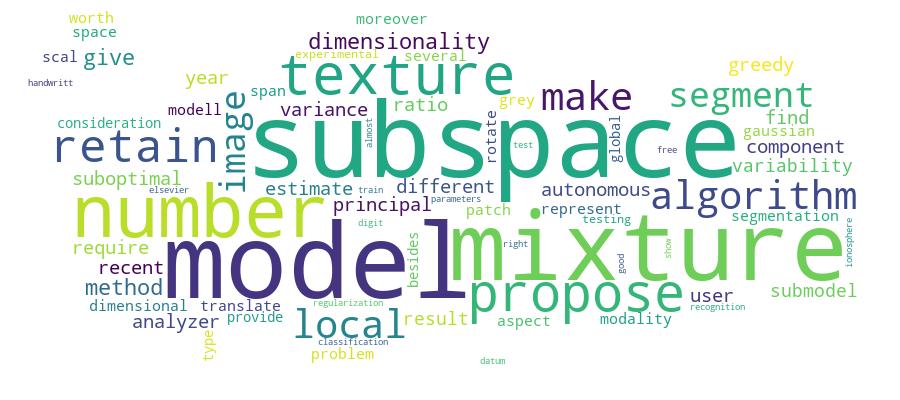
Competency Cloud

GCRIS Competency Cloud

Scholarly Output Search Results

Now showing 1 - 3 of 3
  • Article
    Texture segmentation using the mixtures of principal component analyzers
    (2003) Musa, Mohamed E.M.; Duin, Robert P.W.; De Ridder, Dick; Atalay, Volkan
    The problem of segmenting an image into several modalities representing different textures can be modelled using Gaussian mixtures. Moreover, texture image patches when translated, rotated or scaled lie in low dimensional subspaces of the high-dimensional space spanned by the grey values. These two aspects make the mixture of local subspace models worth consideration for segmenting this type of images. In recent years a number of mixtures of local PCA models have been proposed. Most of these models require the user to set the number of subspaces and subspace dimensionalities. To make the model autonomous, we propose a greedy EM algorithm to find a suboptimal number of subspaces, besides using a global retained variance ratio to estimate for each subspace the dimensionality that retains the given variability ratio. We provide experimental results for testing the proposed method on texture segmentation.
  • Article
    Citation - WoS: 4
    Citation - Scopus: 5
    Almost Autonomous Training of Mixtures of Principal Component Analyzers
    (Elsevier Science Bv, 2004) Musa, MEM; de Ridder, D; Duin, RPW; Atalay, V
    In recent years, a number of mixtures of local PCA models have been proposed. Most of these models require the user to set the number of submodels (local models) in the mixture and the dimensionality of the submodels (i.e., number of PC's) as well. To make the model free of these parameters, we propose a greedy expectation-maximization algorithm to find a suboptimal number of submodels. For a given retained variance ratio, the proposed algorithm estimates for each submodel the dimensionality that retains this given variability ratio. We test the proposed method on two different classification problems: handwritten digit recognition and 2-class ionosphere data classification. The results show that the proposed method has a good performance. (C) 2004 Elsevier B.V. All rights reserved.
  • Conference Object
    Citation - WoS: 1
    Citation - Scopus: 2
    Texture Segmentation Using the Mixtures of Principal Component Analyzers
    (Springer-verlag Berlin, 2003) Musa, MEM; Duin, RPW; de Ridder, D; Atalay, V
    The problem of segmenting an image into several modalities representing different textures can be modelled using Gaussian mixtures. Moreover, texture image patches when translated, rotated or scaled lie in low dimensional subspaces of the high-dimensional space spanned by the grey values. These two aspects make the mixture of local subspace models worth consideration for segmenting this type of images. In recent years a number of mixtures of local PCA models have been proposed. Most of these models require the user to set the number of subspaces and subspace dimensionalities. To make the model autonomous, we propose a greedy EM algorithm to find a suboptimal number of subspaces, besides using a global retained variance ratio to estimate for each subspace the dimensionality that retains the given variability ratio. We provide experimental results for testing the proposed method on texture segmentation.