
Çağıltay, Nergiz
Loading...
Profile URL
Name Variants
Cagiltay, Nergiz & Cagiltay, Nergiz Ercil & Cagiltay, Nergiz ercil & Cağıltay, N.E.
Job Title
Prof. Dr.
Email Address
necagiltay@cankaya.edu.tr
Main Affiliation
06.09. Yazılım Mühendisliği
Yazılım Mühendisliği
06. Mühendislik Fakültesi
01. Çankaya Üniversitesi
Yazılım Mühendisliği
06. Mühendislik Fakültesi
01. Çankaya Üniversitesi
Status
Current Staff
Website
ORCID ID
Scopus Author ID
Turkish CoHE Profile ID
Google Scholar ID
WoS Researcher ID
Files
Sustainable Development Goals
 1
1NO POVERTY
0
Research Products
 2
2ZERO HUNGER
0
Research Products
 3
3GOOD HEALTH AND WELL-BEING
0
Research Products
 4
4QUALITY EDUCATION
3
Research Products
 5
5GENDER EQUALITY
0
Research Products
 6
6CLEAN WATER AND SANITATION
0
Research Products
 7
7AFFORDABLE AND CLEAN ENERGY
0
Research Products
 8
8DECENT WORK AND ECONOMIC GROWTH
0
Research Products
 9
9INDUSTRY, INNOVATION AND INFRASTRUCTURE
0
Research Products
 10
10REDUCED INEQUALITIES
0
Research Products
 11
11SUSTAINABLE CITIES AND COMMUNITIES
0
Research Products
 12
12RESPONSIBLE CONSUMPTION AND PRODUCTION
0
Research Products
 13
13CLIMATE ACTION
0
Research Products
 14
14LIFE BELOW WATER
0
Research Products
 15
15LIFE ON LAND
0
Research Products
 16
16PEACE, JUSTICE AND STRONG INSTITUTIONS
0
Research Products
 17
17PARTNERSHIPS FOR THE GOALS
0
Research Products

This researcher does not have a Scopus ID.

This researcher does not have a WoS ID.
No records found in other affiliations.

Scholarly Output
30
Articles
19
Views / Downloads
422/25
Supervised MSc Theses
0
Supervised PhD Theses
0
WoS Citation Count
112
Scopus Citation Count
143
Patents
0
Projects
0
WoS Citations per Publication
3.73
Scopus Citations per Publication
4.77
Open Access Source
8
Supervised Theses
0
| Journal | Count |
|---|---|
| Journal of Dental Education | 2 |
| PeerJ Computer Science | 2 |
| Surgical Innovation | 2 |
| 9th Annual International Conference of Education, Research and Innovation (iCERi) -- NOV 14-16, 2016 -- Seville, SPAIN | 1 |
| Egitim Ve Bilim-Education and Science | 1 |
Current Page: 1 / 6
Scopus Quartile Distribution
Competency Cloud
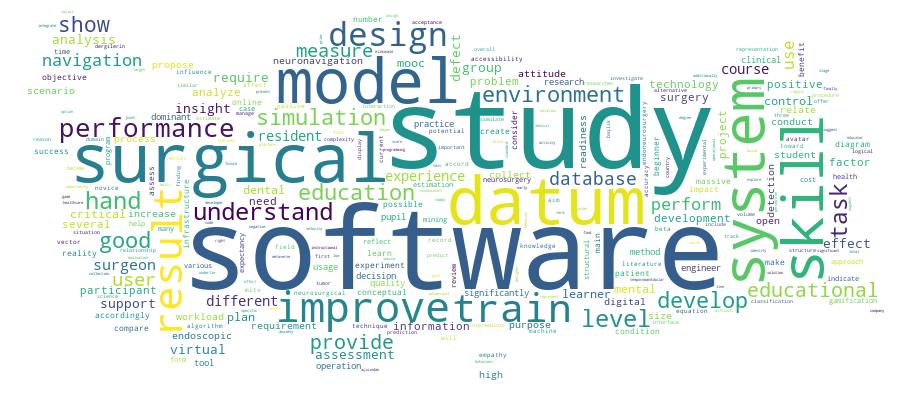
30 results
Scholarly Output Search Results
Now showing 1 - 10 of 30
Article Citation - WoS: 9Citation - Scopus: 7The Underlying Reasons of the Navigation Control Effect on Performance in a Virtual Reality Endoscopic Surgery Training Simulator(Taylor & Francis inc, 2019) Ozcelik, Erol; Berker, Mustafa; Dalveren, Gonca Gokce Menekse; Cagiltay, Nergiz Ercil; Menekse Dalveren, Gonca GokceNavigation control skills of surgeons become very critical for surgical procedures. Strategies improving these skills are important for developing higher-quality surgical training programs. In this study, the underlying reasons of the navigation control effect on performance in a virtual reality-based navigation environment are evaluated. The participants' performance is measured in conditions: navigation control display and paper-map display. Performance measures were collected from 45 beginners and experienced residents. The results suggest that navigation display significantly improved performance of the participants. Also, navigation was more beneficial for beginners than experienced participants. The underlying reason of the better performance in the navigation condition was due to lower number of looks to the map, which causes attention shifts between information sources. Accordingly, specific training scenarios and user interfaces can be developed to improve the navigation skills of the beginners considering some strategies to lower their number of references to the information sources.Article Contextual, Formal and Correlational Examination of Article Titles Published in International Indexed Journals in the Field of Educational Sciences(Turkish Education Assoc, 2025) Goktas, Yuksel; İskender, Mülkiye Ezgi; Gürbüz, Nihal Elif; Cagiltay, Nergiz Ercil; Topaloglu, Mulkiye Ezgi IskenderBir makalenin yayımlanması ve atıf alması açısından doğru başlık yazımı önemli bir değişkendir. Bu bağlamda bu araştırmada eğitim bilimleri alanında yayımlanan uluslararası indeksli makalelerin başlıkları içerik ve biçim açısından incelenmiştir. Doküman analizi, Web of Science veri tabanında yer alan 800 makale ve başlığın araştırmacılar tarafından literatüre dayalı olarak belirlenen kriterlere göre incelenmesiyle gerçekleştirilmiştir. İçerik-başlık uyumu konusunda elde edilen verilere SPSS 27.0 programından faydalanılarak istatistiksel analizler yapılmıştır. Bulgular, makalelerin cümle yapılarının yayımlandıkları dergilerin menşei ülkelerine göre farklılaştığını göstermiştir. Ayrıca, etki faktörü yüksek olan dergilerin başlıklarının metodolojik eğilimlerini daha net verdiği tespit edilmiştir. Etki faktörünün, potansiyel başlık standartlarına ulaşma ve kelime sayısı ile doğrusal ve orta düzeyde ilişkili olduğu bulunmuştur. Dergilerin Q değerlerine göre yapılan analizde, potansiyel içerik standartlarının Q1 dergilerin lehine anlamlı bir şekilde farklılaştığı görülmüştür. Dergiler için yapılan fark analizine göre başlık potansiyel standartları açısından dört dergi arasında istatistiksel olarak anlamlı farklılık bulunmuştur. Ortalamalara göre Review of Educational Research (Q1), Eğitim ve Bilim (Q4), Educational Researcher (Q1) ve Pedagogy (Q4) şeklinde bir sıralama ortaya çıkmıştır. Elde edilen sonuçlar kapsamında araştırmacılara bilimsel çalışmalar için başlık oluşturmada yol gösterecek bazı önerilerde bulunulmuştur.Article Citation - WoS: 16Citation - Scopus: 15Construct and Face Validity of the Educational Computer-Based Environment (Ece) Assessment Scenarios for Basic Endoneurosurgery Skills(Springer, 2017) Ozcelik, Erol; Sengul, Gokhan; Berker, Mustafa; Cagiltay, Nergiz ErcilBackground In neurosurgery education, there is a paradigm shift from time-based training to criterion-based model for which competency and assessment becomes very critical. Even virtual reality simulators provide alternatives to improve education and assessment in neurosurgery programs and allow for several objective assessment measures, there are not many tools for assessing the overall performance of trainees. This study aims to develop and validate a tool for assessing the overall performance of participants in a simulation-based endoneurosurgery training environment. Methods A training program was developed in two levels: endoscopy practice and beginning surgical practice based on four scenarios. Then, three experiments were conducted with three corresponding groups of participants (Experiment 1, 45 (32 beginners, 13 experienced), Experiment 2, 53 (40 beginners, 13 experienced), and Experiment 3, 26 (14 novices, 12 intermediate) participants). The results analyzed to understand the common factors among the performance measurements of these experiments. Then, a factor capable of assessing the overall skill levels of surgical residents was extracted. Afterwards, the proposed measure was tested to estimate the experience levels of the participants. Finally, the level of realism of these educational scenarios was assessed. Results The factor formed by time, distance, and accuracy on simulated tasks provided an overall performance indicator. The prediction correctness was very high for the beginners than the one for experienced surgeons in Experiments 1 and 2. When non-dominant hand is used in a surgical procedure-based scenario, skill levels of surgeons can be better predicted. The results indicate that the scenarios in Experiments 1 and 2 can be used as an assessment tool for the beginners, and scenario-2 in Experiment 3 can be used as an assessment tool for intermediate and novice levels. It can be concluded that forming the balance between perceived action capacities and skills is critical for better designing and developing skill assessment surgical simulation tools.Conference Object Citation - WoS: 1Neuronavigation Systems and Passive Usage Problem(Ieee, 2015) Tonbul, Gokcen; Aydin, Elif; Cagiltay, Nergiz; Topalli, Damla; Borcek, Alp Ozgun; Tokdemir, Gul; Maras, HakanNowadays, neuronavigation systems are used in brain surgery procedures, known as a technology to help the surgeon during the operational period. However, the surgeons have faced several problems with the existing systems. Some of these problems are related to the systems software and user interfaces. In this study, such problems are examined and the "Passive Usage" term is added to the literature by establishing a connection between the problems of endoscopic surgical procedures and similar issues occurred in other domains. The passive usage problem is generalized on different domains for the first time with this study. The results of the study expected to gather up the similar passive usage problems experienced in different domains. Accordingly, the methodologies and studies that are conducted in different research areas may lead to eliminate the Passive Usage problems efficiently.Conference Object The Usability Study for the Personal Health Record Systems(Ieee, 2015) Cagiltay, Nergiz; Aykac, Y. Evren; Gokay, Gonca; Ercil, Yavuz; Tokdemir, GulWith the emergence of new technologies, there is an increasing number of studies to improve healthcare delivery quality and health services. The studies have shown that the focus should be on integrated, sharable and personalized healthcare solutions which requires usage of patient data as much as possible for fast and correct diagnosis and care. Hence, data related to people when they are healthy and when they are sick become very critical for which many projects have been initiated to increase awareness of people about the importance of data collection all over the world and in our country as well. This requires more active role of the citizens in tracking their healthcare data. In this study, Microsoft Health Vault system that is used for storage of personal health records, has been analyzed in terms of its usability characteristics and the results have been discussed.Conference Object Neuronavigation Skill Training Through Simulation: Insights From Eye Data(Iated-int Assoc Technology Education A& development, 2016) Çağıltay, Nergiz; Tokdemir, Gül; Cagiltay, N. E.; Topalli, D.; Maraş, Hadi Hakan; Borcek, A. O.; Tokdemir, G.; Aydın, Elif; Maras, H. H.; Tonbul, G.; Aydin, E.; Yazılım Mühendisliği; Bilgisayar Mühendisliği; Elektrik-Elektronik MühendisliğiNeuronavigation systems are developed to support the brain surgery operations. Because of its complex anatomical structure, the neurosurgery is a risky and critical operation. The surgeon is required to perform the operation in a very small area with very restricted movements. The neuronavigation systems are developed to help the surgeon during the operation to show the current position of the surgery with respect to the 3D virtual model of the patient. In these systems, the 3D virtual model of the patient is created according to the medical data (MRI/BT) of the patient. Hence these systems work like navigations systems that are used in driving a car. The surgeon uses this system by controlling the system through a software interface and its user interface and correlates the current position of the operation with the 3D patient virtual model. In this way the surgeon checks the critical anatomical structures through this system and eliminates possible risks. Hence surgeons who will perform such operations are required to develop several skills to manage this very complicated environment. They are required to perform the operation according to the information coming from the navigation display. Additionally, in order to reach relevant information from the navigation display they have to control the navigation panel. In order to prepare surgeons to manage this very complicated environment, their required skills need to be improved during the training period. In this study, to better understand the surgeons' behaviours while managing the tasks related to the surgical navigation procedures, a simulation based environment is developed and an experimental study is conducted with 10 people. Their eye data and their performance data is recorded based on the simulated tasks. The results of the study is analysed statistically and descriptively. The results show that it is possible to control a neuronavigation display through eye movements which could be an alternative human-computer interaction option for designing the neuronavigation systems' user interfaces. Secondly, it is shown that performing a task according to the results of a second information source (neuronavigation system) lowers the general performance in terms of travelled distance with the operation tool and camera (endoscope). However the success level while performing each task and the time spent values are similar in both cases. On the other hand the number of errors is higher in the first scenario. Hence, the surgical education programs need to provide appropriate solutions to better understand and measure the skill levels of trainees on such tasks and to improve their skills through virtual practice systems.Book Part Artificial Intelligence in Dentistry(CRC Press, 2025) Cagiltay, Nergiz Ercil; Kılıçarslan, Mehmet Ali; Basmaci, FulyaToday, with advanced technologies, collecting detailed and big data from the environment and analyzing it using intelligent techniques has become possible, providing important insights into phenomena as well as future predictions. Big data is characterized by its high volume, velocity, and variety. Here, the volume is the amount and size of the data, which is measured in terabytes, petabytes, exabytes, or zettabytes. Velocity is the offered form of big data, which can be batch, near-real-time, real-time, or streaming. Finally, variety is the structure of the big data, which can be structured, such as in relational or dimensional models, as in warehouses, or unstructured, which is stored without any organization. It can also be in semi-structured form, where the data is unstructured but there is some meta-data or some tags for describing the data. Today, these forms of data are being collected for different dental purposes in several formats, such as images, raw data, or coordinates. © 2025 Elsevier B.V., All rights reserved.Conference Object Citation - WoS: 1Citation - Scopus: 1Empathy Development in Digital Accessibility Through Real-Life Practices in a Programming Course: a Case Study(Assoc Computing Machinery, 2024) Inal, Yavuz; Cagiltay, NergizThis case study adopted a project-based learning approach to a programming course based on real-life practices to help software engineering students develop empathy skills regarding digital accessibility. A project was assigned to first-year students to develop software for people with disabilities. The data were collected from each individual project of thirty-three students over four months. Students' efforts regarding analysis, design and development steps, and project outcomes were analyzed. The study results showed that students' experience level and knowledge about the accessibility domain were quite low initially. Regarding the target disability type in their projects, half of the students selected mental illness, followed by blindness, deafness, and physical illness. The students who gathered requirements from domain experts or target users made their products more accessible, indicating the importance of user involvement in empathy building in the development process. We also measured increased awareness of and knowledge about accessibility at the end of the course, leading us to discuss the effectiveness of real-life practices in teaching digital accessibility in programming courses.Article Citation - WoS: 22Citation - Scopus: 37Performing and Analyzing Non-Formal Inspections of Entity Relationship Diagram (Erd)(Elsevier Science inc, 2013) Tokdemir, Gul; Kilic, Ozkan; Topalli, Damla; Cagiltay, Nergiz ErcilDesigning and understanding of diagrammatic representations is a critical issue for the success of software projects because diagrams in this field provide a collection of related information with various perceptual signs and they help software engineers to understand operational systems at different levels of information system development process. Entity relationship diagram (ERD) is one of the main diagrammatic representations of a conceptual data model that reflects users' data requirements in a database system. In today's business environment, the business model is in a constant change which creates highly dynamic data requirements which also requires additional processes like modifications of ERD. However, in the literature there are not many measures to better understand the behaviors of software engineers during designing and understanding these representations. Hence, the main motivation of this study is to develop measures to better understand performance of software engineers during their understanding process of ERD. Accordingly, this study proposes two measures for ERD defect detection process. The defect detection difficulty level (DF) measures how difficult a defect to be detected according to the other defects for a group of software engineers. Defect detection performance (PP) measure is also proposed to understand the performance of a software engineer during the defect detection process. The results of this study are validated through the eye tracker data collected during the defect detection process of participants. Additionally, a relationship between the defect detection performance (PP) of a software engineer and his/her search patterns within an ERD is analyzed. Second experiment with five participants is also conducted to show the correlation between the proposed metric results and eye tracker data. The results of experiment-2 also found to be similar for DF and PP values. The results of this study are expected to provide insights to the researchers, software companies, and to the educators to improve ERD reasoning process. Through these measures several design guidelines can be developed for better graphical representations and modeling of the information which would improve quality of these diagrams. Moreover, some reviewing instructions can be developed for the software engineers to improve their reviewing process in ERD. These guidelines in turn will provide some tools for the educators to improve design and review skills of future software engineers. (c) 2013 Elsevier Inc. All rights reserved.Article Citation - WoS: 2Citation - Scopus: 3Investigating the Relationship Between Sloc and Logical Database Measures To Improve the Early Estimation of Software Cost(World Scientific Publ Co Pte Ltd, 2019) Cagiltay, Nergiz Ercil; Tokdemir, GulProject planning is a critical activity in the software development life cycle. At the early stages of a project, the managers need to estimate required time, effort and cost to plan, track and then to deliver the project successfully. Many studies have attempted to provide methods for precise software cost estimation. The current software cost estimation methods are mainly based on software size estimation and functional system requirements. The main assumption of this study is that, as the primary source of complexity in today's software is the interaction between the database and the user, database measures may provide inputs allowing current software estimation methods to achieve more accurate results. Accordingly, this study attempts to gain insights from objective measures, collected through the logical database model of software systems, for better prediction of the software's effort and hence cost through software lines of code (SLOC) measure. For this purpose, more than 2.5 million lines of code developed by four different companies, for 79 different software packages with their related database design measures, are analyzed. The results of this study show that there is a close correlation between the software size and database design measure, namely, the number of tables which can be collected at the logical database design stage. By adapting this result, the current estimation models could be improved significantly.
- «
- 1 (current)
- 2
- 3
- »