
Eyyuboğlu, Halil Tanyer
Loading...
Profile URL
Name Variants
Eyyuboglu, Halil T. & Eyyuboglu, H. T. & Eyyuboğlu, Halil T. & Eyyuboğlu, H.T. & Eyyuboglu, HT & Eyyuboglu, Halil Tanyer & Eyyuboglu, Haill Tanyer & Eyyuboǧlu, H.T. & Eyyuboglu, H.T.
Job Title
Prof. Dr.
Email Address
Main Affiliation
Elektronik ve Haberleşme Mühendisliği
Status
Former Staff
Website
ORCID ID
Scopus Author ID
Turkish CoHE Profile ID
Google Scholar ID
WoS Researcher ID
Sustainable Development Goals
 1
1NO POVERTY
0
Research Products
 2
2ZERO HUNGER
0
Research Products
 3
3GOOD HEALTH AND WELL-BEING
0
Research Products
 4
4QUALITY EDUCATION
0
Research Products
 5
5GENDER EQUALITY
0
Research Products
 6
6CLEAN WATER AND SANITATION
0
Research Products
 7
7AFFORDABLE AND CLEAN ENERGY
0
Research Products
 8
8DECENT WORK AND ECONOMIC GROWTH
0
Research Products
 9
9INDUSTRY, INNOVATION AND INFRASTRUCTURE
1
Research Products
 10
10REDUCED INEQUALITIES
0
Research Products
 11
11SUSTAINABLE CITIES AND COMMUNITIES
1
Research Products
 12
12RESPONSIBLE CONSUMPTION AND PRODUCTION
0
Research Products
 13
13CLIMATE ACTION
0
Research Products
 14
14LIFE BELOW WATER
0
Research Products
 15
15LIFE ON LAND
0
Research Products
 16
16PEACE, JUSTICE AND STRONG INSTITUTIONS
0
Research Products
 17
17PARTNERSHIPS FOR THE GOALS
0
Research Products

This researcher does not have a Scopus ID.

This researcher does not have a WoS ID.
No records found in other affiliations.

Scholarly Output
143
Articles
115
Views / Downloads
2112/32
Supervised MSc Theses
0
Supervised PhD Theses
0
WoS Citation Count
4713
Scopus Citation Count
5222
Patents
0
Projects
0
WoS Citations per Publication
32.96
Scopus Citations per Publication
36.52
Open Access Source
17
Supervised Theses
0
| Journal | Count |
|---|---|
| Applied Physics B | 32 |
| Optics Communications | 18 |
| Optics Express | 11 |
| Applied Optics | 9 |
| Optics & Laser Technology | 8 |
Current Page: 1 / 9
Scopus Quartile Distribution
Competency Cloud
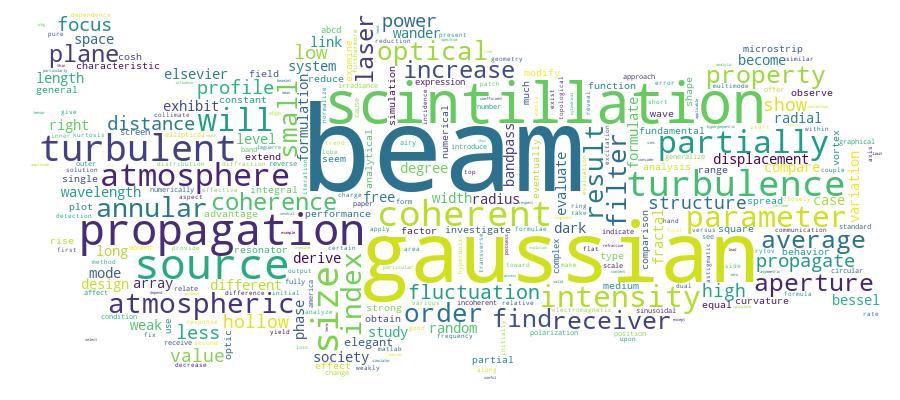
143 results
Scholarly Output Search Results
Now showing 1 - 10 of 143
Article Citation - Scopus: 70Influence of Turbulence on the Effective Radius of Curvature of Radial Gaussian Array Beams(Optical Society of American (OSA), 2010) Ji, X.; Eyyuboglu, H.T.; Baykal, Y.The analytical formula for the effective radius of curvature of radial Gaussian array beams propagating through atmospheric turbulence is derived, where coherent and incoherent beam combinations are considered. The influence of turbulence on the effective radius of curvature of radial Gaussian array beams is studied by using numerical calculation examples. © 2010 Optical Society of America.Article Citation - WoS: 76Citation - Scopus: 82Scintillation Properties of Dark Hollow Beams in a Weak Turbulent Atmosphere(Springer Heidelberg, 2008) Chen, Y.; Cai, Y.; Eyyuboglu, H. T.; Baykal, Y.The on-axis scintillation index for a circular dark hollow beam (DHB) propagating in a weak turbulent atmosphere is formulated, and the scintillation properties of a DHB are investigated in detail. The scintillation index for a DHB reduces to the scintillation index for a Gaussian beam, an annular beam and a flat-topped beam under certain conditions. It is found that the scintillation index of a DHB is closely related to the beam parameters and can be lower than that of a Gaussian beam, an annular beam and a flat-topped beam in a weak turbulent atmosphere at smaller waist sizes and longer propagation lengths.Conference Object Citation - WoS: 2Citation - Scopus: 3Method of Evaluation of the Mutual Coherence Function of Laser Beams and Its Application for Symmetric Dark Hollow Beams(Spie-int Soc Optical Engineering, 2011) Banakh, V. A.; Marakasov, D. A.; Rytchkov, D. S.; Baykal, Y. K.; Eyyuboglu, T.; Eyyuboǧlu, H.T.In our report, a method of evaluation of the mutual coherence function (MCF) of optical wave propagating in turbulent atmosphere is proposed. The method is based on using inverse Fresnel transform and 2-D Fast Fourier Transformation procedure (FFT) and provides a high accuracy in various propagation conditions from weak up to strong optical turbulence regime. This technique allows significantly reducing the evaluation time of MCF. The proposed method is suitable for optical waves with arbitrary initial distribution of amplitude and phase. Results of investigations on the degradation of coherence of symmetric dark hollow beams (DHB) propagating in turbulent atmosphere are presented. Analysis of evolution of MCF is brought up, and some characteristics of DHB, such as mean intensity distribution, and moments of Wigner distribution are calculated for various kinds of profiles of structural characteristic of refractive index. All of the evaluations for DHB are fulfilled for Kolmogorov spectrum of correlation function of refractive index fluctuations. The comparison between mean intensity calculations within the proposed method and method based on semi-analytical approach using of quadratic approximation of spherical wave structure function, is presented.Article Citation - WoS: 18Citation - Scopus: 22Partially Coherent Lorentz Gaussian Beam and Its Scintillations(Springer, 2011) Eyyuboglu, H. T.We study the scintillation aspects of partially coherent Lorentz Gaussian (LG) beams via numerically integrating the average and average squared intensity expressions. Within the examined range of input and propagation medium parameters, the LG beams are generally found to offer less and less scintillations against the pure Gaussian beam, particularly when the Lorentzian feature of the beam is emphasized more. This lower scintillation property is exhibited for collimated coherent beams with different Lorentz widths and at on-axis and off-axis positions of the receiver plane. When focusing is introduced, at shorter propagation distances the ordering of the beams remains as described above, but at longer propagations distances a complete reversing of the beam order is observed. Raising the turbulence levels by increasing the structure constant inevitably causes rises in scintillations, while preserving the advantage of LG beams over the pure Gaussian beam. Partial coherence reduces scintillations as expected, at the same time nearly eliminating the scintillation differences between the beam types.Article Citation - WoS: 24Citation - Scopus: 27Partially Coherent Airy Beam and Its Propagation in Turbulent Media(Springer Heidelberg, 2013) Sermutlu, Emre; Eyyuboglu, Halil T.The properties of partially coherent Airy beam propagating in turbulent media are investigated. Firstly the variations in the intensity profile and the location of the Airy beam peak with respect to dislocation and width parameters are examined. On the source plane, it is shown that there is a threshold value of the dislocation parameter which determines whether the beam peak will lie on the negative or positive side of the axis. The changes in source beam power and source beam size with respect to dislocation and width parameters are also examined. Then analysis is made for partially coherent Airy beam propagating in turbulence against variations in propagation distance, dislocation and width parameters, structure constant and partial coherence. It is found that the peak of the Airy beam will always shift to the right for increasing propagation distance. But this shift will become less as the dislocation and width parameters are increased. Finally it is shown that higher levels of turbulence and partial coherence will lead to more spreading and shift the beam peak more toward the on-axis position.Article Citation - WoS: 4Citation - Scopus: 4The Performance Bounds of an Optical Communication System Using Irradiance Profile Modulation(Taylor & Francis Ltd, 2017) Eyyuboglu, Halil T.We assess the performance bounds of an optical communication system that uses irradiance profile modulation. This modulation is based on the four different orders of vortex beams. To this end, we find the turbulence induced average irradiance profiles of Gaussian, Bessel-Gaussian and modified Bessel-Gaussian vortex beams on the receiver plane. Each one is then cross correlated against the free space equivalents. Plotting the cross-correlation coefficients, it becomes possible to identify the borders of correct decision and error regions, thus, deduce the performance bounds of such a system. When measured in terms of structure constant, i.e. the turbulence strength and the propagation length being fixed to 3km, it is seen that the error region extends beyond the structure constant values of 10(-13) m(-2/3) and higher. There seem to be some variations with the beam type and the order of the vortex beam. The performance of Bessel-Gaussian vortex beam comes out to be slightly better than the rest.Conference Object Citation - WoS: 1Propagation of a Generalized Beam in Abcd System(Cemal Ardil-IEC Barbaros Mah Hasret Sitesi, 2005) Eyyuboglu, HT; Elektronik ve Haberleşme MühendisliğiFor a generalized Hermite sinosiodal/hyperbolic Gaussian beam passing through an ABCD system with a finite aperture, the propagation properties are derived using the Collins integral. The results are obtained in the form of intensity graphs indicating that previously demonstrated rules of reciprocity are applicable, while the existence of the aperture accelerates this transformation.Article Citation - WoS: 67Influence of Turbulence on the Effective Radius of Curvature of Radial Gaussian Array Beams(Optical Soc Amer, 2010) Ji, Xiaoling; Eyyuboglu, Halil T.; Baykal, YahyaThe analytical formula for the effective radius of curvature of radial Gaussian array beams propagating through atmospheric turbulence is derived, where coherent and incoherent beam combinations are considered. The influence of turbulence on the effective radius of curvature of radial Gaussian array beams is studied by using numerical calculation examples. (C) 2010 Optical Society of AmericaArticle Citation - WoS: 19Citation - Scopus: 19Off-Axis Beam Intensity in Random Medium(Elsevier Science Bv, 2007) Baykal, Yahya; Eyyuboglu, Halil T.The receiver intensity profile of an off-axis-Gaussian beam travelling in random medium is formulated. By examining the related exponential terms of this intensity expression, the rules governing the receiver plane displacements are deduced. Off-axis-Gaussian beam is characterized by introducing into a Gaussian beam, complex displacement parameters that exhibit transverse source coordinate dependent attenuation and phase shifts. Our results are applied to turbulent horizontal links. Intensity plots describing the dependence on the source and propagation parameters both on the source and the receiver planes are provided. Even though the normalized intensities of the off-axis-Gaussian beam having the same source sizes but differing displacements in x- and y-directions may look the same on the source plane, they will differentiate after propagation. The views from the progress of an off-axis-Gaussian beam along the turbulent link length show that a source displaced beam will act according to rules set by related exponential terms. An asymmetrical (ellipsoidal) off-axis-Gaussian beam will initially be converted into symmetric (circular) shape at the intermediate link lengths, then it will start to expand in the other direction, thus reverting to an ellipsoid shape whose major axis is now along the transverse coordinate opposite to that of the source plane. (c) 2006 Elsevier B.V. All rights reserved.Article Citation - WoS: 7Citation - Scopus: 8Hermite Hyperbolic/Sinusoidal Gaussian Beams in Abcd Systems(Elsevier Gmbh, 2007) Eyyuboglu, Halil TanyerFor a Hermite hyperbolic/sinusoidal Gaussian beam with focusing properties, passing through an arbitrarily shaped rectangular aperture on the source plane and an on-axis x-y asymmetric ABCD system, the receiver plane expression is derived using the Collins integral. The specific example of a single thin lens placed on the propagation path is examined at selected source, propagation and optical element parameters. Viewing the progress of the beam in propagation, we find that subjecting the source beam to an aperture will give rise to excessive spreading during propagation. The lens setup will act to concentrate the energy of the beam around its focal point as expected, while in some circumstances it will also execute beam profile changes. By adjusting the aperture opening in the shape of a narrow slit, the beam will become aligned in the opposite direction after propagating after having traveled sufficiently. The results are presented as intensity graphs in the form of contour plots and 3D illustrations. (c) 2006 Elsevier GmbH. All rights reserved.