Bilgilendirme: Kurulum ve veri kapsamındaki çalışmalar devam etmektedir. Göstereceğiniz anlayış için teşekkür ederiz.
 

Tunç, Sevgi

Loading...
Profile Picture
Name Variants
Tunç, S.K.
Tunc, Sevgi Koyuncu
Job Title
Öğr. Gör.
Email Address
sevgik@cankaya.edu.tr
Main Affiliation
06.09. Yazılım Mühendisliği
Yazılım Mühendisliği
06. Mühendislik Fakültesi
01. Çankaya Üniversitesi
Status
Current Staff
Scopus Author ID
Turkish CoHE Profile ID
Google Scholar ID
WoS Researcher ID

Sustainable Development Goals

SDG data is not available
Documents

4

Citations

5

Google Analytics Visitor Traffic

JournalCount
Current Page: 1 / NaN

Scopus Quartile Distribution

Competency Cloud

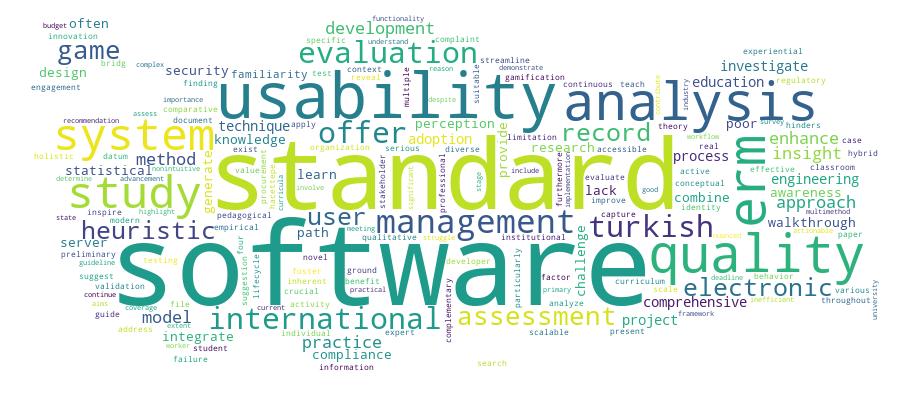
GCRIS Competency Cloud

Scholarly Output Search Results

Now showing 1 - 3 of 3
  • Conference Object
    Investigating the Adoption of International Software Quality Standards in Turkiye: a Comprehensive Analysis
    (Institute of Electrical and Electronics Engineers Inc., 2024) Tunç, S.K.
    Despite significant advancements in software development practices, software projects continue to struggle in meeting their deadlines, budget, and quality goals. One of the primary reasons for this challenge is the lack of awareness and implementation of international software quality standards, which offer best practices and guidelines for software professionals. This study aims to investigate the current state of Turkish software professionals' knowledge and familiarity with these standards. The research involved two stages, including an analysis of the engineering curricula of Turkish universities to determine the extent of coverage of software quality standards, and a survey of Turkish software industry workers to assess their knowledge, familiarity and perception of international software quality standards. © 2024 IEEE.
  • Article
    Comparative Analysis of Four Usability Assessment Techniques for Electronic Record Management Systems
    (Wiley, 2025) Tunc, Sevgi Koyuncu
    Effective electronic record management systems (ERMSs) are crucial for modern organizations, offering benefits such as streamlined document management, enhanced security, and improved institutional memory. However, poor usability often hinders ERMS adoption and effectiveness. While various usability evaluation methods exist, a comprehensive approach integrating multiple techniques is often lacking, particularly in the context of ERMS, where factors like data security and regulatory compliance are paramount. This paper presents a novel hybrid usability assessment model that combines heuristic walkthrough, statistical log analysis, server log path analysis, and user testing to provide a holistic evaluation of ERMS usability. This integrated approach, suitable for continuous evaluation throughout the software lifecycle, addresses limitations inherent in individual methods, capturing both expert insights and real-world user behavior at scale, and generating complementary insights for diverse stakeholders (executives, developers, procurement, UX researchers). Furthermore, this study offers specific heuristics for evaluating ERMS, such as "standardized terminology" and "automatic suggestions for the standard file plan." Applied to Hacettepe University's ERMS, the model revealed usability challenges such as poor search functionality, inefficient workflows, and nonintuitive design. The study demonstrates how the combined insights from these methods provide a more nuanced understanding of ERMS usability than single-method approaches, generating actionable and cost-effective recommendations for system improvement. This research contributes a practical framework for enhancing ERMS usability and highlights the importance of multimethod evaluations for complex web applications.
  • Conference Object
    Software Standards in Action: A Complaint-Driven Game Inspired by Real Project Failures
    (Fac Organization and Informatics, University Zagreb, 2025) Tunc, Sevgi Koyuncu
    Complaint to Compliance is a classroom-based game teaching ISO/IEC/IEEE 12207 standards through real-world complaint-driven scenarios. Grounded in experiential learning, its low-tech, card-based design fosters active learning via guided discussion. A qualitative case study (n=21) analyzed student perceptions, revealing: (1) conceptual bridging of theory and practice, (2) professional identity development, and (3) enhanced engagement through gamification. The accessible design offers a scalable model for standards education. Preliminary findings suggest pedagogical value for information systems education, with further cross-cultural validation needed.