
Selvi, Özgün
Loading...
Profile URL
Name Variants
Selvi, Ozgun & Selvi, O. & Selvi, Ö.
Job Title
Dr. Öğr. Üyesi
Email Address
ozgunselvi@cankaya.edu.tr
Main Affiliation
06.06. Makine Mühendisliği
Makine Mühendisliği
06. Mühendislik Fakültesi
01. Çankaya Üniversitesi
Makine Mühendisliği
06. Mühendislik Fakültesi
01. Çankaya Üniversitesi
Status
Former Staff
Website
ORCID ID
Scopus Author ID
Turkish CoHE Profile ID
Google Scholar ID
WoS Researcher ID
Sustainable Development Goals
 1
1NO POVERTY
0
Research Products
 2
2ZERO HUNGER
0
Research Products
 3
3GOOD HEALTH AND WELL-BEING
0
Research Products
 4
4QUALITY EDUCATION
1
Research Products
 5
5GENDER EQUALITY
0
Research Products
 6
6CLEAN WATER AND SANITATION
0
Research Products
 7
7AFFORDABLE AND CLEAN ENERGY
0
Research Products
 8
8DECENT WORK AND ECONOMIC GROWTH
0
Research Products
 9
9INDUSTRY, INNOVATION AND INFRASTRUCTURE
4
Research Products
 10
10REDUCED INEQUALITIES
0
Research Products
 11
11SUSTAINABLE CITIES AND COMMUNITIES
1
Research Products
 12
12RESPONSIBLE CONSUMPTION AND PRODUCTION
0
Research Products
 13
13CLIMATE ACTION
0
Research Products
 14
14LIFE BELOW WATER
0
Research Products
 15
15LIFE ON LAND
0
Research Products
 16
16PEACE, JUSTICE AND STRONG INSTITUTIONS
0
Research Products
 17
17PARTNERSHIPS FOR THE GOALS
0
Research Products

This researcher does not have a Scopus ID.

This researcher does not have a WoS ID.
No records found in other affiliations.

Scholarly Output
14
Articles
7
Views / Downloads
448/498
Supervised MSc Theses
0
Supervised PhD Theses
0
WoS Citation Count
5
Scopus Citation Count
18
Patents
0
Projects
0
WoS Citations per Publication
0.36
Scopus Citations per Publication
1.29
Open Access Source
5
Supervised Theses
0
| Journal | Count |
|---|---|
| International Journal of 3D Printing Technologies and Digital Industry | 3 |
| Robotica | 2 |
| Joint International Conference of the 12th International Conference on Mechanisms and Mechanical Transmissions (MTM) / 23rd International Conference on Robotics (Robotics) -- OCT 26-27, 2016 -- Aachen, GERMANY | 1 |
| Journal of Naval Sciences and Engineering | 1 |
| Mechanisms and Machine Science | 1 |
Current Page: 1 / 3
Scopus Quartile Distribution
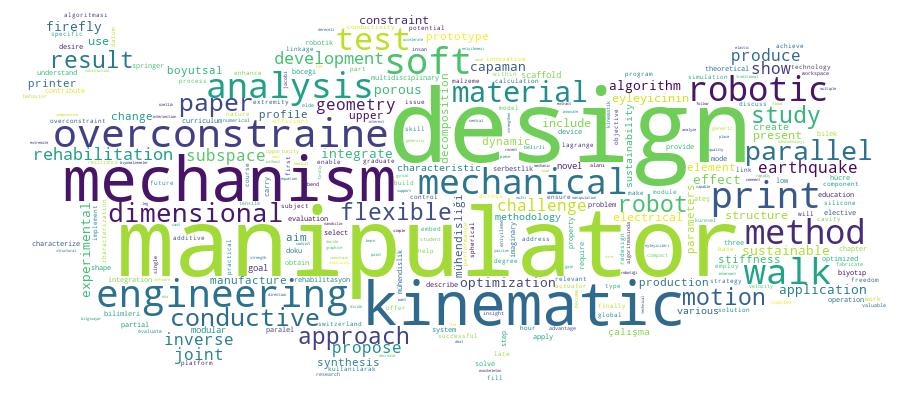
Competency Cloud
14 results
Scholarly Output Search Results
Now showing 1 - 10 of 14
Article Citation - Scopus: 2Effects of Earthquake Motion on Mechanism Operation: an Experimental Approach(Levrotto and Bella, 2015) Selvi, Ö.; Selvi, Özgün; Ceccarelli, M.; Aytar, E.B.; Makine MühendisliğiThis paper presents an experimental characterization of the effects of earthquakes on the operation of mechanical systems with the help of CaPaMan (Cassino Parallel Manipulator), which is a 3 DOF robot that can fairly well simulate 3D earthquake motion. The sensitivity of operation characteristics of machinery to earthquake disturbance is identified and characterized through experimental tests. Experimental tests have been carried out by using a slider-crank linkage, a small car model, and LARM Hand as test-bed mechanisms that have been sensored with proper acceleration or force sensors. Results are reported and discussed to describe the effects of earthquake motion on the characteristics of mechanism operation as a service application of the robotic CaPaMan system.Conference Object Üç Serbestlik Dereceli Paralel Rehabilitasyon Eyleyicinin Ateş Böceği Algoritması Kullanılarak Boyutsal Olarak Eniyilemesi(2016) Selvi, Özgün; Yavuz, SametBu çalışma, insan bilek eklemi rehabilitasyonunda kullanılacak üç serbestlik derecesine sahip üç bacaklı küresel bir paralel eyleyicinin belirli bir çalışma uzayında çalışmasını sağlayacak boyutsal parametrelerin tespitini amaçlamaktadır. Bahsi geçen eyleyicinin son-elemanı insan bilek ekleminin üç serbestlik derecesini kapsamaktadır. Eyleyicinin her bacağı iki küresel uzva sahiptir ve tüm eklem eksenleri ortak bir noktada kesişmektedir. Eniyileme algoritmasında kullanılmak üzere eyleyicinin ters kinematik denklemleri çözülmüş Jacobi matrisi elde edilmiştir. Daha sonra ters kinematik denklemlerinden ve Jacobi matrisinden elde edilen kısıtlar ateş böceği algoritmasında kullanılarak belirli çalışma alanı için boyutsal eniyileme gerçekleştirilmiştir. Son olarak bu boyutsal parametrelerle bilek hareketleri benzetimlenerek çalışma alanı testi gerçekleştirilmiştir.Article Strengthening Effect of Flooding in 3d Printed Porous Soft Robotics Scaffolds(2021) Arslan, Ozan; Selvi, Özgün; Mıstıkoglu, Selçuk; Totuk, OnatThis study aims to design and 3D print porous elements for soft robotic applications and test the stiffness changes when the cavities are filled with liquids. When an elastic element has porous scaffolds, the stiffness can be controlled by filling the cavities with a liquid. A gyroid structure is selected for the design and evaluation of the characteristics of elements. The stiffness of the element in both non-filled and liquid-filled modes is analyzed using FEM simulation Software in two modes where simple support with central loading and compressive uniform loading. A porous test structure is created and tested in these modes for observation of the stiffness change. Employing an FDM printer in this project enabled us to make our thoughts to reality. The results show that liquid-filling can be used as a stiffening method for porous scaffolds in soft robotic applications.Article Citation - WoS: 2Citation - Scopus: 2Kinematic Design and Analysis of a Novel Overconstraint Walking Mechanism(Cambridge Univ Press, 2025) Selvi, Ozgun; Cindioglu, Cagri; Ider, Sitki Kemal; Ceccarelli, MarcoWalking mechanisms offer advantages over wheels or tracks for locomotion but often require complex designs. This paper presents the kinematic design and analysis of a novel overconstrained spatial a single degree-of-freedom leg mechanism for walking robots. The mechanism is generated by combining spherical four-bar linkages into two interconnecting loops, resulting in an overconstrained design with compact scalability. Kinematic analysis is applied using recurrent unit vector methods. Dimensional synthesis is performed using the Firefly optimization algorithm to achieve a near-straight trajectory during the stance phase for efficient walking. Constraints for mobility, singularity avoidance, and transmission angle are also implemented. The optimized design solution is manufactured using 3D printing and experimentally tested. Results verify the kinematic properties including near-straight-line motion during stance. The velocity profile shows low perpendicular vibrations. Advantages of the mechanism include compact scalability allowing variable stride lengths, smooth motion from overconstraint, and simplicity of a single actuator. The proposed overconstrained topology provides an effective option for the leg design of walking robots and mechanisms.Article Design and Production of Multi Material 3d Printer for Soft Robotic Structural Elements(2021) Yetim, Murat; Çırnık, Samed Yiğit; Akan, Muhammed Enes; Tomaç, Temel; İlter, Hasan Fehmi; Selvi, ÖzgünWith the latest technology, the development and interest in soft robots have gained speed. Flexible robots are generally produced by the casting method. This traditional production method cannot meet the required quality and production speed. For this, it is aimed to solve the problem by accelerating the production of robots without decreasing the quality. The most successful method for solving this problem is 3D printers, which could print multiple materials. It was decided to be used multi-materials printing, and the system design was carried out. This study aims to design and produce a multi-material 3D printer capable of printing non-conductive and conductive rapidly curing silicone that can be used in soft robotics and medical simulators. The electrical conductivity was achieved by mixing silicone and graphite powder. The parts in the designed system are also obtained by the additive manufacturing method. Test pieces were printed using the produced 3D printer. Specific tests have been carried out on the produced parts. Technical data such as strength, elasticity, electrical conductivity have been obtained.Conference Object Citation - WoS: 1Citation - Scopus: 1Inverse Kinematics and Dynamics of an Overconstrained Manipulator for Upper Extremity Rehabilitation(Springer international Publishing Ag, 2017) Yilmaz, K.; Selvi, O.In this paper, an overconstrained manipulator is selected for the purpose of rehabilitation of the upper extremity. The geometry of the selected manipulator fits the exact motion of the upper extremity and acts as an exoskeleton. Inverse kinematics calculations are shown for describing the motion of actuators for a desired arm motion. Lagrange Formulation is used for the inverse dynamic model of the system. Due to the geometry of the manipulator, kinematic and dynamic calculations are applied to the two spherical subspaces of the manipulator using imaginary joints.Article Kinematic Analysis Of A 5 Dof Overconstrained Manipulator For Rehabilitation Of Upper Extremite(2015) Selvi, Özgün; Al-dulaimi, HasanThis study deals with one of the applications of parallel manipulator as a rehabilitation robot. This device is an over –constrained parallel manipulator 5 degree of freedom with 3 legs. This manipulator consists of a moving platform which is connected to a fixed base via three legs. Each leg is made of RRR(RR) (revolute) joints where the first three joint in all legs are parallel and the recent two joint are intersecting .Inverse kinematics of this device is solved by dividing manipulator into two sub-manipulators with the help of three imaginary joints placed at the intersection of platform joints with a direction parallel to base joints.Conference Object Citation - WoS: 1Citation - Scopus: 3Redesign and Construction of a Low-Cost Capaman Prototype(Springer international Publishing Ag, 2019) Karaahmet, S. B.; Selvi, O.; Cafolla, D.; Ceccarelli, M.; Arslan, O.In this paper a redesign solution for CaPaMan structure is presented to build a scaled low-cost prototype with market components and 3D printed parts. A CAD design is worked out to define 3D printing manufacturing for link parts and to adjust the mechanical design and its assembly after performance evaluation ensuring characteristic features of CaPaMan operation. A small-size prototype is built and tested with satisfactory functioning.Conference Object Citation - Scopus: 4Design and Dimensional Optimization of a Novel Walking Mechanism With Firefly Algorithm(Springer Netherlands, 2018) Selvi, Ö.; Yavuz, S.In this paper, a walking mechanism named Atlas is proposed which is a Watt-I type 6 link mechanism. First, the geometry is proposed and then kinematic analysis is done that will be used for the synthesis problem. Furthermore, constraints and an objective function are obtained from kinematic analysis. Then, these constraints are implemented to the Firefly Algorithm and dimensional parameters are obtained for a desired step profile. Finally, these dimensional parameters are tested. © Springer International Publishing AG 2018.Book Part Integrating Multidisciplinary DBR in Mechanical Engineering Education, Challenges, and Opportunities: Innovating ME Education Via Cross-Discipline DBR(IGI Global, 2025) Totuk, O.H.; Selvi, O.This chapter explores the challenges and opportunities of integrating multidisciplinary design-based research (DBR) into mechanical engineering education. As engineering problems become more complex, there is a growing need for graduates who can work across disciplines. DBR enhances the mechanical engineering curriculum by fostering collaboration, promoting real-world problem-solving skills, and bridging theory and practice. The chapter addresses challenges in implementing DBR, including resistance to change, resource constraints, and assessment issues, while highlighting opportunities for improved student engagement, creativity, and industry partnerships. Case studies of successful DBR integration in mechanical engineering programs are presented, showcasing innovative approaches and outcomes. Finally, the chapter proposes strategies to overcome barriers and maximize the benefits of multidisciplinary DBR, contributing valuable insights for educators seeking to prepare students for the evolving demands of the engineering profession. © 2025 by IGI Global Scientific Publishing.