Bilgilendirme: Sürüm Güncellemesi ve versiyon yükseltmesi nedeniyle, geçici süreyle zaman zaman kesintiler yaşanabilir ve veri içeriğinde değişkenlikler gözlemlenebilir. Göstereceğiniz anlayış için teşekkür ederiz.
 

Tolun, Mehmet Reşit

Loading...
Profile Picture
Name Variants
Tolun, Mehmet
Tolun, Mehmet Resit
Tolun, Mehmet R.
Tolun, M.R.
Job Title
Prof. Dr.
Email Address
tolun@cankaya.edu.tr
Main Affiliation
Yazılım Mühendisliği
Status
Current Staff
Website
Scopus Author ID
Turkish CoHE Profile ID
Google Scholar ID
WoS Researcher ID

Sustainable Development Goals

SDG data could not be loaded because of an error. Please refresh the page or try again later.
Scopus data could not be loaded because of an error. Please refresh the page or try again later.
WoS data could not be loaded because of an error. Please refresh the page or try again later.
Bibliometrics data could not be loaded because of an error. Please refresh the page or try again later.

Google Analytics Visitor Traffic

Google Analytics Visitor Traffic could not be loaded because of an error. Please refresh the page or try again later.
Scholarly output chart could not be loaded because of an error. Please refresh the page or try again later.
Journals could not be loaded because of an error. Please refresh the page or try again later.

Scopus Quartile Distribution

Quartile distribution chart could not be loaded because of an error. Please refresh the page or try again later.

Competency Cloud

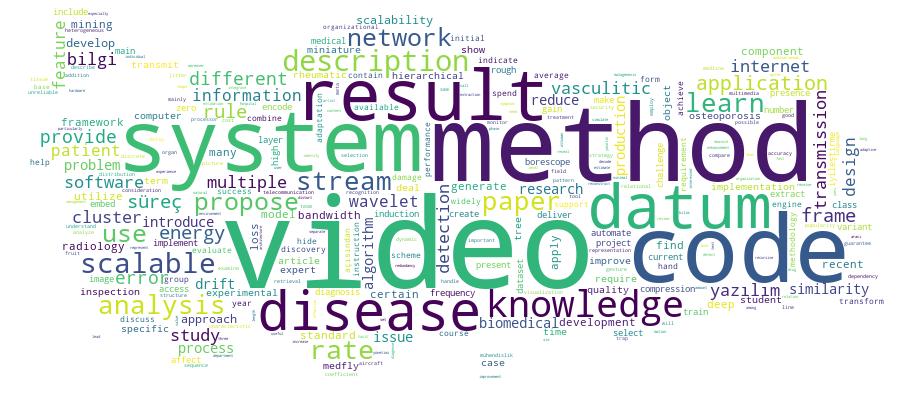
GCRIS Competency Cloud

Scholarly Output Search Results

Now showing 1 - 10 of 34
  • Publication
    Clustering Analysis for Vasculitic Diseases
    (Springer-Verlag Berlin, 2010) Yıldırım, Pınar; Çeken, Çınar; Çeken, Kağan; Tolun, Mehmet R.; 1863
    We introduce knowledge discovery for vasculitic diseases in this paper. Vasculitic diseases affect some organs and tissues and diagnosing can be quite difficult. Biomedical literature can contain hidden and useful knowledge for biomedical research and we develop a study based on co-occurrence analysis by using the articles in MEDLINE which is a widely used database. The mostly seen vasculitic diseases are selected to explore hidden patterns. We select PolySearch system as a web based biomedical text mining tool to find organs and tissues in the articles and create two separate datasets with their frequencies for each disease. After forming these datasets, we apply hierarchical clustering analysis to find similarities between the diseases. Clustering analysis reveals some similarities between diseases. We think that the results of clustered diseases positively affect on the medical research of vasculitic diseases especially during the diagnosis and certain similarities can provide different views to medical specialists.
  • Article
    Citation - WoS: 2
    Citation - Scopus: 4
    An Intelligent System for Detecting Mediterranean Fruit Fly [Medfly; Ceratitis Capitata (Wiedemann)]
    (Pagepress Publ, 2022) Eyyuboglu, Halil Tanyer; Sari, Filiz; Uzun, Yusuf; Tolun, Mehmet Resit
    Nowadays, the most critical agriculture-related problem is the harm caused to fruit, vegetable, nut, and flower crops by harmful pests, particularly the Mediterranean fruit fly, Ceratitis capitata, named Medfly. Medfly's existence in agricultural fields must be monitored systematically for effective combat against it. Special traps are utilised in the field to catch Medflies which will reveal their presence and applying pesticides at the right time will help reduce their population. A technologically supported automated remote monitoring system should eliminate frequent site visits as a more economical solution. This paper develops a deep learning system that can detect Medfly images on a picture and count their numbers. A particular trap equipped with an integrated camera that can take photos of the sticky band where Medflies are caught daily is utilised. Obtained pictures are then transmitted by an electronic circuit containing a SIM card to the central server where the object detection algorithm runs. This study employs a faster region-based convolutional neural network (Faster R-CNN) model in identifying trapped Medflies. When Medflies or other insects stick on the trap's sticky band, they spend extraordinary effort trying to release themselves in a panic until they die. Therefore, their shape is badly distorted as their bodies, wings, and legs are buckled. The challenge is that the deep learning system should detect these Medflies of distorted shape with high accuracy. Therefore, it is crucial to utilise pictures containing trapped Medfly images with distorted shapes for training and validation. In this paper, the success rate in identifying Medflies when other insects are also present is approximately 94%, achieved by the deep learning system training process, owing to the considerable amount of purpose-specific photographic data. This rate may be seen as quite favourable when compared to the success rates provided in the literature.
  • Article
    Damage Detection in Aircraft Engine Borescope Inspection Using Deep Learning
    (Springer Science and Business Media Deutschland GmbH, 2025) Uzun, I.; Tolun, M.R.; Sari, F.; Alpaslan, F.N.
    Aircraft engine inspection is a key pillar of aviation safety as it helps to maintain adequate performance standards to ensure engine airworthiness. In addition, it is also vital for asset value retention. Borescope inspection is currently the most widely used visual inspection method for aircraft engines. However, borescope inspection is a time-consuming, subjective, and complex process that heavily depends on the experience and attention level of the inspector. Moreover, the cost savings of airlines and the maintenance, repair, and overhaul (MRO) centers expose pressure and workload on inspectors. These factors make an automated system to support damage detection during borescope inspection necessary in order to mitigate potential risks. In this paper, we propose a deep learning-based automated damage detection framework that employs aircraft engine borescope inspection images. Faster R-CNN-based deep learning model with Inception v2 feature extractor is utilized for the present architecture. Due to the limited number of images, data augmentation and other overfitting methods are also employed. The framework supports crack, burn, nick, and dent damage types across all modules of turbofan engines. It is trained and validated with moderate to complex borescope images obtained from the field. The framework achieves 92.64% accuracy for crack, 92.05% for nick or dent, and 81.14% for burn damage classes, with an overall 88.61% average accuracy. © The Author(s) 2025.
  • Conference Object
    Yeşil BHT Bilgi ve Haberleşme Teknolojileri Akademisyen ve Uygulayıcılar Açısından Bir İnceleme
    (2011) Akba, Fırat; Medeni, İhsan Tolga; Medeni, Tunç Durmuş; Tolun, Mehmet Reşit; Öztürk, Mehmet; 181215
  • Conference Object
    Production and Retrieval of Rough Classes in Multi Relations
    (Ieee Computer Soc, 2007) Tolun, M.R.; Sever, H.; Gorur, A.K.
    Organizational memory in today's business world forms basis for organizational learning, which is the ability of an organization to gain insight and understanding from experience through experimentation, observation, analysis, and a willingness to examine both successes and failures. This basically requires consideration of different aspects of knowledge that may reside on top of a conventional information management system. Of them, representation, retrieval and production issues of meta patterns constitute to the main theme of this article. Particularly we are interested in a formal approach to handle rough concepts. We utilize rough classifiers to propose a preliminary framework based on minimal term sets with p-norms to extract meta patterns. We describe a relational rule induction approach, which is called rila. Experimental results are provided on the mutagenesis, and the KDD Cup 2001 genes data sets. © 2007 IEEE.
  • Conference Object
    Citation - Scopus: 1
    Induction for Radiology Patients
    (Springer, 2009) Yildirim, Pinar; Tolun, Mehmet R.
    This paper represents the implementation of an inductive learning algorithm for patients of Radiology Department in Hacettepe University hospitals to discover the relationship between patient demo-graphics information and time that patients spend during a specific radiology exam. ILA has been used for the implementation which generates rules and the results are evaluated by evaluation metrics. According to generated rules, some patients in different age groups or birthplaces may spend more time for the same radiology exam than the others.
  • Conference Object
    Citation - WoS: 1
    Citation - Scopus: 2
    Clustering Analysis for Vasculitic Diseases
    (Springer-verlag Berlin, 2010) Yildirim, Pinar; Ceken, Cinar; Ceken, Kagan; Tolun, Mehmet R.
    We introduce knowledge discovery for vasculitic diseases in this paper. Vasculitic diseases affect some organs and tissues and diagnosing can be quite difficult. Biomedical literature can contain hidden and useful knowledge for biomedical research and we develop a study based on co-occurrence analysis by using the articles in MEDLINE which is a widely used database. The mostly seen vasculitic diseases are selected to explore hidden patterns. We select PolySearch system as a web based biomedical text mining tool to find organs and tissues in the articles and create two separate datasets with their frequencies for each disease. After forming these datasets, we apply hierarchical clustering analysis to find similarities between the diseases. Clustering analysis reveals some similarities between diseases. We think that the results of clustered diseases positively affect on the medical research of vasculitic diseases especially during the diagnosis and certain similarities can provide different views to medical specialists.
  • Article
    Citation - WoS: 4
    Citation - Scopus: 6
    Multiple Description Coding for Snr Scalable Video Transmission Over Unreliable Networks
    (Springer, 2014) Choupani, Roya; Wong, Stephan; Tolun, Mehmet
    Streaming multimedia data on best-effort networks such as the Internet requires measures against bandwidth fluctuations and frame loss. Multiple Description Coding (MDC) methods are used to overcome the jitter and delay problems arising from frame losses by making the transmitted data more error resilient. Meanwhile, varying characteristics of receiving devices require adaptation of video data. Data transmission in multiple descriptions provides the feasibility of receiving it partially and hence having a scalable and adaptive video. In this paper, a new method based on integrating MDC and signal-to-noise ratio (SNR) scalable video coding algorithms is proposed. Our method introduces a transform on data to permit transmitting them using independent descriptions. Our results indicate that on average 1.71dB reduction in terms of Y-PSNR occurs if only one description is received.
  • Article
    OSMANLI MİNYATÜRLERİNİN UZMAN SİSTEMLE ÇÖZÜMLENMESİ
    (2021) Tolun, Elif Fatma; Tolun, Mehmet Reşit; 21168
    Bu çalışmada, Osmanlı İmparatorluğu döneminde bazı minyatürleri sınıflandırmakta kullanılan ve "Minyatür" olarak adlandırılan bilgi tabanlı bir uzman sistem geliştirilmiştir. Geliştirilen prototip uzman sistemin bir amacı da sanat tarihi ile ilgilenenlerin minyatürler hakkında bilgi edinmesine yardımcı olmaktır. Uzman sistem, Osmanlı minyatür sanatının en güzel örneklerinin yer aldığı 16-18 yüzyıl minyatürleriyle ilgili bilgiler üzerine kurgulanmıştır. İrdelenen minyatürler genelde Levni, Nakkaş Osman ve Seyyid Lokman gibi en ünlü minyatür sanatçılarının yaşadığı dönemlere denk gelmektedir. Uzman sistem kullanıcı ile gerçekleştirdiği soru-cevap diyaloğu sonunda minyatürün hangi minyatür sanatçısına ait olduğuna karar verir ve sanatçı ile minyatürlerinin önemli özelliklerini listeler. Bu kapsamda sistemin kullanıcı ile yapmış olduğu diyologlara ilişkin çeşitli örnekler makalede yer almaktadır.
  • Conference Object
    Bilgi Biliminin Mühendislik Gereksinimi ve Bilgi Mühendisliği
    (2009) Medeni, İhsan Tolga; Aktaş, A. Ziya; Tolun, Mehmet R.; 1863
    Yirminci yüzyılın ikinci yarısında bilgisayar, bilgi ve iletişim teknolojilerindeki gelişmeler bilgiye dayalı yeni bilim ve mühendislik disiplinleri oluşturma ihtiyacını doğurmuştur. Bu ihtiyaç nedeniyle doğan yeni bilim ve mühendislik disiplinlerinin gelişiminin aslında (veri, enformasyon ve bilgi ) üçlüsüne yönelik oluşumlar olduğu gözlemlenmektedir.Bu makalede bilgi sözcüğü bu üçlü için genel bir ad olarak kullanılacaktır. Bilgi disiplini bir taraftan, bu üçlü arasındaki bağların örgütler ve bireyler açısından ortaya koyulmasını amaçlar; açık ve örtük bilginin birbirine dönüşümünü sağlamaya çalışırken, diğer taraftan da ortaya çıkan yeni dallar ve var olan dalların bilgi temelli ilişkisini kurmaya yönelik çalışmalar yapmaktadır. Bu üçlünün ve bilgi disiplininin bilim / mühendislik, işletme / yönetim disiplinleriyle olan ilişkisi ve oluşturulacak bir bilgi mühendisliği lisans programının bu kavramlarla olabilecek ilgisi bu bildirinin konusudur.